Should You Pay Off Your Mortgage Faster or Invest More?
Extra cash each month raises an old question: do you put it on the mortgage and become debt-free sooner, or invest it and aim to build more wealth?
Both are reasonable, and neither is automatically better. Paying down debt gives you a certain saving and peace of mind. Investing offers the chance of a larger return, with more risk and more moving parts. Keep reading to understand what each path earns, where investing starts to beat paying down the loan, and the options in between.
Every dollar you put on your home loan saves you interest at your loan rate. At 6.5%, $100,000 on the mortgage saves about $6,500 a year. That saving is not taxed, and you do not need a tenant, a good market, or a good year to get it. It holds as long as your rate does, and variable rates can change.
That sets the bar for anything else you do with the money. To be worth the extra risk, an investment has to beat that saving after tax and costs.
Here is what paying down can do at scale. Take an $800,000 loan over 30 years at 6.5%. Repayments are about $5,057 a month. Adding $55,000 a year in extra repayments, about $4,583 a month, clears the loan in around 9.2 years and saves roughly $755,000 in interest. That result is why many households find debt reduction so appealing.
What Investing Instead Needs to Beat
The alternative is to use the same cash, and often equity in your home, to buy an investment property. The loan on that property is larger than the cash you put in, which is leverage. It lifts your gains when prices rise and your losses when they fall.
To compare the two fairly, put $100,000 to work each way for ten years.
Investing: $100,000 covers a 20% deposit and purchasing costs on a $370,000 property, with a $296,000 interest-only loan at 6.5%.
Holding costs: the property earns net rent of 3% a year after other costs, so it runs at a shortfall of about $8,140 a year (interest of $19,240 less net rent of $11,100).
Paying down: the $100,000, plus the same $8,140 a year, goes onto the mortgage at 6.5%. That keeps the cash put in equal on both sides, at $181,400.
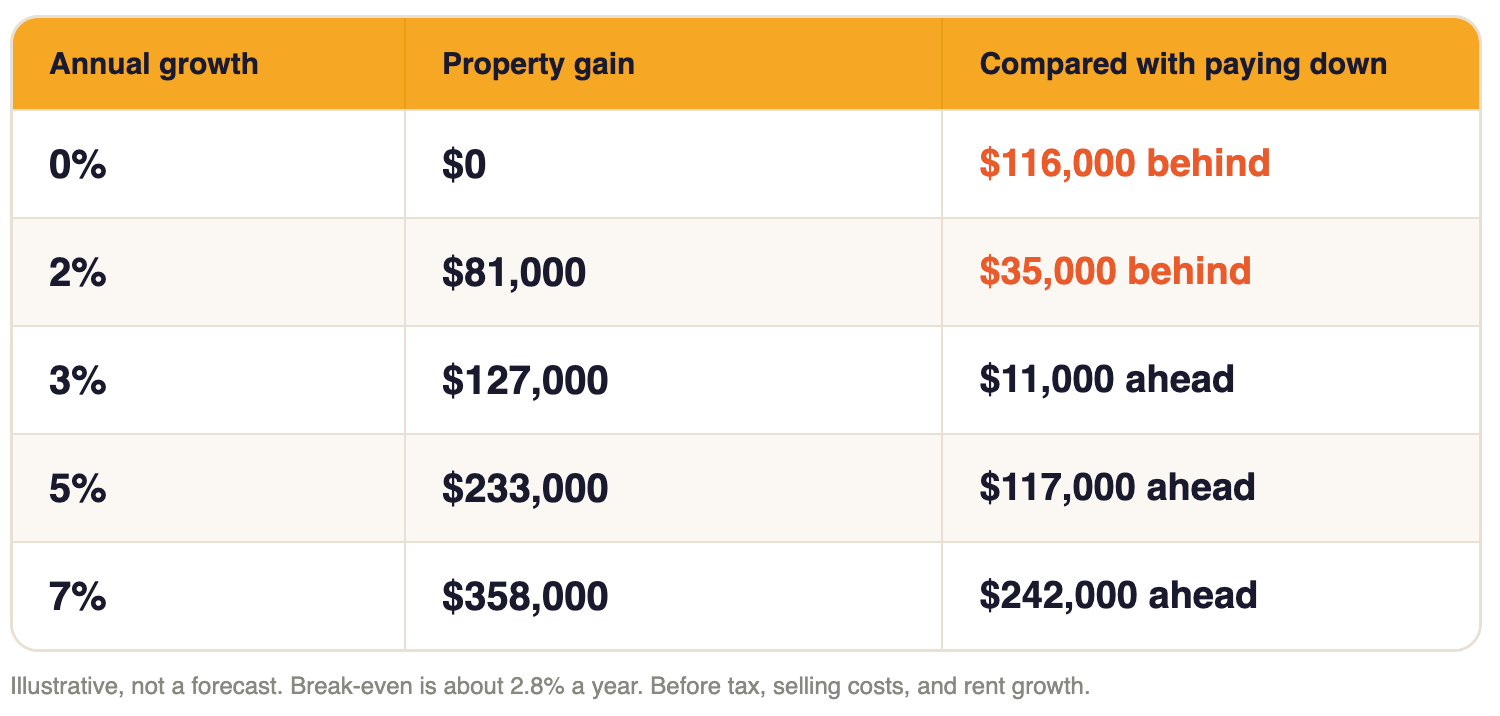
Over ten years, paying down earns about $116,000. Here is how the property compares at different growth rates.
In this example, investing only came out ahead if the property grew by more than about 2.8% a year. At 2% it fell $35,000 behind, and at 0% it lost out by the full $116,000. These are illustrations, not forecasts. Selling costs and capital gains tax would raise the break-even, while rent growth would lower it.
What the Comparison Leaves Out
Tax. Interest on your home loan is not deductible. Interest on an investment loan generally is. For established residential properties bought after 12 May 2026, losses carry forward against future property income instead of offsetting your wages, while new builds keep full negative gearing. From 1 July 2027, the CGT discount is replaced with indexation and a 30% minimum tax on real gains.
The downside. A property bought with a small deposit leaves little cushion if prices fall, and you carry the holding costs through vacancies and rate rises.
Peace of mind. Being debt-free sooner has a value the table does not show. For some households that matters more than the extra return.
The Options in Between
Offset account. A 100% offset account reduces the interest charged by the balance you hold in it, at your loan rate. You get the same savings as paying down the loan, and the cash stays available. That makes it a way to build a buffer and keep your options open while you decide.
Redraw. Many loans let you redraw extra repayments, though terms vary by lender, so check yours.
Splitting. Put part toward the mortgage and part toward your next investment, for example while you build a deposit.
Debt recycling. This gradually shifts debt from your non-deductible home loan to deductible investment debt.
*Speak to your broker and accountant before changing your loan structure.
Five Questions That Help You Decide
Do you hold a buffer? Six months of repayments across all your properties is a common starting point. If you do not have one, build it before choosing either path.
How does your mortgage rate compare with the after-tax return you realistically expect elsewhere? The higher your rate, the harder it is for an investment to beat paying down the loan.
How long could you hold an investment through a bad stretch? Property tends to reward holding for many years.
Can you service a new loan at the assessment rate and cover the shortfall? Test it against a rate rise and a vacancy period.
How would you feel if values fell 10%? If the answer is stress, a more cautious path may suit you better.
Life stage matters too. Someone approaching retirement may reasonably put more weight on reducing debt, while someone with a long horizon has more room for growth assets.
If You Are Approaching Retirement
The same question can have a different answer when retirement is five or ten years away.
You have less time to recover. A fall in prices close to retirement is harder to wait out, particularly if you carry a large loan.
Debt is paid from retirement income. Repayments continue after your salary stops, so paying the loan down first lowers the income you need each year.
The Age Pension has means tests. Your assets and income affect how much you may receive, and generally your home is not counted while an investment property is. The rules change, so check the current settings.
None of this means someone near retirement should never hold an investment property. It means the balance usually shifts toward lower debt and a clear plan for the income.
Want to see where you stand? Our free Retirement Guide for Australians shows the cost of a comfortable retirement, how your super compares, and three ways to close the gap.
Ready to Work Out the Right Path for You?
At Search Property, we help Australians cut through the noise and build data-driven investment strategies aligned with long-term wealth goals. Our buyers agents have helped thousands of clients build wealth through property because we focus on fundamentals, not headlines.
It depends on your mortgage rate, your risk tolerance, your time horizon, and your cash buffer. Paying down the loan gives a certain saving at your loan rate. Investing can return more if growth is strong enough, with more risk. In the example above, property needed to grow more than about 2.8% a year to come out ahead.
Is paying off my mortgage a guaranteed return?
The interest you save is equal to your loan rate, and it does not depend on markets. It is only as steady as your rate, because variable rates can rise or fall.
What does an offset account do?
A 100% offset account reduces the interest charged on your loan by the amount you hold in it, while the cash stays available to you. It gives you the same savings as paying down the loan with more flexibility.
Can I do both?
Yes. Many people split extra cash between the mortgage and investing, or hold it in an offset account while they decide. The right split depends on your buffer, your income, and your goals.
Does paying down my home loan help me borrow for an investment later?
It can, because lower debt means lower repayments in a lender’s assessment. Lender policies differ, including how they treat offset and redraw balances, so check with a broker.
Disclaimer: Important Notice for Readers
By reading the content provided on this blog, you acknowledge and agree to the terms outlined in this disclaimer, binding yourself to its provisions unconditionally.
This blog presents information for informational, educational, and general non-advisory purposes only. It's important for you, the reader, to understand that the information provided does not take into account your specific personal, financial, or other circumstances. Consequently, we do not offer legal, financial, investment, or taxation advice, recommendations, or guidance. Before acting upon any information from this blog, you are strongly advised to consult with an independent professional, including legal, financial, taxation, accounting, or other relevant advisors, to verify the information’s relevance to your particular situation.
The information is provided in good faith, derived from sources believed to be reliable. However, we do not guarantee the accuracy, completeness, or applicability of the information to your individual circumstances, needs, objectives, or financial situation. The information may be selective and has not been independently verified. Therefore, it should not be the sole basis for any decision-making.
We expressly disclaim any liability for errors, omissions, or inaccuracies in the information, as well as any direct or indirect losses, damages, or expenses that arise from relying on our content, regardless of the cause, including negligence or other factors. Your engagement with this blog is entirely at your own risk.
Please be aware, we do not hold an Australian Financial Services Licence as defined by section 9 of the Corporations Act 2001 (Cth), nor are we authorised to provide financial services, and we have not provided financial services to you.
Disclaimer: Search Property Pty Ltd (SP) does not provide financial or investment advice and does not hold a financial services license as defined in the Corporations Act 2001 (Cth). Any advice given by SP is general in nature and does not take into account your personal circumstances or objectives, financial situation or needs.