Should I Buy an Investment Property First, Upgrade My Home, or Rentvest?
You’ve built up some equity, or your deposit is finally getting somewhere, and now there are three ways to go. Buy an investment property, upgrade the home you live in, or rent where you want to live and invest somewhere else.
It comes down to what you’re trying to do. Upgrading is mostly about lifestyle. Investing first and rentvesting are about building wealth. This guide covers what each path costs you, where the risk sits, and the questions that usually settle it.
The three options sound like a choice between properties. They are a choice between goals.
Upgrading your home is mainly a lifestyle decision that also holds some wealth.
Buying an investment property first is a wealth-building decision that keeps your current lifestyle.
Rentvesting is a way to separate where you live from where you invest.
Getting clear on which goal comes first makes the choice much easier.
Option 1: Upgrade Your Home
Upgrading means selling your current home, or keeping it, and buying a bigger or better one to live in.
What it offers
Better space, schools, or location for your family now
A home that is generally exempt from capital gains tax under the main residence exemption, which the 2026 budget did not change
One property to manage, one loan, and a stable place to live
What to weigh
Interest on the loan for your own home is not tax deductible, while interest on an investment loan generally is
Selling and buying brings transaction costs, including stamp duty, that you do not get back
A larger home usually means a larger non-deductible debt, which can reduce the borrowing capacity you would need for an investment later
Your wealth stays concentrated in one asset in one location
Option 2: Buy an Investment Property First
This means keeping your current home, or your current rental, and buying an investment property before upgrading.
What it offers
You start building a second asset while keeping your lifestyle the same
If you own a home, the equity in it can fund the deposit. As an example from our equity guide, a $900,000 home with $500,000 owing leaves around $220,000 in usable equity at an 80% limit
Investment loan interest and other holding costs are generally deductible
You can choose a market on its fundamentals rather than where you want to live
What to weigh
The 2026 rules changed. For established residential properties bought after 12 May 2026, negative gearing losses carry forward against future property income instead of offsetting your wages. New builds keep full negative gearing
From 1 July 2027, the 50% CGT discount is replaced with indexation and a 30% minimum tax on real gains. Gains that built up before that date are still taxed under the existing discount.
You need cash flow to hold it. Our cash flow blog shows how to test it
Your home does not improve, so you may be waiting for the upgrade
Option 3: Rentvest
Rentvesting means renting where you want to live and buying an investment property in a market where the numbers work. Our latest rentvesting blog covers the strategy in detail.
What it offers
Entry into the market sooner, because a deposit goes further in a more affordable market
Freedom to live in a suburb you could not afford to buy in
You do not get the main residence exemption on the property you rent out, because you do not live in it
The 5% Deposit Scheme, which lets eligible first home buyers purchase with as little as 5% and without lenders mortgage insurance, is designed for homes you will live in. Eligibility rules generally require that you have not previously owned property, which can include an investment property, so check the current rules before you buy
You carry two sets of costs, rent and an investment loan
How much sense rentvesting makes depends on the city. According to Compare the Market, mortgage repayments on a median house are 106% higher than rent in Sydney, 75% higher in Brisbane, and 66% higher in Melbourne, assuming a 20% deposit and a 6% interest rate. Our rent vs buy breakdown by city blog has the full numbers.
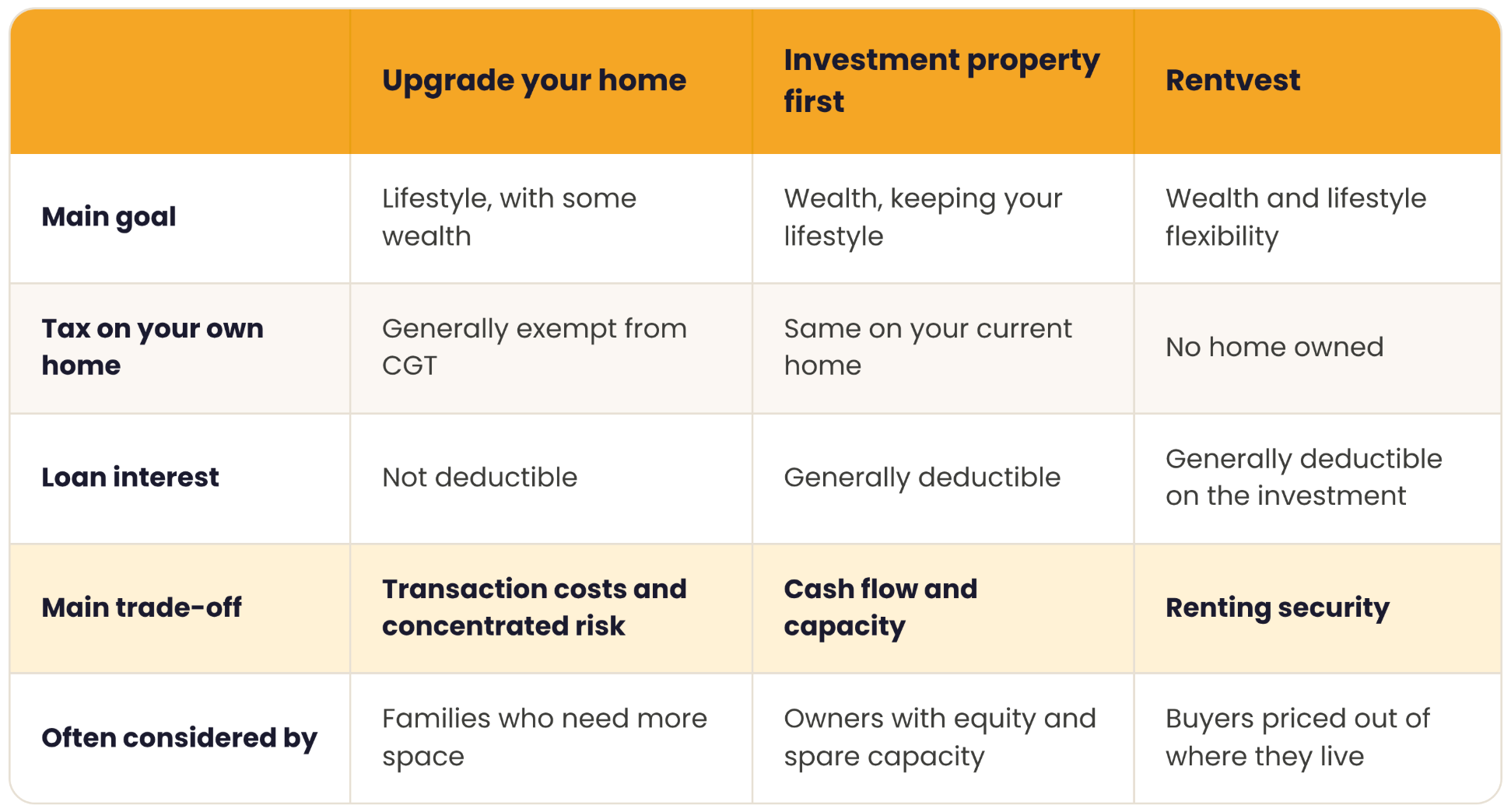
The Three Paths at a Glance
Five Questions Can Help You Decide
What problem are you solving? If your home no longer fits your family, upgrading may be a need rather than a choice. If your home works, an investment may be the better use of your next dollar.
What can you realistically borrow? Every loan reduces capacity for the next one. Our guide to what you can realistically borrow explains how lenders assess you.
Can you carry the cost? Test the numbers with a rate rise of 1% to 2% and a vacancy of several weeks, and hold a cash buffer.
How long can you hold? Property rewards holding over years, and a sale in a soft period can lock in a loss.
How much does security matter to you? If renting would cause real stress, rentvesting may cost more than the numbers show.
You Do Not Always Have to Choose
Many households sequence the paths rather than choosing one. A common pattern is buying an investment property using equity from a current home, then upgrading later as the portfolio grows. Another is rentvesting for several years, then using the equity to buy a home on your own terms.
Sequencing depends on your capacity, and the order matters. Whatever path you choose, the same foundations apply. Choose assets with solid rental demand and constrained supply, and avoid buying because of a tax deduction alone.
What the Current Market Means for This Decision
A few conditions shape the choice right now.
National prices are down 2.7% from their March 2026 peak according to the realestate.com.au Home Price Index, so buying into a softer market may mean more room to negotiate
Vacancy is below 2.0% in every capital city, which supports rental demand
Rates are higher than a year ago, which increases holding costs and reduces capacity
Tax rules for new investment purchases have changed
None of these decides the question for you. They change the numbers, which is why it is worth testing each path against your own position rather than relying on a rule of thumb.
Ready to Find Out Which Path Fits Your Situation?
At Search Property, we help Australians cut through the noise and build data-driven investment strategies aligned with long-term wealth goals. Our buyers agents have helped thousands of clients build wealth through property because we focus on fundamentals, not headlines.
Is it better to buy an investment property before upgrading my home?
It depends on your goals and finances. Buying an investment first lets you build a second asset while keeping your lifestyle the same, and equity in your current home can fund it. Upgrading first improves your living situation but can reduce the capacity you would need later. A broker and accountant can model both for your situation.
Do I pay capital gains tax when I sell my home?
The main residence exemption generally means no capital gains tax on a home you live in, and the 2026 budget did not change that. Rules can differ if you rent the property out or move out, so speak to an accountant
Can I use equity in my home to buy an investment property?
Yes, if you have usable equity and can service the extra debt. Lenders usually allow borrowing up to around 80% of a property’s value without lenders mortgage insurance.
Can I still get first home buyer support if I rentvest?
Support such as the 5% Deposit Scheme is designed for homes you will live in. Eligibility generally requires that you have not owned property before, which can include an investment property. Check the current rules before you buy.
Is rentvesting only for people priced out of the market?
No. Some households could buy where they live and choose to invest elsewhere for yield, growth, or flexibility. It tends to appeal most where buying costs far more than renting.
Disclaimer: Important Notice for Readers
By reading the content provided on this blog, you acknowledge and agree to the terms outlined in this disclaimer, binding yourself to its provisions unconditionally.
This blog presents information for informational, educational, and general non-advisory purposes only. It's important for you, the reader, to understand that the information provided does not take into account your specific personal, financial, or other circumstances. Consequently, we do not offer legal, financial, investment, or taxation advice, recommendations, or guidance. Before acting upon any information from this blog, you are strongly advised to consult with an independent professional, including legal, financial, taxation, accounting, or other relevant advisors, to verify the information’s relevance to your particular situation.
The information is provided in good faith, derived from sources believed to be reliable. However, we do not guarantee the accuracy, completeness, or applicability of the information to your individual circumstances, needs, objectives, or financial situation. The information may be selective and has not been independently verified. Therefore, it should not be the sole basis for any decision-making.
We expressly disclaim any liability for errors, omissions, or inaccuracies in the information, as well as any direct or indirect losses, damages, or expenses that arise from relying on our content, regardless of the cause, including negligence or other factors. Your engagement with this blog is entirely at your own risk.
Please be aware, we do not hold an Australian Financial Services Licence as defined by section 9 of the Corporations Act 2001 (Cth), nor are we authorised to provide financial services, and we have not provided financial services to you.
Disclaimer: Search Property Pty Ltd (SP) does not provide financial or investment advice and does not hold a financial services license as defined in the Corporations Act 2001 (Cth). Any advice given by SP is general in nature and does not take into account your personal circumstances or objectives, financial situation or needs.

.png)

.png)
.png)

.png)
.png)
.png)
.png)