Is It Cheaper to Rent or Buy in Australia? The 2026 Numbers by City
The monthly cost of owning a home in Australia has diverged so sharply from the cost of renting the same property that for a growing share of the population, buying has stopped being a choice and started being an impossibility.
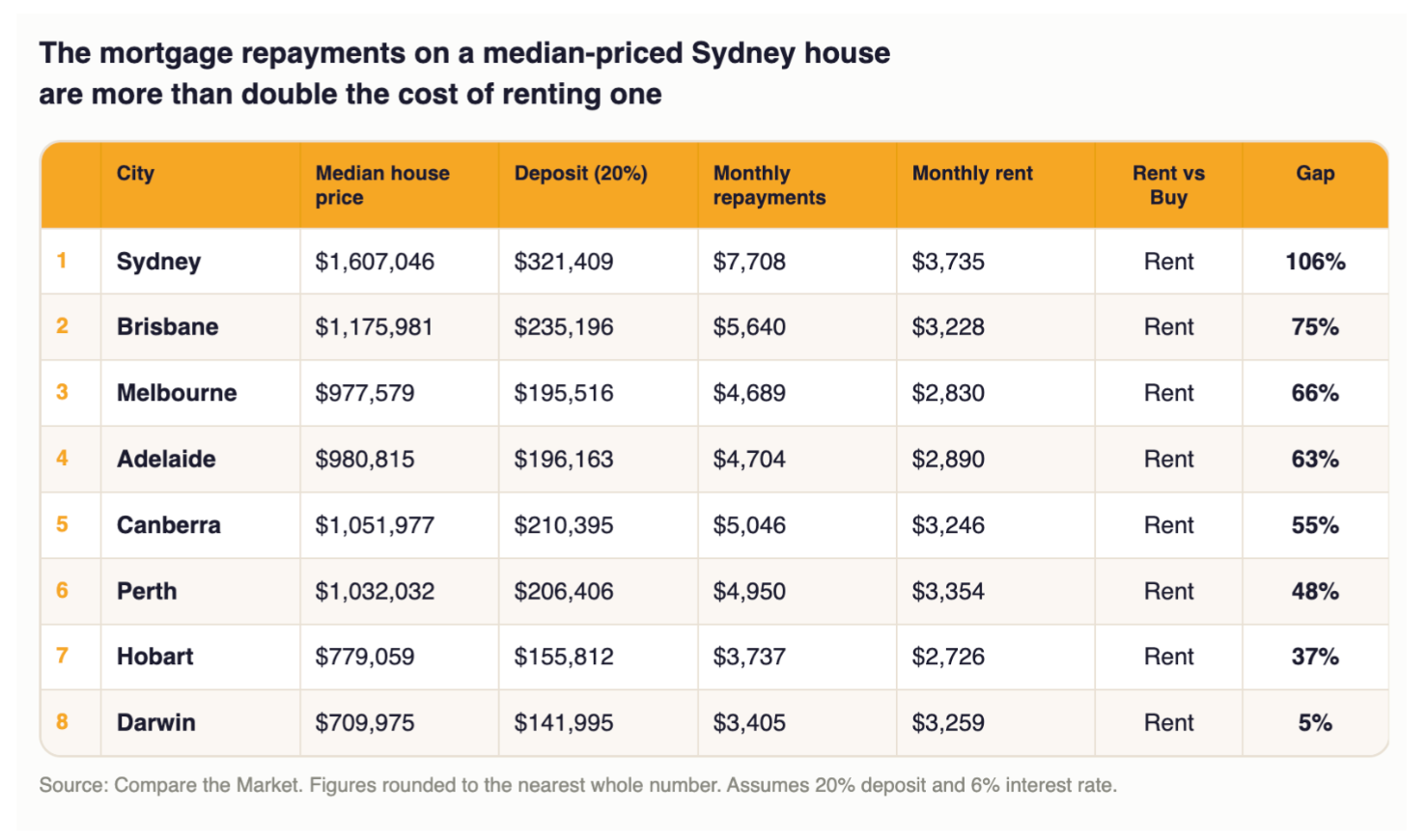
In Sydney, mortgage repayments on a median house are 106% higher than the rent on the same property. In Brisbane, 75% higher. Melbourne and Adelaide sit at 66% and 63%. This is not a media narrative about housing affordability. The numbers don’t lie and those numbers mean the old advice about buying where you live no longer holds for a growing share of Australians.
According to Compare the Market analysis, based on median house and unit values against median rents across every capital city, assuming a 20% deposit and a 6% interest rate, the gap between owning and renting has never been wider.
Importantly, this analysis excludes stamp duty, council rates, insurance, maintenance, and the opportunity cost of tying up a large deposit. The real gap between buying and renting is almost certainly wider than these figures suggest.
Sydney is the most extreme case in the country. Based on a median house price of just over $1.6 million, monthly mortgage repayments sit at approximately $7,708. Median monthly rent for the same property is approximately $3,735. That is a gap of almost $4,000 per month before a single additional ownership cost is added.
Brisbane has the second largest gap despite its long-standing reputation as Sydney's more affordable alternative. Rapid price growth has pushed Brisbane into one of Australia's most expensive housing markets. Monthly mortgage repayments on a median house sit at approximately $5,640 against median rent of $3,228, a gap of roughly $2,400 per month on a required deposit exceeding $235,000.
Melbourne and Adelaide recorded gaps of 66% and 63% respectively. Canberra came in at 55%. Perth at 48%. Hobart at 37%.
Darwin is the sole outlier. Mortgage repayments on a median-priced house are only approximately 5% higher than median rent, reflecting comparatively lower property prices against high rental costs.
Units Tell a Different Story
The comparison becomes significantly less extreme for units, which is one of the reasons apartments remain an important entry point into ownership for many Australians.
In Sydney, estimated repayments on a median-priced unit are approximately 30% higher than rent, compared to 106% for houses. Melbourne's unit gap sits at 17%. Perth at 15%. Canberra at 10%.
Darwin again stands apart. Compare the Market estimates monthly mortgage repayments on a median unit at approximately $2,125 against median rent of roughly $2,648, making buying a unit in Darwin genuinely cheaper on a monthly basis than renting one.
Brisbane remains the least affordable unit market for buyers relative to renters, with repayments approximately 43% higher than monthly rent despite strong population growth and tight vacancy rates.
What This Means
The monthly gap between renting and buying an owner-occupied home is real, and Australia's position globally confirms it is not just a perception problem. According to Demographia's International Housing Affordability report, Sydney ranks as the second least affordable city in the world behind only Hong Kong, with a typical home costing 13.8 to 14.0 times median household income. Australia is the only country in the world with four capital cities on the global list of least affordable major housing markets.
That does not mean property is out of reach. It means the traditional assumption, buy where you live, is not the only path worth considering.
The deposit required for a median house ranges from approximately $142,000 in Darwin to more than $321,000 in Sydney. Those are large numbers. They become significantly more accessible when directed toward an investment property in a market where entry points are lower, yields are stronger, and the long-term growth case is compelling.
The question for most Australians is not whether buying is better long-term. It almost certainly is. The question is which property to own first and where. For many households the answer is not the family home in an expensive capital city. It is an investment property in a market where the entry point is accessible, the yield supports the cash flow, and the growth fundamentals are in place.
Why This Data Matters Beyond the Headline
When the monthly cost of buying a median house in Sydney is 106% higher than renting one, a growing proportion of the population has no realistic path to ownership regardless of their financial discipline or ambition. Renting is not a preference for most of these households. It is the only outcome the numbers allow.
That structural dynamic is the foundation of Australia's rental demand story. It is not driven solely by migration or population growth. It is driven by the widening gap between what properties cost to buy and what households can realistically afford to service at current interest rates.
Add the 2026 budget changes reducing investor activity and therefore rental supply, the housing construction shortfall of 196,000 completions against demand for more than 250,000 according to the Housing Industry Association, and vacancy rates sitting at or near record lows in every capital city, and the demand side of the rental equation looks structurally stronger than at any point in recent history.
For investors with quality assets in well-located rental markets, the combination of rising rents and a permanently large pool of tenants who cannot afford to buy is not a short-term condition. It is a structural feature of the Australian housing market that is deepening rather than resolving.
The Belief Gap Making This Worse
The psychological toll of these numbers is arguably as damaging as the numbers themselves.
According to the same research, 68% of current renters believe they will be renting for the rest of their lives, and 63% believe rent money is "dead money." Gen Z shows the sharpest version of this contradiction. 78% are actively looking or hoping to buy a property, the highest ambition of any generation. Yet only 18% of Gen Z non-homeowners believe it is likely they will buy, and 46% say they have given up on the idea entirely.
This is the belief gap that costs people the most. Renters who assume ownership is permanently out of reach do not investigate the paths that remain available, including paths that do not require buying in the city they currently live in. The mismatch between ambition and belief is not a data point. It is the reason so many people who could realistically build property wealth never start.
The Rentvesting Alternative
Rentvesting is how a growing number of Australians are solving this problem.
Rentvesting means renting in the suburb or city where you choose to live while owning an investment property in a market where the numbers stack up. You capture the wealth-building benefit of property ownership, the equity growth and compounding returns, without being tied to a mortgage in a market where repayments are more than double the rent.
It is not giving up on home ownership. It is sequencing it more intelligently. Build the asset base first through investment property in accessible markets. Use the equity to eventually buy the home you want rather than the home the bank will let you have right now.
The data above reinforces exactly why this approach makes sense in 2026. In a city where buying costs 106% more than renting, the opportunity cost of directing every dollar toward an owner-occupied mortgage rather than an investment portfolio can be enormous.
Ready to Build Wealth Through Property Regardless of Where You Live?
At Search Property, we help Australians cut through the noise and build data-driven investment strategies aligned with long-term wealth goals. Our buyers agents have helped thousands of clients build wealth through property because we focus on fundamentals, not headlines.
Book a FREE investment assessment with Search Property. We'll discuss your goals and position, and help you build a clear plan to move forward with confidence.
Frequently Asked Questions
Is it better to rent or buy in Australia right now?
It depends entirely on your city, financial position, and goals. In Sydney, monthly mortgage repayments on a median house are 106% higher than rent according to Compare the Market analysis. In Darwin the gap is just 5%. Buying builds equity in an appreciating asset over time. Renting may be the only financially viable option for many households at current prices and interest rates. Rentvesting, where you rent where you live and invest where the numbers work, is increasingly how serious wealth builders are approaching this question.
Why are mortgage repayments so much higher than rent in Sydney and Brisbane?
Rapid price growth has pushed median house prices well above what rents have risen to. In Sydney, a median house price of just over $1.6 million produces monthly mortgage repayments of approximately $7,708 at a 6% interest rate. The median monthly rent for the same type of property is approximately $3,735. The gap reflects years of price growth outpacing both income growth and rental growth.
Does renting mean I am wasting money?
Not necessarily. Both rent and mortgage repayments pay for housing. The difference is that a mortgage builds equity in an asset that appreciates over time. Rent does not. The question worth asking is not whether renting wastes money but what you are doing with the difference. In Sydney, renting instead of buying saves approximately $4,000 per month. Directed into an investment property in a market with growth fundamentals, that capital gap becomes an accelerant rather than a loss.
What is rentvesting and does it make sense in 2026?
Rentvesting means renting where you want to live while owning an investment property in a more affordable market. It allows you to build wealth through property without being locked into a mortgage in an unaffordable city. With Sydney mortgage repayments running at more than double the rent, rentvesting allows households to capture the equity building benefits of property ownership without the extreme monthly cost of buying in the most expensive markets.
Which Australian city has the smallest gap between buying and renting?
Darwin has the smallest gap between mortgage repayments and rent for houses, at approximately 5% according to Compare the Market analysis. For units, Darwin is the only city where buying is actually cheaper on a monthly basis than renting, with estimated mortgage repayments of approximately $2,125 compared to median rent of roughly $2,648.
Disclaimer: Important Notice for Readers
By reading the content provided on this blog, you acknowledge and agree to the terms outlined in this disclaimer, binding yourself to its provisions unconditionally.
This blog presents information for informational, educational, and general non-advisory purposes only. It's important for you, the reader, to understand that the information provided does not take into account your specific personal, financial, or other circumstances. Consequently, we do not offer legal, financial, investment, or taxation advice, recommendations, or guidance. Before acting upon any information from this blog, you are strongly advised to consult with an independent professional, including legal, financial, taxation, accounting, or other relevant advisors, to verify the information’s relevance to your particular situation.
The information is provided in good faith, derived from sources believed to be reliable. However, we do not guarantee the accuracy, completeness, or applicability of the information to your individual circumstances, needs, objectives, or financial situation. The information may be selective and has not been independently verified. Therefore, it should not be the sole basis for any decision-making.
We expressly disclaim any liability for errors, omissions, or inaccuracies in the information, as well as any direct or indirect losses, damages, or expenses that arise from relying on our content, regardless of the cause, including negligence or other factors. Your engagement with this blog is entirely at your own risk.
Please be aware, we do not hold an Australian Financial Services Licence as defined by section 9 of the Corporations Act 2001 (Cth), nor are we authorised to provide financial services, and we have not provided financial services to you.
Disclaimer: Search Property Pty Ltd (SP) does not provide financial or investment advice and does not hold a financial services license as defined in the Corporations Act 2001 (Cth). Any advice given by SP is general in nature and does not take into account your personal circumstances or objectives, financial situation or needs.


.png)
.png)

.png)
.png)
.png)
.png)
.png)

