How Much Does a Buyers Agent Cost in Australia? (2026 Investor Fees Guide)
How much does a buyers agent cost in Australia? For an investment purchase, most full-service buyers agents charge a fixed fee. Some take an upfront engagement fee, with the balance paid at settlement. The figure depends on the property, the level of service, the market, and the agent's experience. Buyers agent fees are not regulated in Australia, so they vary, and the lowest number is rarely the best value.
Working out what a buyers agent costs is one of the first questions property investors ask, and the answer is less simple than a single number. Fees vary by structure, service level, and the value of the property, and the cheapest option is rarely the one that returns the most. This guide breaks down buyers agent fees in Australia in 2026 from an investor's point of view: the fee models, the typical ranges, what is included, whether the fees are tax deductible, and how to judge whether the cost is worth it.
Buyers agents in Australia charge in one of two main ways.
A fixed fee is a set dollar amount agreed before the search begins, regardless of what you end up paying for the property. It gives you certainty on cost from the outset.
A percentage fee is calculated as a share of the property's final purchase price, usually settled once the purchase is agreed. It scales with the value of what you buy.
Some agents also offer tiered or hybrid pricing, and some charge a smaller upfront amount to begin work, covered below. Whichever model applies, the fee is normally quoted plus GST.
How Much Does a Buyers Agent Cost?
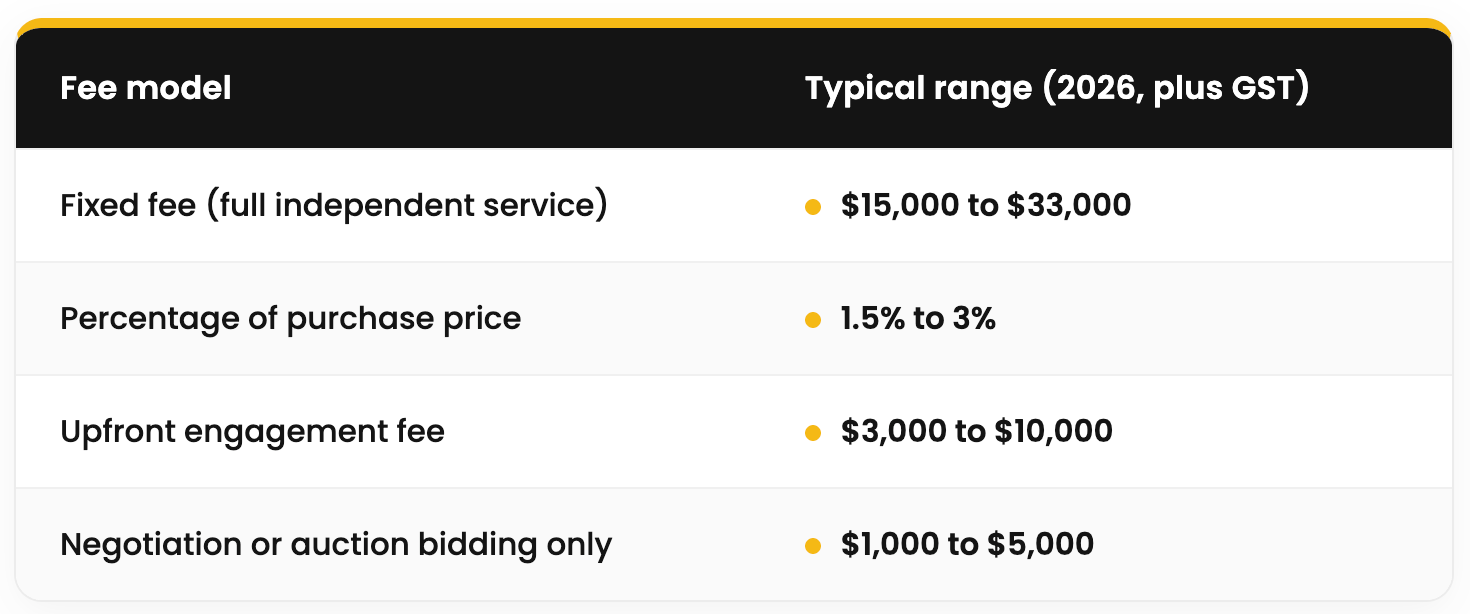
The table below sets out the typical ranges across the market in 2026. Treat them as a guide, since fees are unregulated and vary by agent and market.
A full-service, independent buyers agent who manages the whole purchase from strategy to settlement generally sits in the high-teens to low-thirties thousands. Fees advertised well below that usually reflect a limited scope, a single-market focus, or a model where the agent is paid a commission by a developer or seller rather than by you. For a national search that can go wherever the numbers work, judge the fee against the quality of the asset it secures, not against the cheapest quote.
Fixed Fee vs Percentage Fee: Which Is Better?
A fixed fee is the more transparent model for an investor. You know the exact figure before the search begins, and the fee does not rise just because you buy a more expensive property, so the agent has no incentive to push the price up. Their only job is to secure the best asset at the lowest price.
A percentage fee scales with the purchase, which can look cheaper on a lower-priced property. The trade-off is a built-in tension: the agent's fee grows as the price they negotiate grows, the opposite of what you want. That is why many investors prefer a flat, fixed fee, where the cost is agreed upfront and the incentives are fully aligned with getting you the best result.
Engagement Fee and Success Fee: How You Pay
Some buyers agents split the payment. You pay an engagement fee upfront, to commission the search and cover the research phase. The balance of the fee is then paid at settlement, once you have secured a property. This structure ties the bulk of the fee to a completed purchase. Others charge a single flat fee for the full engagement. Always confirm how and when the fee is paid, and what any upfront amount covers.
Buyers Agent Cost by Service Level
What you pay reflects how much of the process the agent runs.
Full search and acquisition is the most complete service and the reason for the higher fees. The agent handles strategy, suburb and property research, shortlisting, inspections, due diligence, negotiation, and settlement. This is where investors get the value, and it maps to a rigorous, data-led method like the one in our guide on how buyers agents assess investment potential.
Negotiation only covers just the negotiation on a property you have already found, at a lower fee.
What Is Included in a Buyers Agent's Fee
For a full-service engagement, the fee typically covers a strategy session to define your investment goals and budget, market and suburb research, sourcing properties including off-market listings, inspections and shortlisting, due diligence, price negotiation or auction bidding, and management of the purchase through to settlement. Ask any agent for a written scope, so you know exactly what the fee buys and what sits outside it.
Are Buyers Agent Fees Tax Deductible on an Investment Property?
For an investment property, buyers agent fees are not immediately deductible against your income in the year you buy. They are treated as a capital cost and added to the property's cost base, alongside items such as stamp duty and legal fees on purchase. That reduces your capital gains tax when you eventually sell, according to the Australian Taxation Office. In effect, the fee lowers your future CGT rather than your current tax bill.
The fee sits in the cost base, the 2026 capital gains tax changes affect how much that deduction is ultimately worth. It is worth reviewing our guide to the CGT changes and what they mean for investors, and confirming your position with a property-specialist accountant before you rely on it.
Is a Buyers Agent Worth the Cost?
The fee is only expensive if it does not pay for itself. A good buyers agent aims to return more than they cost in three ways: negotiating a lower purchase price than you would achieve alone, selecting a better-performing asset in a stronger market, and steering you away from a poor purchase. On an investment held for years, a better property and a better entry price usually outweigh the fee many times over. The question is not whether a buyers agent is cheap, it is whether the outcome is better net of the fee. We cover that trade-off in full in our guide to whether a buyers agent is worth it.
Watch for Fees That Look Free
Some operators advertise a low fee or no fee to the buyer, because they are paid a commission by the developer or seller instead. The service can look cheap or free, but the advice is not impartial, and the incentive is to place you into their stock rather than find you the best investment property. A transparent fee paid only by you is a feature, not a downside. Before you compare prices, read our guide on how to choose a buyers agent, because independence matters more than the headline number.
How Search Property Charges
Search Property is a dedicated investment property buyers agency operating Australia-wide. We charge a transparent, flat fee, agreed in writing before we begin, and we are paid only by our clients. We accept no commissions from developers or sellers, so our recommendation is based on the numbers, not on who is paying us. Our buyers agents run the full process, from strategy and national market research through to negotiation and settlement, on established, investment-grade property wherever the fundamentals are strongest.
Book an investment assessment call with Search Property. We will walk you through our fee, our process, and how we work, so you can decide whether we are the right fit.
Frequently Asked Questions
How much does a buyers agent cost in Australia?
For an investment purchase, most full-service buyers agents charge a fixed fee of around $15,000 to $33,000, or a percentage of the purchase price of roughly 1.5% to 3%, plus GST. Some also take an upfront engagement fee with the balance paid at settlement. The figure depends on the property, the service level, the market, and the agent, and fees are not regulated in Australia.
Do buyers agents charge a percentage or a fixed fee?
Both models are common. A fixed fee is a set amount agreed upfront and gives cost certainty, with no incentive for the agent to push the price up. A percentage fee, usually 1.5% to 3% of the purchase price, scales with the property value, which creates a tension because the agent's fee rises with the price. Many investors prefer a flat, fixed fee for that reason
What is a buyers agent engagement fee?
An engagement fee is an upfront payment, commonly $3,000 to $10,000, that commissions the search and covers the research phase, with the balance paid at settlement. Some agents instead charge a single flat fee for the full engagement. Confirm how and when the fee is paid before you sign.
Are buyers agent fees tax deductible on an investment property?
Not immediately. Buyers agent fees on an investment property are a capital cost added to the property's cost base, which reduces your capital gains tax when you sell rather than your income tax at purchase. Confirm your position with a property-specialist accountant, and note that the 2026 CGT changes affect how much that ultimately saves.
Is a buyers agent worth the cost?
A buyers agent is worth it when they return more than they cost, through a lower purchase price, a better-performing asset, and the mistakes they help you avoid. On a long-term investment, that usually outweighs the fee. The right question is whether the outcome is better net of the fee, not whether the fee is cheap.
How much does a buyers agent cost for auction bidding only?
Auction bidding is the cheapest engagement, often around $1,000 to $5,000, where the agent bids on your behalf at auction on a property you have already chosen. Negotiation-only services on a private-treaty purchase sit in a similar lower range. Both are partial services rather than a full search.
Do buyers agent fees include GST?
Buyers agent fees are normally quoted plus GST, so budget for GST on top of the quoted figure. Always ask whether a quoted fee is inclusive or exclusive of GST.
Disclaimer: Important Notice for Readers
By reading the content provided on this blog, you acknowledge and agree to the terms outlined in this disclaimer, binding yourself to its provisions unconditionally.
This blog presents information for informational, educational, and general non-advisory purposes only. It's important for you, the reader, to understand that the information provided does not take into account your specific personal, financial, or other circumstances. Consequently, we do not offer legal, financial, investment, or taxation advice, recommendations, or guidance. Before acting upon any information from this blog, you are strongly advised to consult with an independent professional, including legal, financial, taxation, accounting, or other relevant advisors, to verify the information’s relevance to your particular situation.
The information is provided in good faith, derived from sources believed to be reliable. However, we do not guarantee the accuracy, completeness, or applicability of the information to your individual circumstances, needs, objectives, or financial situation. The information may be selective and has not been independently verified. Therefore, it should not be the sole basis for any decision-making.
We expressly disclaim any liability for errors, omissions, or inaccuracies in the information, as well as any direct or indirect losses, damages, or expenses that arise from relying on our content, regardless of the cause, including negligence or other factors. Your engagement with this blog is entirely at your own risk.
Please be aware, we do not hold an Australian Financial Services Licence as defined by section 9 of the Corporations Act 2001 (Cth), nor are we authorised to provide financial services, and we have not provided financial services to you.
Disclaimer: Search Property Pty Ltd (SP) does not provide financial or investment advice and does not hold a financial services license as defined in the Corporations Act 2001 (Cth). Any advice given by SP is general in nature and does not take into account your personal circumstances or objectives, financial situation or needs.



.png)
.png)

.png)
.png)
.png)
.png)
.png)

