Can I Afford an Investment Property? How to Know Before You Buy
Can you afford an investment property in Australia? You can afford one when you have roughly 20% of the purchase price plus 4% to 5% for costs saved or available in equity, an income that services the new loan alongside your existing commitments, and a cash buffer of three to six months of repayments. Affordability is not just the deposit. It is the deposit, the ongoing holding cost, and what the bank will lend you. Most people ask the affordability question and think only about the deposit. The deposit is the entry cost. The part that decides whether you can hold the property is what it costs you each week after rent, and whether a lender agrees you can service the debt. Two things changed in 2026 that make this calculation different from the one investors were running a year ago: the cash rate rose three times, and the May Budget reformed negative gearing.
What decides whether you can afford an investment property?
Affordability comes down to three things: upfront cost, ongoing cost, and serviceability.
Upfront cost is your deposit plus purchasing costs. Most investors aim for a 20% deposit to avoid lenders mortgage insurance, plus stamp duty, conveyancing, building and pest inspections, mortgage registration, and loan fees.
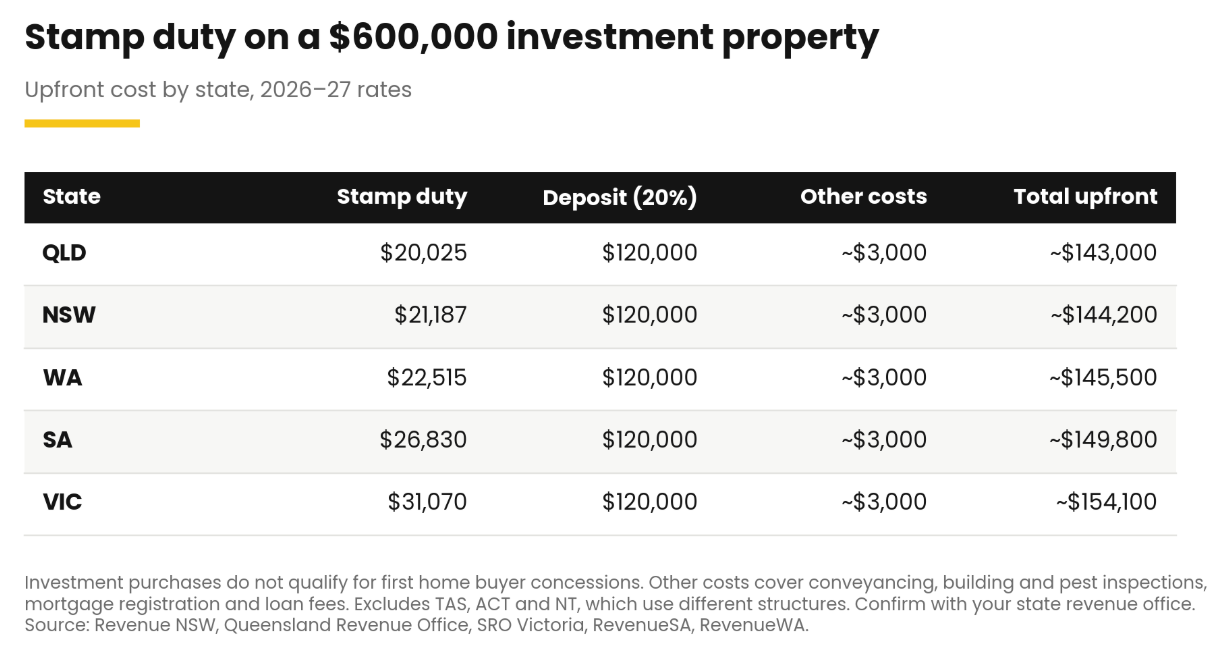
On a $600,000 property that is $120,000 for the deposit and $23,000 to $34,000 in costs depending on the state. You do not always need this in cash. If you own property, you may be able to fund it using equity to buy an investment property instead of saving from scratch.
Ongoing cost is what the property costs you to hold each week once rent comes in. This is where most first-time investors are surprised.
Serviceability is the lender's view of whether you can afford the repayments. It is assessed more conservatively than most people expect, and it is usually the real limit on what you can buy.
How much deposit do you need for an investment property?
The 20% benchmark is about avoiding lenders mortgage insurance, not about what lenders will accept. Investors can buy with 10%, and occasionally less, at the cost of an LMI premium and a rate loading on borrowings above 80% LVR.
Purchasing costs vary more by state than most buyers expect. Stamp duty on the same $600,000 investment purchase differs by more than $11,000 between Queensland and Victoria.
Investment purchases do not qualify for first home buyer concessions. Other costs cover conveyancing, building and pest inspections, mortgage registration and loan fees. Figures are current for the 2026–27 rates and exclude Tasmania, the ACT and the Northern Territory, which use different structures. Confirm your figure with the relevant state revenue office before you budget.
How the 2026 negative gearing changes affect your holding cost
Until recently, the answer to "what does the gap really cost me" involved subtracting a tax benefit. For most people buying now, that no longer holds.
In the 2026–27 Federal Budget on 12 May 2026, the government reformed negative gearing and capital gains tax. The measures are law. Which rules apply to you depends on one moment in time: 7:30pm AEST on 12 May 2026.
If you owned the property, or were under contract, before that time, nothing changes. You keep the ability to deduct net rental losses against your salary until you sell.
If you buy an established residential property after that time, from 1 July 2027 your net rental losses can no longer be deducted against your salary. They can be offset against other residential property income, including capital gains on residential property, and anything unused is quarantined and carried forward to future years.
If you buy an eligible new build, negative gearing continues as it does today, and the existing 50% CGT discount remains available.
Separately, from 1 July 2027 the 50% CGT discount is replaced by cost base indexation plus a 30% minimum tax rate on net capital gains, applying to gains that accrue after that date. Widely held trusts, superannuation funds, build-to-rent developments and certain government housing programs are excluded from the negative gearing measures.
What this means practically: if you are buying an established property today, model the weekly gap on a pre-tax basis. Treat any deduction against salary as a benefit that ends on 30 June 2027, not as an ongoing offset. It also raises the value of yield. A property that covers more of its own costs matters more when the tax system covers less of them. See our guide on positive vs negative gearing for the mechanics, and confirm your position with a property-specialist accountant, since the treatment of a former home converted to a rental is still being clarified.
What the bank looks at
A lender does not assess affordability the way you do. Three rules do most of the work.
The serviceability buffer. APRA requires lenders to assess your repayments at a rate at least 3 percentage points above the actual loan rate. APRA confirmed on 28 May 2026 that the buffer stays at 3 percentage points. With investor rates in the low-to-mid 6% to 7% range, most borrowers are being tested at roughly 9.3% to 9.7%.
Rental income shading. Lenders count only 70% to 80% of expected rent, to allow for vacancy, management and maintenance. Some apply further caps.
The debt-to-income cap. From 1 February 2026, banks can write no more than 20% of new lending at a debt-to-income ratio of six times or higher. The limit applies to owner-occupier and investor portfolios separately and is measured quarterly. Loans for new dwellings are exempt.
That last rule is the one investors underestimate. As a rough guide, a borrower on $100,000 gross can take total debt to around $600,000 before entering the high-DTI band, and $150,000 of income lifts that to around $900,000. Existing home loan debt counts. Once a lender is near its quota, a high-DTI application can be declined, deferred, or resized even when the borrower services the loan comfortably on paper.
This is why two people on the same salary can be approved for very different amounts. Your borrowing capacity depends on how your finances are structured, on which lender you approach, and on where that lender sits against its quota. If serviceability is your constraint, improving your borrowing position often does more than saving a larger deposit.
Signs you are ready, and signs you are not
You are likely ready if you have a stable income, your deposit or usable equity is in place, you hold a buffer of three to six months of repayments, and you can cover the weekly holding gap without cutting into essentials.
Hold off if the purchase would leave you with no buffer, if you are relying on best-case rent with no allowance for vacancy, or if a rate rise would tip your budget into stress. That last risk is live: the RBA lifted the cash rate three times in the first half of 2026 to 4.35%, and while it held in June and August, it has kept the option of further increases open.
Buying an asset you cannot hold through a quiet period is the most common way investors are forced to sell at the wrong time.
Affordability is about the right property, not the most expensive one
The stronger question is not "what is the most I can borrow?" It is "what is the best asset I can comfortably hold?" A property you can service through vacancies and rate movements will build more wealth than a more expensive one that stretches you to breaking point.
With deductions against salary ending for established purchases and rates where they are, yield does more work than it did in 2021. That often means looking at where the numbers work rather than where you happen to live, including interstate and regional markets with stronger yields and lower entry prices. National rental vacancy sat at 1.3% in July 2026, with Brisbane, Perth, Adelaide, Darwin and Hobart all below 1%, so tenant demand remains the more favourable side of the equation.
Ready to find out what you can actually afford?
At Search Property, we help Australians understand their real borrowing position and buy an investment-grade property they can comfortably hold. Our buyers agents focus on fundamentals, not headlines, and match the purchase to what your budget can sustain.
This blog is general information only and does not take your personal circumstances into account
Frequently Asked Questions
How much income do I need to buy an investment property in Australia?
There is no single figure, though the debt-to-income cap introduced in February 2026 gives a rough guide. Banks can write no more than 20% of new lending at a DTI of six times or higher, so a borrower on $100,000 gross is approaching that band at around $600,000 of total debt, including any existing home loan. On top of that, lenders test your repayments at a rate at least 3 percentage points above the actual rate and count only 70% to 80% of expected rent. A mortgage broker can calculate your specific borrowing capacity across lenders.
How much deposit do I need for an investment property?
Most investors aim for 20% of the purchase price to avoid lenders mortgage insurance, plus 4% to 5% for stamp duty and purchasing costs. On a $600,000 property that is $143,000 to $154,000 in total depending on the state, since stamp duty ranges from about $20,000 in Queensland to about $31,000 in Victoria. A smaller deposit is possible, usually with lenders mortgage insurance and a rate loading above 80% LVR.
Can I still negatively gear an investment property?
It depends on what you buy and when you bought it. Properties held or under contract before 7:30pm AEST on 12 May 2026 are grandfathered and keep the current treatment until sold. Eligible new builds keep negative gearing and the existing 50% CGT discount. Established residential properties purchased after that time lose the ability to offset rental losses against salary from 1 July 2027, with losses quarantined and carried forward against future residential property income.
Can I afford an investment property on a single income?
Many investors buy on one income. The deciding factors are your borrowing capacity, your DTI position including existing debt, the weekly holding cost, and whether you hold an adequate buffer. Choosing a property with a stronger rental yield reduces the out-of-pocket cost and makes a single-income purchase more manageable, which matters more now that deductions against salary are ending for established purchases.
What ongoing costs should I budget for?
Beyond loan repayments, budget for council rates, water rates, landlord insurance, property management of 6% to 8% of rent plus letting and admin fees, maintenance, land tax where applicable, strata levies if you buy a unit, and periods of vacancy. A realistic holding cost assumes the property is not tenanted every week of the year.
Should I use savings or equity to fund the deposit?
Both work. Savings leave your existing equity untouched, while accessing equity lets you invest sooner without saving a new deposit. Equity release also adds to your total debt, which matters under the DTI cap. A broker can advise which is more cost-effective for your situation.
Disclaimer: Important Notice for Readers
By reading the content provided on this blog, you acknowledge and agree to the terms outlined in this disclaimer, binding yourself to its provisions unconditionally.
This blog presents information for informational, educational, and general non-advisory purposes only. It's important for you, the reader, to understand that the information provided does not take into account your specific personal, financial, or other circumstances. Consequently, we do not offer legal, financial, investment, or taxation advice, recommendations, or guidance. Before acting upon any information from this blog, you are strongly advised to consult with an independent professional, including legal, financial, taxation, accounting, or other relevant advisors, to verify the information’s relevance to your particular situation.
The information is provided in good faith, derived from sources believed to be reliable. However, we do not guarantee the accuracy, completeness, or applicability of the information to your individual circumstances, needs, objectives, or financial situation. The information may be selective and has not been independently verified. Therefore, it should not be the sole basis for any decision-making.
We expressly disclaim any liability for errors, omissions, or inaccuracies in the information, as well as any direct or indirect losses, damages, or expenses that arise from relying on our content, regardless of the cause, including negligence or other factors. Your engagement with this blog is entirely at your own risk.
Please be aware, we do not hold an Australian Financial Services Licence as defined by section 9 of the Corporations Act 2001 (Cth), nor are we authorised to provide financial services, and we have not provided financial services to you.
Disclaimer: Search Property Pty Ltd (SP) does not provide financial or investment advice and does not hold a financial services license as defined in the Corporations Act 2001 (Cth). Any advice given by SP is general in nature and does not take into account your personal circumstances or objectives, financial situation or needs.


.png)
.png)

.png)
.png)