What the RBA's Financial Review Says About Australian Households and Businesses
Every six months the Reserve Bank of Australia publishes its Financial Stability Review, a detailed assessment of how resilient Australian households, businesses, and the financial system are to economic shocks. The October 2026 edition contains some of the most important data available for understanding how Australian mortgage holders are actually coping with a cash rate that has now reached 4.6%, its highest level in 15 years.
Here is what the data shows, and why it matters more than the headlines currently circulating.
The RBA's own assessment is direct. Household and business borrowers continue to display a high level of resilience overall, and loan arrears remain low, despite financial pressures picking up this year in response to higher inflation and interest rates.
The Monetary Policy Board increased the cash rate by 100 basis points in 2026 to help return inflation to target, driven by domestic capacity pressures and higher input costs linked to the Middle East conflict. What is notable is how little it has translated into financial distress across the household sector.
Mortgage Stress Remains Historically Low
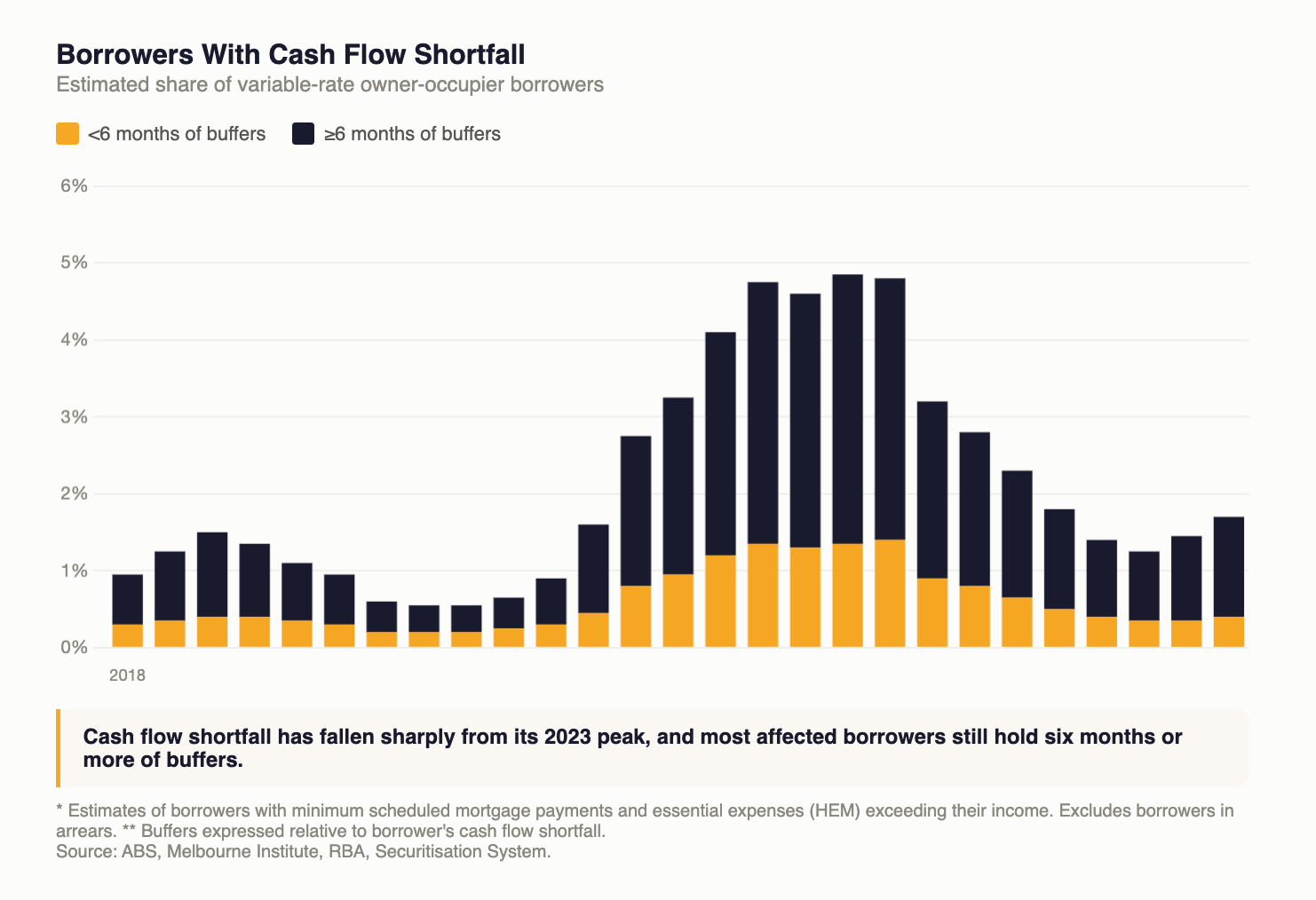
The estimated share of variable-rate owner-occupier borrowers experiencing a cash flow shortfall, meaning their income does not cover scheduled mortgage repayments and essential expenses, increased only slightly over the first half of 2026 and remains at around 2%.
That figure is significant in context. Even though interest rates are now above their previous peak during the 2023 to 2024 cycle, the RBA expects instances of stress to peak at a lower level this time. Two factors explain this. Households estimated to have been in cash flow deficit during 2023 to 2024 have since experienced meaningful income growth. Borrowers who took out loans in recent years have faced loan servicing capacity requirements well above current interest rates, a product of APRA's serviceability buffer requiring lenders to assess borrowers at 3 percentage points above the actual loan rate.
Arrears rates tell a similar story. The share of housing loans more than three months behind on repayments has increased slightly over the year to date but remains around pre-pandemic levels. Borrowers with lower incomes, high loan-to-value ratios, or high loan-to-income ratios remain more vulnerable, but these cohorts represent a very small share of overall borrowers.
The Equity Buffer Story
The most compelling evidence in the entire review is the household equity position.
Most mortgagors hold large savings buffers in offset and redraw accounts, with the median borrower able to cover over a year of scheduled mortgage payments at current interest rates from these buffers alone. That is a stronger position than existed before the pandemic.
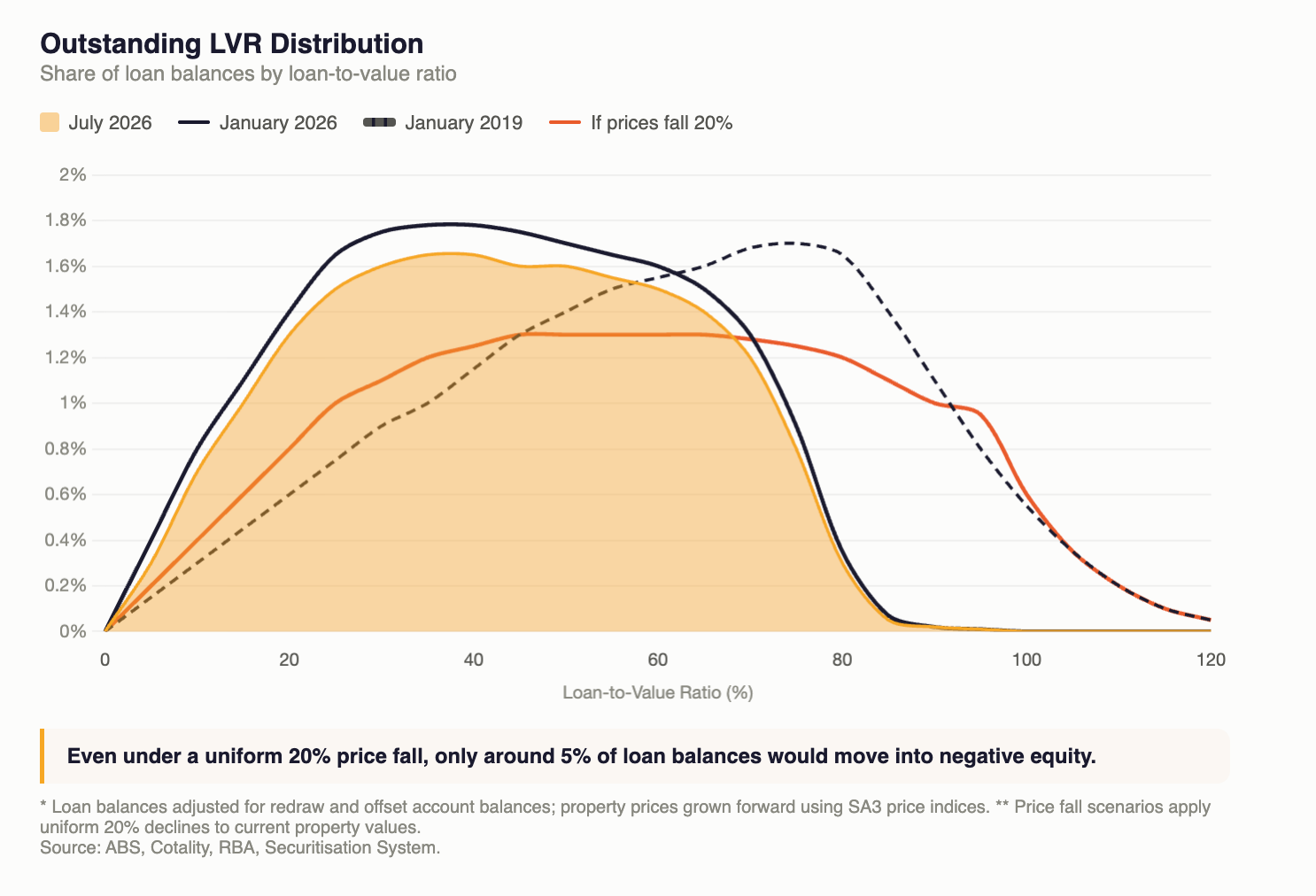
On negative equity specifically, less than 1% of borrowers are estimated to owe more on their loan than their property is worth. Even under a scenario involving a uniform 20% fall in housing prices from current levels, the RBA's Securitisation System data suggests only around 5% of mortgages would fall into negative equity.
This data directly supports the case made elsewhere about why a severe property crash is not the likely outcome of the current correction. Negative equity alone is insufficient to trigger default if a borrower remains able to service their loan, which remains true for the vast majority of households. Most Australian mortgages are full recourse, which reinforces the incentive for borrowers to continue servicing their loan wherever possible rather than walking away.
What an Adverse Scenario Would Take
The RBA models what would need to happen for household stress to become a systemic problem, and the threshold is considerably higher than current conditions.
In a very adverse downturn, for example a shock originating overseas where unemployment rises to 6.3%, inflation increases to 7%, and the cash rate climbs to 5.6%, the share of mortgagors at higher risk of default is estimated to increase to around 5%. That is only a little higher than the peak reached in 2023. Even in that scenario, around two-thirds of those borrowers would have insufficient income to cover expenses but enough buffers to service debt and essential costs for at least six months. Few households would fall into negative equity even with a further 20% price decline layered on top.
This is why the labour market matters more than falling prices when judging real risk. A modest rise in unemployment is a normal part of an economic slowdown. A sharp rise in unemployment is what would actually tip things into serious stress, not price falls on their own.
Investor Lending Has Moderated, Not Collapsed
New lending to investors picked up strongly through 2025 but has slowed recently and is expected to moderate further in response to the 2026 tax changes, tighter monetary policy settings, and softer housing prices.
This matters because investor activity has historically had a greater influence on housing price dynamics than owner-occupier activity. In periods of declining prices, investors may be less willing to enter the market and more inclined to sell to limit losses, which can amplify downward pressure.
What the data also shows is that investors, like other borrowers, generally hold considerable equity positions and have historically exhibited lower rates of arrears and default than owner-occupiers. Investor incomes also continue to be supported by rising rents, which is helping offset the reduced tax incentives introduced by the 2026 budget changes.
Business Resilience Has a More Mixed Picture
Most businesses entered 2026 with strong balance sheets and contained debt levels, and bank loan arrears for businesses remain low. Larger companies in particular are expected to remain resilient to higher rates because many issue fixed-rate debt or hedge their interest rate exposure, meaning the pass-through of higher borrowing costs takes time to materially affect them.
Smaller businesses face a different reality. Company insolvencies remain elevated relative to longer-term averages in hospitality, construction, and transport, sectors more exposed to recent wage and input cost pressures and typically operating on thinner margins. The administration of one large builder and developer, already covered in detail in the analysis of Australia's housing supply crisis, is expected to cause a temporary spike in the October quarter insolvency figures due to the number of subsidiaries involved.
Importantly, the RBA assesses that broader financial system spillovers from these insolvencies have been contained, since most involve small companies with limited bank debt.
What This Means for Property Investors
It is easy to lose sight of the bigger picture amid rate rises and softening prices. The Financial Stability Review makes one thing clear. Australian households entered this tightening cycle from an exceptionally strong position, and that strength is the main reason the current correction has not turned into something worse.
Three things stand out for investors.
There is no wave of forced selling. The data does not show the kind of distress that typically drives a severe downturn. That supports the case that quality assets in supply-constrained markets are not facing the systemic risk that would justify staying on the sidelines.
Investor lending has slowed, not stopped. Despite the tax changes, investing in property remains viable, especially for those focused on long-term fundamentals rather than short-term tax savings.
Foreign capital keeps flowing into Australian real estate. Overseas investors have no exposure to Australia's domestic tax settings, so their continued confidence is a strong signal about the underlying strength of the market itself.
None of this means prices cannot fall further in the near term. It does mean the ingredients for a crash, widespread forced selling, large-scale negative equity, and a collapse in lending, are not present according to the RBA's own data.
Ready to Build a Portfolio That Benefits From Household Resilience?
At Search Property, we help Australians cut through the noise and build data-driven investment strategies aligned with long-term wealth goals. Our buyers agents have helped thousands of clients build wealth through property because we focus on fundamentals, not headlines.
Book a FREE investment assessment with Search Property. We'll discuss your goals and position, and help you build a clear plan to move forward with confidence.
Frequently Asked Questions
What is the RBA?
The Reserve Bank of Australia is Australia's central bank. It sets the cash rate, manages monetary policy to keep inflation within its target band, and monitors the stability of the broader financial system. Twice a year it publishes a Financial Stability Review assessing how resilient households, businesses, and the financial system are to economic shocks.
How many Australian mortgage holders are currently in negative equity? Less than 1% according to the RBA's October 2026 assessment. Even under a scenario involving a uniform 20% fall in housing prices from current levels, only around 5% of mortgages would fall into negative equity based on Securitisation System data.
What would it actually take for household mortgage stress to become severe? The RBA's adverse scenario involves unemployment rising to 6.3%, inflation increasing to 7%, and the cash rate climbing to 5.6%. Even in that scenario, the share of mortgagors at higher risk of default is estimated to reach only around 5%, a little higher than the 2023 peak, with most of those borrowers still holding sufficient buffers to service debt for at least six months.
Is investor activity in the property market declining? Investor credit growth has moderated from the elevated levels seen through 2025 in response to the 2026 tax changes, tighter monetary policy, and softer prices, but it has not collapsed. Investors continue to hold considerable equity positions and have historically shown lower rates of arrears and default than owner-occupiers, with rental income growth continuing to support their cash flow.
Why are business insolvencies still elevated in some sectors? Hospitality, construction, and transport remain more exposed to wage and input cost pressures and typically operate on thinner margins than other industries. The RBA notes that financial system spillovers from these insolvencies have been contained because most involve small companies with limited bank debt exposure.
Disclaimer: Important Notice for Readers
By reading the content provided on this blog, you acknowledge and agree to the terms outlined in this disclaimer, binding yourself to its provisions unconditionally.
This blog presents information for informational, educational, and general non-advisory purposes only. It's important for you, the reader, to understand that the information provided does not take into account your specific personal, financial, or other circumstances. Consequently, we do not offer legal, financial, investment, or taxation advice, recommendations, or guidance. Before acting upon any information from this blog, you are strongly advised to consult with an independent professional, including legal, financial, taxation, accounting, or other relevant advisors, to verify the information’s relevance to your particular situation.
The information is provided in good faith, derived from sources believed to be reliable. However, we do not guarantee the accuracy, completeness, or applicability of the information to your individual circumstances, needs, objectives, or financial situation. The information may be selective and has not been independently verified. Therefore, it should not be the sole basis for any decision-making.
We expressly disclaim any liability for errors, omissions, or inaccuracies in the information, as well as any direct or indirect losses, damages, or expenses that arise from relying on our content, regardless of the cause, including negligence or other factors. Your engagement with this blog is entirely at your own risk.
Please be aware, we do not hold an Australian Financial Services Licence as defined by section 9 of the Corporations Act 2001 (Cth), nor are we authorised to provide financial services, and we have not provided financial services to you.
Disclaimer: Search Property Pty Ltd (SP) does not provide financial or investment advice and does not hold a financial services license as defined in the Corporations Act 2001 (Cth). Any advice given by SP is general in nature and does not take into account your personal circumstances or objectives, financial situation or needs.

.png)

.png)




.png)


