Australia's Housing Shortage: Why Supply Cannot Keep Up
Australia is not building enough homes. That sentence has been true for several years and the gap between supply and demand is widening. The consequences are playing out across the housing market simultaneously. Persistently low vacancy rates. Rents that have risen more than 40% in five years. Elevated construction costs. And a housing pipeline that remains well short of what Australia needs.
Here is what is driving Australia's housing shortage and what it means for property investors.
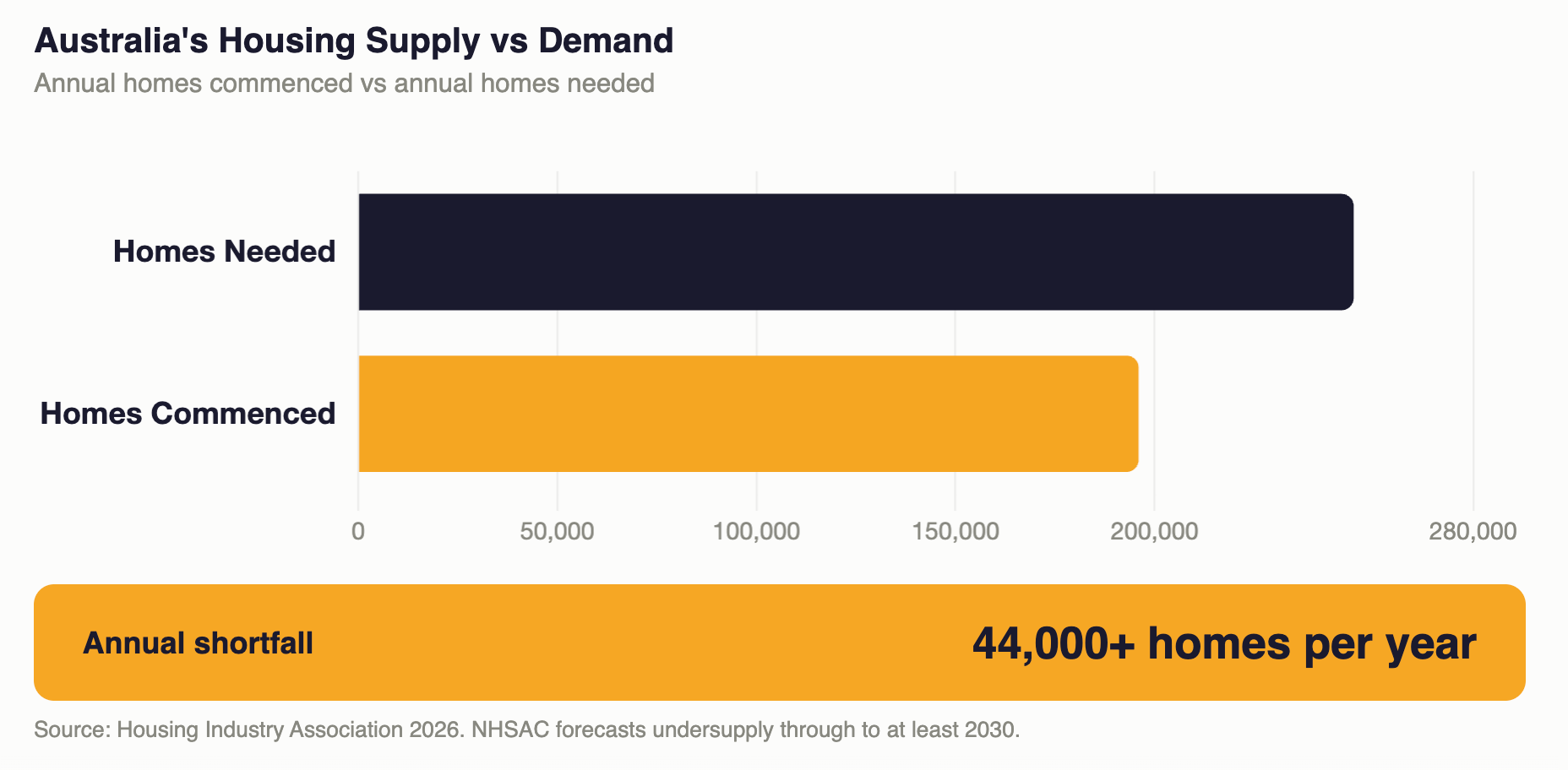
Australia needs approximately 240,000 new homes per year to keep pace with population growth and underlying demand. According to the Housing Industry Association, Australia commenced construction of just 196,000 homes last year. That is a shortfall of more than 44,000 homes in a single year. Australia will continue to undersupply housing through to at least 2030 under current conditions.
ABS building approvals data for May 2026 shows the pipeline is not improving. Total approvals fell 1.1% following a decline in April. Private dwellings excluding houses fell 10.4% in May and are now 8.6% lower year on year. Detached house approvals lifted 2.8% to their highest level since September 2021, with Western Australia particularly strong at 9.9% growth, but this positive movement is not sufficient to offset the broader deterioration in higher density supply.
The government's Housing Accord target of 1.2 million new homes over five years was always ambitious. The current trajectory suggests it will not be met.
Why Developers Are Pulling Back
The headline approval numbers, while concerning, actually overstate the supply that will ultimately reach completion. A significant proportion of approved projects never get built.
The reason is economics. The cost to construct a new apartment in most Australian capital cities now significantly exceeds what buyers are willing or able to pay. Construction costs have risen 30% since 2020 driven by skilled labour shortages, supply chain disruptions, and material cost inflation. Developer margins have been squeezed to the point where many projects that were viable at 2021 cost structures are not viable at 2026 cost structures.
When a developer cannot sell apartments at a price that covers construction cost plus a reasonable margin, they do not build. They shelve the project, retain the approval, and wait for conditions to improve. That wait is creating a growing inventory of approved but uncommenced projects that will not add to housing supply for years, if at all.
Builder insolvencies have compounded the problem significantly. Record numbers of building companies have entered administration over the past two years, leaving partially completed projects, stranded buyers, and disrupted supply chains. Approvals that are recorded in the data as additions to the pipeline may have no viable builder to execute them.
The Policy Changes That Reduced Investor Supply
Private investors have historically been responsible for a significant proportion of the rental housing stock in Australia. When the 2026 federal budget changed the negative gearing rules for established residential properties purchased after 12 May 2026, it reduced the financial incentive for investors to add new rental properties to the market.
First, fewer investors buying means fewer rental properties being added to the market. Each established property that an investor would have purchased and rented out represents one fewer rental property available to the growing pool of renters.
Second, existing investors with grandfathered properties are now significantly less likely to sell. Selling means permanently losing the negative gearing benefits that were secured before 12 May 2026. The rational response is to hold indefinitely. A large volume of established housing stock that would otherwise have transacted, and potentially been purchased by owner-occupiers, is now locked away in investor hands.
The combined effect is a rental market with less incoming supply and less turnover of existing stock, in a market that was already critically undersupplied before the budget changes arrived.
Migration Is Adding Demand Faster Than Supply Can Respond
Australia's population is growing rapidly. Net overseas migration is forecast to exceed 300,000 this financial year. Australia's population grew by approximately 420,000 people in 2025 according to ABS population statistics.
New arrivals to Australia rent first, almost universally. They do not arrive with a deposit saved, a credit history established, or the local market knowledge to purchase immediately. Every additional migrant adds to rental demand in a market already running at record low vacancy rates before they can transition to ownership.
The lag between population arriving and housing supply responding has always existed. The current magnitude of migration combined with the depth of the existing housing shortfall has stretched that lag to a point where the rental market is absorbing demand that the supply side simply cannot meet.
Internal migration is adding a second layer of demand pressure on regional markets. According to CBA's Regional Movers Index March Quarter 2026, capital to regional migration is at record highs nationally with 20% of all movers settling in regional Queensland alone. Regional markets that were previously more affordable are now experiencing the same supply constraints that capital cities have been dealing with for years.
Vacancy Rates Tell the Story
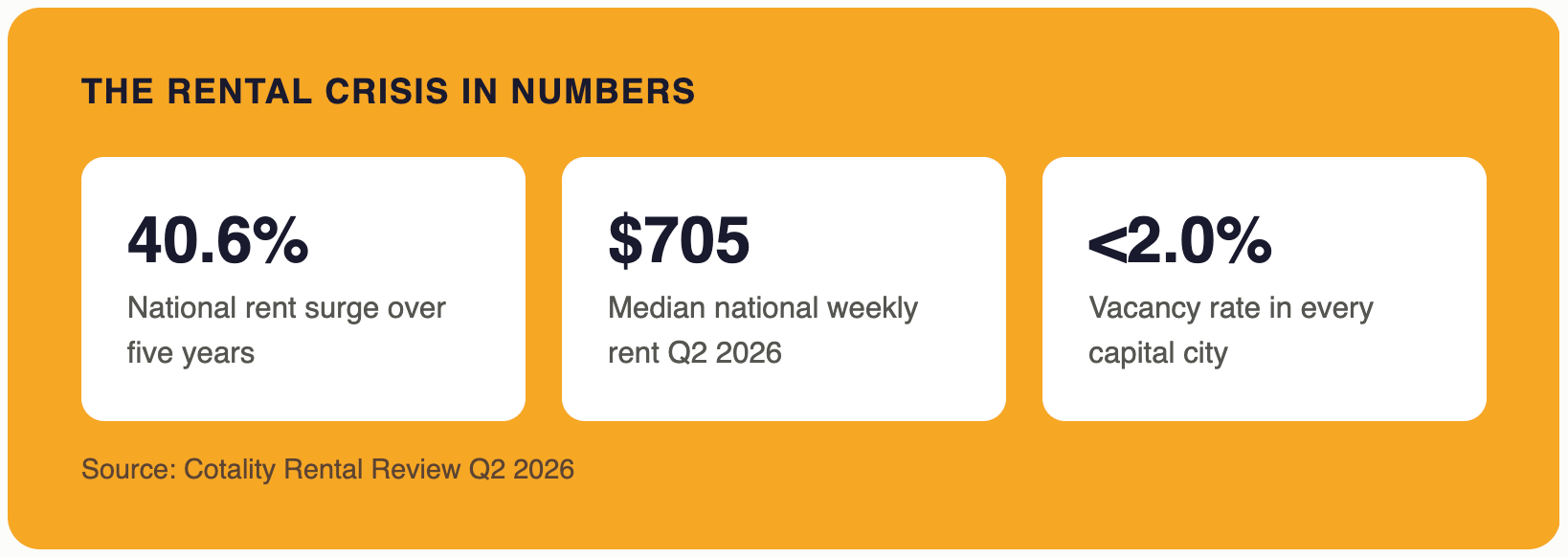
National vacancy rates are one of the clearest indicators of the supply-demand imbalance. According to Cotality's Rental Review Q2 2026:
National vacancy rate: 1.6%, below the five-year average of 1.8%
Every capital city vacancy rate is below 2.0%
Adelaide: 1.0%, the tightest rental market of any capital city
Total rental listings: 16.7% below the five-year average
National rents have surged 40.6% over the past five years
Median national weekly rent: $705
A healthy rental market typically operates with a vacancy rate of 2.5% to 3.0%. Every capital city is operating well below that level. The absence of available rental stock is translating directly into rent increases that are outpacing wages and placing growing financial pressure on Australian households.
What Would Fix the Problem
The housing shortage is fundamentally a supply problem. It will not be resolved by tax policy changes alone. The only durable solution is more housing. That requires several things working simultaneously.
Planning reform. Australia's planning systems are slow, complex, and in many cases actively hostile to density. Approval timelines of two to five years for development projects are not compatible with meeting housing demand in growing cities. Streamlining approvals, reducing the scope for objections that delay genuinely needed housing, and enabling higher density in well-located areas would meaningfully increase the pipeline of viable projects.
Construction cost reduction. The economics of new development need to improve before the private sector will build at the scale required. This means addressing skilled labour shortages through immigration and training pipelines, reducing the regulatory burden on builders, and finding ways to bring material costs back toward sustainable levels.
Infrastructure investment. New housing supply is most viable in locations with existing or planned infrastructure. Transport, schools, hospitals, and utilities need to precede or accompany new housing rather than following it years later. Government investment in enabling infrastructure unlocks private investment in housing supply.
Policy settings that support investor participation. Private investors own a significant proportion of Australia's rental housing stock. Policy changes that reduce the financial incentive for investors to hold and expand rental portfolios directly reduce rental supply in a market that cannot afford further contraction.
What the Housing Shortage Means for Property Investors
The structural housing shortage has direct implications for property investors that are worth understanding clearly.
Rental demand is structural rather than cyclical. In a market undersupplied by tens of thousands of properties annually with a pipeline that will not close the gap for years, rental demand is not going to soften materially. Investors with well-located properties in supply-constrained markets have a structural tailwind behind their rental income.
Replacement cost provides a price floor. When the cost to build a comparable property significantly exceeds its market value, existing stock has inbuilt equity protection. A property worth $800,000 that would cost $1.1 million to build provides meaningful downside protection in a market correction.
Supply constraints amplify the value of well-located assets. Properties in markets where new supply cannot easily emerge, established suburbs, heritage areas, coastal locations, and regional centres with geographic constraints, benefit more from demand growth than properties in markets where supply can expand to absorb demand.
The opportunity is in markets that are undersupplied relative to demand. Not every regional market is equal. The markets with the strongest investment fundamentals are those where population growth is outpacing housing construction, vacancy rates are tight, and the barriers to new supply are genuine rather than temporary.
Ready to Invest in Markets Where Supply Cannot Keep Up With Demand?
At Search Property, we help Australians cut through the noise and build data-driven investment strategies aligned with long-term wealth goals. Our buyers agents have helped thousands of clients build wealth through property because we focus on fundamentals, not headlines.
Book an investment assessment call with Search Property. We'll discuss your goals and position, and help you build a clear plan to move forward with confidence.
Frequently Asked Questions
How big is Australia's housing shortage?
According to the Housing Industry Association, Australia commenced construction of just 196,000 homes last year against demand of more than 250,000. The cumulative shortfall across the Housing Accord's first two years exceeds 91,000 homes. The National Housing Supply and Affordability Council forecasts undersupply will continue through to at least 2030 under current conditions.
Why aren't developers building more homes?
Construction costs have risen 30% since 2020 due to labour shortages, supply chain disruptions, and material cost inflation. In most Australian capital cities, the cost to build a new apartment now exceeds what buyers are willing or able to pay. When development is not economically viable, developers do not build regardless of how strong underlying demand is.
How does the housing shortage affect renters?
National rents have surged 40.6% over the past five years according to Cotality data. The median national weekly rent now sits at $705 with every capital city vacancy rate below 2.0%. Households are now committing approximately one third of gross income to rent, up from around 27% five years ago. The shortage of rental supply relative to demand is the primary driver of rent increases.
Will the housing shortage be resolved anytime soon?
Not under current conditions. The NHSAC forecasts undersupply through to at least 2030. Planning reform, construction cost reduction, and policy settings that support investor participation would all help but none of these are short-term fixes. The pipeline of housing that Australia needs in 2027 and 2028 should have started construction in 2024 and 2025. Much of it did not.
What does the housing shortage mean for property values?
Chronic undersupply in markets with growing populations supports property values over the long term. When demand consistently exceeds supply, prices respond regardless of short-term sentiment or interest rate cycles. The replacement cost floor provides additional price support in markets where new construction is economically unviable. Investors holding quality assets in genuinely undersupplied markets have a structural tailwind that is unlikely to reverse before 2030.
Disclaimer: Important Notice for Readers
By reading the content provided on this blog, you acknowledge and agree to the terms outlined in this disclaimer, binding yourself to its provisions unconditionally.
This blog presents information for informational, educational, and general non-advisory purposes only. It's important for you, the reader, to understand that the information provided does not take into account your specific personal, financial, or other circumstances. Consequently, we do not offer legal, financial, investment, or taxation advice, recommendations, or guidance. Before acting upon any information from this blog, you are strongly advised to consult with an independent professional, including legal, financial, taxation, accounting, or other relevant advisors, to verify the information’s relevance to your particular situation.
The information is provided in good faith, derived from sources believed to be reliable. However, we do not guarantee the accuracy, completeness, or applicability of the information to your individual circumstances, needs, objectives, or financial situation. The information may be selective and has not been independently verified. Therefore, it should not be the sole basis for any decision-making.
We expressly disclaim any liability for errors, omissions, or inaccuracies in the information, as well as any direct or indirect losses, damages, or expenses that arise from relying on our content, regardless of the cause, including negligence or other factors. Your engagement with this blog is entirely at your own risk.
Please be aware, we do not hold an Australian Financial Services Licence as defined by section 9 of the Corporations Act 2001 (Cth), nor are we authorised to provide financial services, and we have not provided financial services to you.
Disclaimer: Search Property Pty Ltd (SP) does not provide financial or investment advice and does not hold a financial services license as defined in the Corporations Act 2001 (Cth). Any advice given by SP is general in nature and does not take into account your personal circumstances or objectives, financial situation or needs.


.png)
.png)

.png)
.png)
.png)
.png)
.png)

