The Trust Tax Backflip: What the New Rules Mean for Property Investors
The government has quietly walked back one of the most significant and least understood elements of the 2026 budget. The 30% minimum tax on discretionary trust distributions is being modified. A draft legislative fix has been released and it looks likely to pass parliament.
If you own property in a trust, are considering buying through one, or have been wondering whether a bucket company makes more sense, the next few months are critical. Here is what is changing and what it means for your ownership structure.
Before the 2026 budget, discretionary trusts were one of the most flexible and tax-effective ownership structures available to Australian property investors.
A discretionary trust gives the trustee full flexibility over how income and capital gains are distributed to beneficiaries each year. That flexibility allowed investors to allocate distributions to whoever in the family group was in the lowest tax bracket in any given year, reducing the overall tax paid on investment income and capital gains.
The 2026 budget introduced a 30% minimum tax on trust distributions. The effect was to remove much of the flexibility that made discretionary trusts attractive in the first place. If the trust was going to be taxed at 30% regardless of which beneficiary received the distribution, the advantage of being able to choose the lowest-taxed beneficiary year to year largely disappeared.
For many investors who had structured portfolios inside trusts specifically for this flexibility, the budget changes were a significant blow.
The Double Taxation Problem Nobody Planned For
The budget changes created an unintended consequence that the government appears to have recognised and is now attempting to fix.
The standard structure used by many investors and their accountants involved a discretionary trust owning the investment property with a bucket company as one of the beneficiaries. The trust would distribute income and gains to the bucket company at a flat 30% corporate tax rate rather than paying it out at higher personal rates.
Under the original budget changes, this structure would have been taxed twice. First at the trust level at 30% minimum. Then again at the bucket company level at 30%. That double taxation was either an oversight or an aggressive policy choice. Either way it made the trust and bucket company structure significantly less viable.
Under the proposed changes, a discretionary trust can avoid the 30% minimum trust tax if the trustee agrees to fix the allocation of benefits to each beneficiary permanently.
In practice this means you can still own investment property through a trust and distribute income or capital gains to a bucket company at 30% rather than paying the 30% minimum at the trust level. The bucket company is then taxed at its flat 30% rate as it always has been, avoiding the double taxation problem.
The significant trade-off is that the word discretionary no longer applies in the way it did. Once you lock in the fixed allocation, it stays that way permanently. You cannot change how distributions flow between beneficiaries without triggering significant tax consequences.
For investors who were using the discretionary element of their trust to shift income to lower-taxed family members year to year, that flexibility is gone. The structure survives but in a substantially reduced form.
The deadline for making these elections is 1 July 2028. Investors with existing trusts need to make decisions about their structure before that date.
How Ownership Structures Compare Under the New Rules
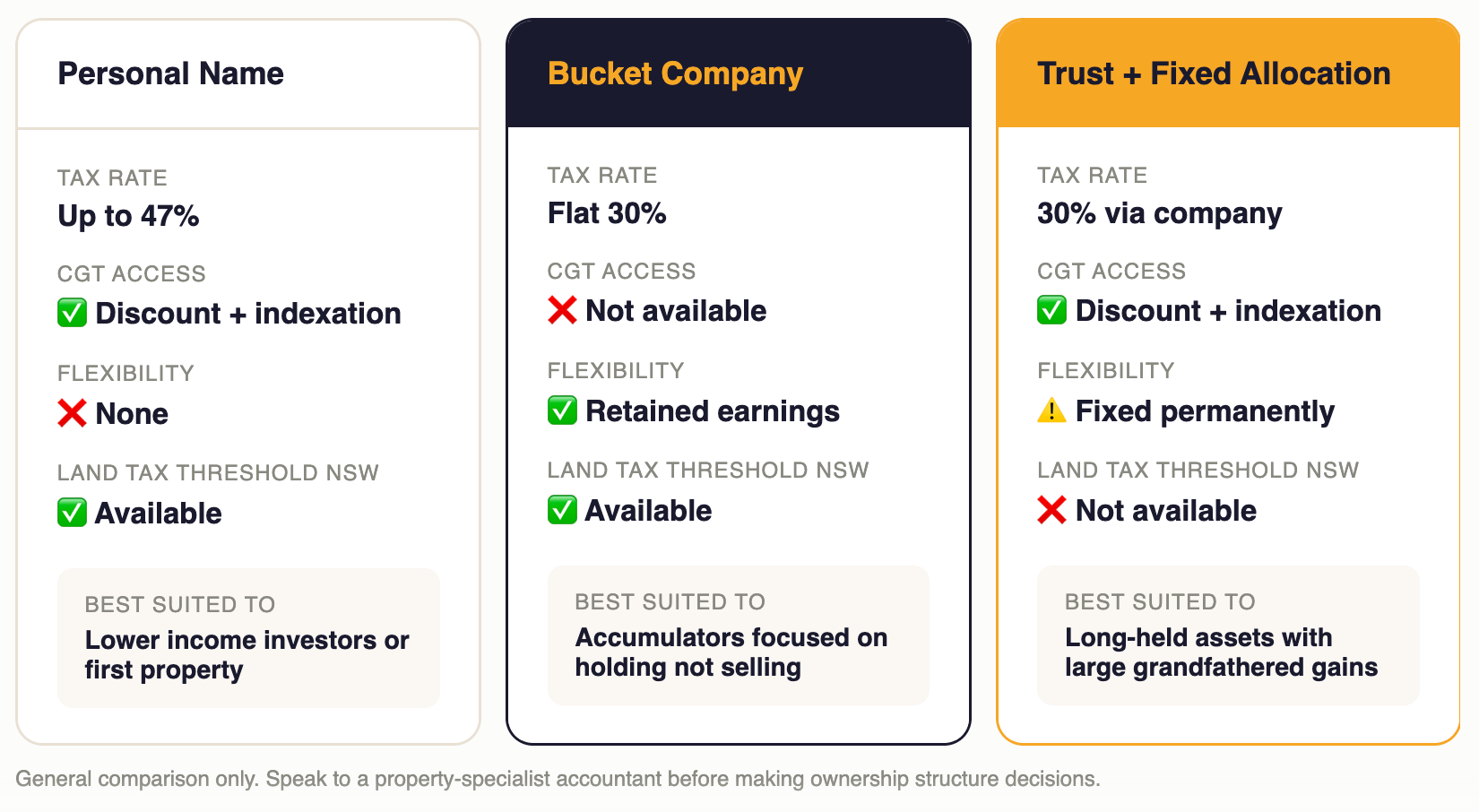
Understanding the three main structures and how they compare under the post-budget rules is essential for making the right decision about how to hold investment property going forward.
Personal name Investment income and capital gains are taxed at your marginal rate, up to 47%. There is no flexibility to shift income to other beneficiaries. Properties purchased before 1 July 2027 retain the 50% CGT discount on gains accrued to that date. Properties purchased after move to the indexation model. As properties transition from negatively geared to positively geared over time, rental income adds to your taxable income at your full marginal rate.
Bucket company A non-trading company is taxed at a flat 30% on income and capital gains. There is no access to the CGT discount or indexation model. The advantage is certainty. The government has not signalled any intention to change the corporate rate and retained earnings can be reinvested without distribution at personal rates. For investors focused on accumulating and holding, the bucket company offers simplicity and land tax threshold advantages in some states.
Discretionary trust with fixed allocation Under the draft rules, a trust can still flow income and gains to a bucket company at 30% and avoid double taxation. It retains access to the indexation model for CGT purposes, which a company does not. The cost is permanent loss of discretion over distributions. Once fixed, the allocation cannot change without significant tax consequences.
The Land Tax Dimension
One aspect of this decision that often gets overlooked is land tax.
In New South Wales, trusts do not receive the same land tax threshold as individuals. Buying through a company rather than a trust can unlock the land tax-free threshold that applies to individual owners, which represents a meaningful ongoing cost saving for investors holding multiple properties in New South Wales.
This is one of the reasons some investors who might otherwise benefit from the trust structure prefer the bucket company for new purchases despite losing the indexation benefit. The ongoing land tax saving in some states can outweigh the CGT benefit of holding through a trust, depending on holding period, growth rate, and when and whether a sale occurs.
What This Means for Investors Making Decisions Now
The draft legislation is not yet final. It looks likely to pass but investors should not restructure existing holdings or make new purchase decisions based solely on a draft. The right move is to get specific advice from a property-specialist accountant who understands both the federal tax implications and the state-level land tax consequences of each structure.
What the current environment does clarify is that the landscape for property ownership structures has shifted permanently. The pre-budget world where discretionary trusts offered maximum flexibility with minimal restriction is gone.
The structures that remain viable are more constrained than they were, but they are still significantly more tax-effective than holding everything in personal names. Getting the structure right from the outset matters more now than at any point in the past decade.
For investors who already hold properties across multiple structures, the period between now and 1 July 2028 is the window to review each holding and determine whether the current structure remains appropriate or whether changes should be made before the fixed allocation deadline arrives.
Ready to Review Your Ownership Structure Before the Deadline?
At Search Property, we help Australians cut through the noise and build data-driven investment strategies aligned with long-term wealth goals. Our buyers agents have helped thousands of clients build wealth through property because we focus on fundamentals, not headlines.
Book a FREE investment assessment with Search Property. We will discuss your goals, your current structure, and connect you with the right accounting and finance professionals to ensure your portfolio is set up correctly before the 2028 deadline arrives.
Frequently Asked Questions
What is the 30% minimum trust tax and has it been reversed?
The 2026 budget introduced a 30% minimum tax on discretionary trust distributions. It has not been fully reversed. A draft fix has been released that allows trusts to avoid the 30% minimum tax if the trustee permanently fixes the allocation of benefits to each beneficiary. The discretionary element of the trust is preserved in name but significantly reduced in practice.
Can I still use a trust and a bucket company together?
Yes under the new draft rules. If you fix a permanent allocation from the trust to the bucket company, distributions flow to the company at its flat 30% rate without the double taxation that would have applied under the original budget changes. The trust also retains access to the indexation model for CGT purposes which a company does not.
What is a bucket company and why do investors use it?
A bucket company is a non-trading company that holds investment assets or receives distributions from a trust. It is taxed at a flat 30% corporate rate. It does not access the CGT discount or indexation model but provides certainty, simplicity, and in some states access to land tax thresholds that trusts do not receive. Many investors use bucket companies to accumulate retained earnings at 30% rather than distributing at personal rates up to 47%.
Should I buy my next property in a trust, company, or personal name?
This depends on your income level, state of purchase, intended holding period, whether you plan to sell before or after 1 July 2027, and your overall portfolio structure. There is no universal answer. A property-specialist accountant needs to model each option against your specific situation before you make a decision. Getting the structure wrong at the point of purchase is expensive to fix later.
What is the deadline for making the fixed allocation election?
The draft legislation sets a deadline of 1 July 2028 for trusts to make the fixed allocation election to avoid the 30% minimum tax going forward. Investors with existing trusts need to review their structures and make decisions before that date.
Does the CGT transitional rule apply to properties held in trusts?
Yes. The transitional rule that splits gains at 1 July 2027, with gains accrued before that date taxed under the existing 50% discount and gains after taxed under the new indexation model, applies to trust-held properties as well as personally held ones. This is one of the reasons maintaining the trust structure for long-held properties with large grandfathered gains may still make sense even under the new rules.
Disclaimer: Important Notice for Readers
By reading the content provided on this blog, you acknowledge and agree to the terms outlined in this disclaimer, binding yourself to its provisions unconditionally.
This blog presents information for informational, educational, and general non-advisory purposes only. It's important for you, the reader, to understand that the information provided does not take into account your specific personal, financial, or other circumstances. Consequently, we do not offer legal, financial, investment, or taxation advice, recommendations, or guidance. Before acting upon any information from this blog, you are strongly advised to consult with an independent professional, including legal, financial, taxation, accounting, or other relevant advisors, to verify the information’s relevance to your particular situation.
The information is provided in good faith, derived from sources believed to be reliable. However, we do not guarantee the accuracy, completeness, or applicability of the information to your individual circumstances, needs, objectives, or financial situation. The information may be selective and has not been independently verified. Therefore, it should not be the sole basis for any decision-making.
We expressly disclaim any liability for errors, omissions, or inaccuracies in the information, as well as any direct or indirect losses, damages, or expenses that arise from relying on our content, regardless of the cause, including negligence or other factors. Your engagement with this blog is entirely at your own risk.
Please be aware, we do not hold an Australian Financial Services Licence as defined by section 9 of the Corporations Act 2001 (Cth), nor are we authorised to provide financial services, and we have not provided financial services to you.
Disclaimer: Search Property Pty Ltd (SP) does not provide financial or investment advice and does not hold a financial services license as defined in the Corporations Act 2001 (Cth). Any advice given by SP is general in nature and does not take into account your personal circumstances or objectives, financial situation or needs.


.png)
.png)