What Does the 2026 Budget Mean for Australian Property Prices and Rents?
Every few months the major banks and property economists release their forecasts and the headlines that follow make it sound like the market is either about to crash or take off. The reality is almost always more measured than either extreme.
Here is what the leading forecasters are saying about Australian property through 2026, 2027, and 2028, what those numbers mean in practice, and why the market you are investing in matters far more than the national headline figure.
Angus Moore, senior economist at REA Group, expects home prices to finish 2026 largely flat across the combined capitals. His view is that higher interest rates and stretched affordability will produce soft to falling prices through the back half of 2026 before a turning point and return to growth late in the year and into 2027.
For 2027, REA Group is forecasting price growth of approximately 5.5% nationally, slightly below the long-run average of around 7%, reflecting ongoing affordability pressures and reduced investor demand following the 2026 budget changes.
The combined capitals are currently tracking at approximately 6.4% year on year to May 2026. The forecast is essentially for that momentum to slow through the remainder of the year before recovering.
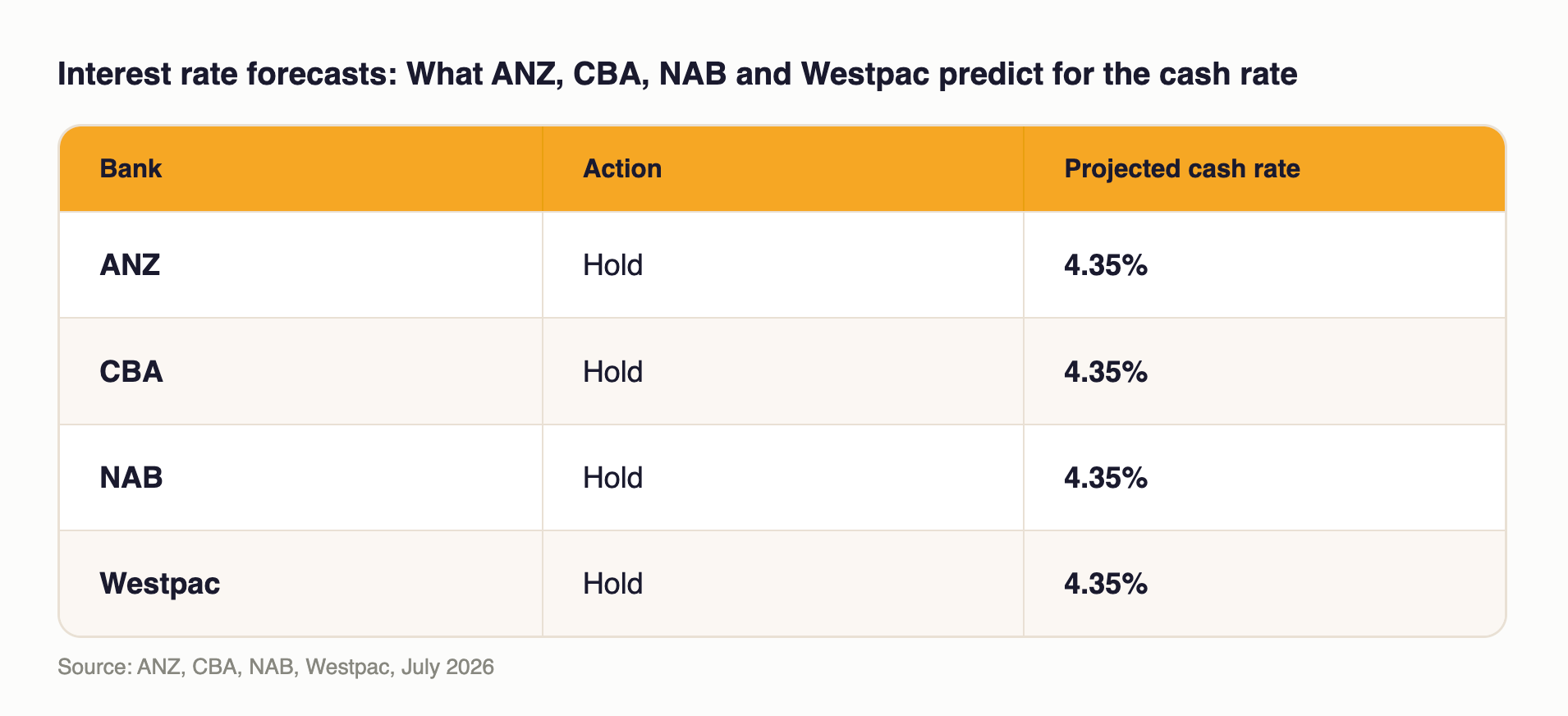
What the Big Four Banks Are Predicting for the Cash Rate
All four major banks are currently forecasting the RBA to hold the cash rate at 4.35%. Rate cuts are tipped for 2027, with CBA forecasting a minimum of two cuts. When those cuts arrive, borrowing capacity recovers, buyer demand returns, and markets that have been soft through the high-rate period respond quickly.
The investors positioning themselves now are doing so ahead of that recovery rather than waiting for confirmation it has arrived.
Why Sydney and Melbourne Are Different to Every Other Market
National property forecasts are heavily shaped by Sydney and Melbourne. According to the Domain Forecast Report FY2027, Melbourne is expected to see house price falls of 4 to 8%, Sydney 3 to 7%, and Canberra flat to down 4% over the year to June 2027.
That is being averaged against Perth forecast to rise 5 to 9%, Adelaide 4 to 8%, and Brisbane 3 to 7%. The same report forecasts unit prices in Perth to surge 7 to 11%.
Sydney and Melbourne are more sensitive to rate movements because buyers there tend to borrow more and price points are higher. When rates rise, fewer buyers can transact at those levels. When rates fall, demand floods back sharply.
Within both cities, headline medians are distorted by premium suburbs. A correction at the top end does not mean every suburb is falling. The only way to understand what is actually happening is at the suburb level, not the city level.
The Window Most Investors Underestimate
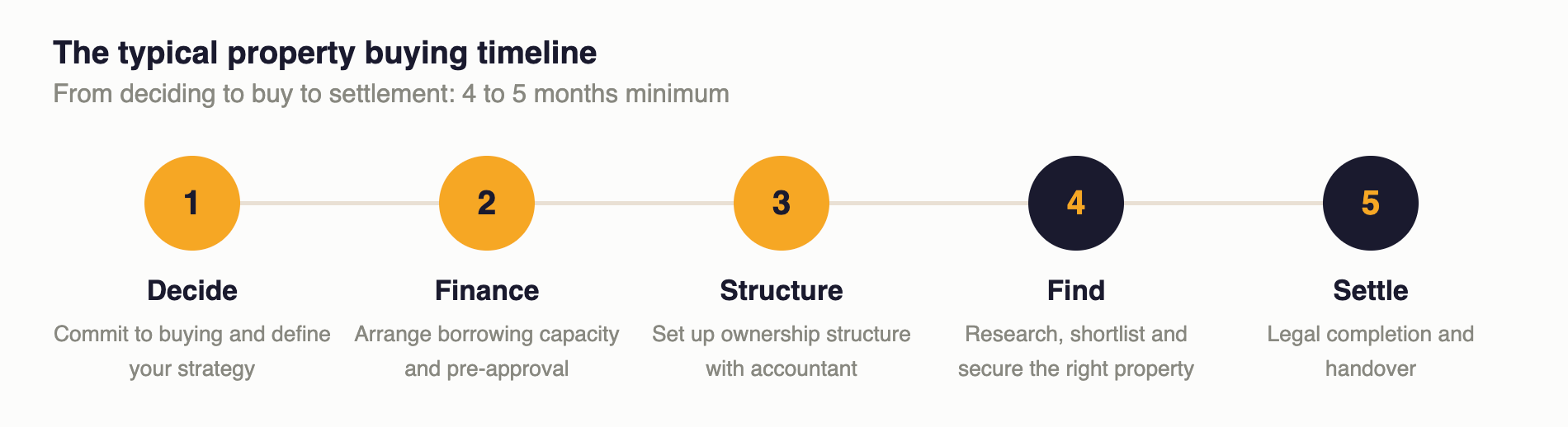
By the time you decide to buy, arrange finance, set up structures, find a property, and settle, you are looking at four to five months minimum. If you are waiting for a dip, the market may already be recovering by the time you get the keys.
On a $700,000 property growing at 5 to 7% annually, every year of waiting costs between $35,000 and $49,000 in foregone capital growth. The cost of hesitation is not zero.
What the 2026 Budget Means for Prices
The REA Group forecast incorporates the expected housing market impact of the 2026 budget changes. Their modelling suggests prices may see a small short-term decrease, rents are expected to increase, and new supply will remain largely unchanged.
The negative gearing changes are a key driver. Losses on established properties purchased after 12 May 2026 now carry forward against future property income rather than offsetting wages immediately, reducing investor appetite for new purchases and contributing to the softening in transaction volumes already visible in the data. The CGT changes compound the effect further, with the existing 50% discount being replaced from 1 July 2027 with cost base indexation and a 30% minimum tax rate on real capital gains
In the medium term, prices are expected to grow but at a slightly lower rate than they would have without the changes. The more significant near-term impact is on transaction volumes rather than prices. Uncertainty suppresses activity. Fewer transactions mean less stamp duty revenue for state governments, which creates its own political pressure to revisit the policy settings.
Rents Are Accelerating Faster Than Anyone Predicted
Rents are the most significant and most underestimated consequence of the budget changes.
The government's own modelling suggested rents would rise by $2 per week. PropTrack data shows they have already risen approximately $20 per week nationally in the two months since the budget. According to Cotality's Rental Review Q2 2026, national rents have accelerated to 5.9% annually with the median national weekly rent now sitting at $705. Every capital city vacancy rate is below 2.0%.
When investor activity falls, rental supply contracts. When rental supply contracts in a market already at record low vacancy rates, rents respond quickly. Historical precedent from 1985 to 1987 points to increases of 10 to 20% or more when investor supply is reduced in undersupplied markets. The situation today is more acute than 1985. The housing construction shortfall is deeper, vacancy is lower, and migration is higher.
Which Markets Are Worth Watching
Based on current forecasts and data, here is how the major markets are tracking:
Sydney and Melbourne are experiencing corrections through the softer period of 2026 before recovering into 2027. These are normal cyclical adjustments in markets digesting rate rises and affordability pressure. Within both cities, affordable suburbs with genuine rental demand are performing very differently to the premium end.
Brisbane, Adelaide, and Perth continue to record strong growth. Annual growth rates of 13% in Adelaide and 20% in Perth in the prior year are moderating to more sustainable levels of 5 to 8%. Moderating from those levels is not a crash. It is a healthy transition to a growth rate that can be maintained over longer periods.
Regional markets continue to outperform capital cities on a combined basis. The affordability advantage, lifestyle appeal, and genuine supply constraints in well-located regional centres are supporting continued demand from both owner-occupiers and investors. Regional markets were up 9.5% year on year to June 2026 according to PropTrack, outperforming the combined capitals significantly.
What This Means for Investors
The forecasts point to transition rather than collapse. Flat to slightly negative conditions in Sydney and Melbourne through the second half of 2026, recovery in 2027, and continued growth into 2028. Stronger conditions in Brisbane, Adelaide, Perth, and regional markets throughout.
For investors already in the right markets, this is consolidation not a crisis. For those yet to enter, reduced competition and more motivated vendors create an entry environment that is more favourable than the headlines suggest.
The market you buy in matters more than the national forecast. The suburb matters more than the city. The asset matters more than both.
Ready to Position Your Portfolio Ahead of the Recovery?
At Search Property, we help Australians cut through the noise and build data-driven investment strategies aligned with long-term wealth goals. Our buyers agents have helped thousands of clients build wealth through property because we focus on fundamentals, not headlines.
Book an investment assessment call with Search Property. We'll discuss your goals and position, and help you build a clear plan to move forward with confidence.
Frequently Asked Questions
Will Australian property prices crash in 2026?
No. The Domain Forecast Report FY2027 expects Melbourne to fall 4 to 8% and Sydney 3 to 7%. Brisbane, Perth, and Adelaide are forecast to keep growing. A correction in two cities while others rise is a diverging market, not a crash.
What do the big four banks predict for interest rates?
All four major banks are currently forecasting the RBA to hold the cash rate at 4.35%. Rate cuts are tipped for 2027 with CBA forecasting a minimum of two cuts. When cuts arrive, borrowing capacity recovers and markets that have been suppressed by high rates respond quickly. The investors moving now are positioning ahead of that recovery.
Why are Sydney and Melbourne falling while other cities are growing?
Higher prices and larger mortgages make both cities more sensitive to rate movements. Brisbane, Adelaide, and Perth have more undersupplied markets with demand still ahead of supply, supporting continued growth.
What is happening to rents and why does it matter for investors?
National rents have already risen approximately $20 per week since the budget despite the government forecasting $2. Rents are now growing at 5.9% annually according to Cotality with every capital city vacancy rate below 2.0%. For investors with quality assets in supply-constrained markets, improving yields are making the cash flow position significantly stronger than it was twelve months ago.
When is the property market expected to recover?
REA Group expects a turning point late in 2026. Domain's chief economist Dr Nicola Powell suggests a gradual recovery from mid-2027. Both expect 2027 to be stronger than 2026 nationally.
Disclaimer: Important Notice for Readers
By reading the content provided on this blog, you acknowledge and agree to the terms outlined in this disclaimer, binding yourself to its provisions unconditionally.
This blog presents information for informational, educational, and general non-advisory purposes only. It's important for you, the reader, to understand that the information provided does not take into account your specific personal, financial, or other circumstances. Consequently, we do not offer legal, financial, investment, or taxation advice, recommendations, or guidance. Before acting upon any information from this blog, you are strongly advised to consult with an independent professional, including legal, financial, taxation, accounting, or other relevant advisors, to verify the information’s relevance to your particular situation.
The information is provided in good faith, derived from sources believed to be reliable. However, we do not guarantee the accuracy, completeness, or applicability of the information to your individual circumstances, needs, objectives, or financial situation. The information may be selective and has not been independently verified. Therefore, it should not be the sole basis for any decision-making.
We expressly disclaim any liability for errors, omissions, or inaccuracies in the information, as well as any direct or indirect losses, damages, or expenses that arise from relying on our content, regardless of the cause, including negligence or other factors. Your engagement with this blog is entirely at your own risk.
Please be aware, we do not hold an Australian Financial Services Licence as defined by section 9 of the Corporations Act 2001 (Cth), nor are we authorised to provide financial services, and we have not provided financial services to you.
Disclaimer: Search Property Pty Ltd (SP) does not provide financial or investment advice and does not hold a financial services license as defined in the Corporations Act 2001 (Cth). Any advice given by SP is general in nature and does not take into account your personal circumstances or objectives, financial situation or needs.



.png)




.png)


