Which Australian Property Markets Are Worth Investing In Right Now
Every week the same question comes up: where should I buy in 2026?
The answer is that it depends on your numbers. Not the headlines. Not what your friends and family think.
Your borrowing capacity, your cash flow, your risk profile, and your timeline are what actually determine which markets make sense for you. Here is a snapshot of what the data is showing right now across Australia's key property markets, and what it means for investors trying to make sense of the current environme
When there are not enough homes for the number of people who want them, prices go up. When there are too many, prices stagnate or fall.
Right now in Australia, we are in a significant undersupply, and it is getting worse, not better.
Australia needs around 240,000 new dwellings per year to keep pace with population growth. We are tracking closer to 180,000. Monthly approvals are running roughly 18% below what is needed. New South Wales alone is only building around two-thirds of the homes it requires.
Higher-density approvals have fallen 44.2% over the past year. Private sector house approvals are holding up, rising 1.1% in January 2026. The apartment pipeline is collapsing while demand keeps growing. That gap is where opportunity lives for investors who understand it.
Construction costs compound the problem further. Building a new home today costs around 50% more than it did in 2018 and 2019. Build times have hit record highs. Completions are running at around 177,000 per year, still well short of the 240,000 needed.
Where the Markets Stand Right Now
The report provides a detailed breakdown of every major Australian market. Here is a high-level picture of where things stand:
Regional Queensland continues to show the strongest macro tailwinds nationally. Interstate migration is flowing in at record rates. Vacancy rates across multiple centres sit below 1%. Entry points in the $500,000 to $800,000 range still exist in areas where demand consistently outpaces supply.
Brisbane is being shaped by the 2032 Olympics, with billions in infrastructure investment flowing through the city. Cross River Rail, Brisbane Metro, and stadium upgrades are reshaping liveability and connectivity. Rents have surged 86.1% in total value growth over five years.
Perth has run hard, with median house prices now passing $1 million after 22% annual growth. The fundamentals are genuine but entry point matters more now than it did two years ago. Suburb selection is critical.
Adelaide has delivered 75% growth since 2020 but yields are now compressing as values have outpaced rental growth. Annual rental growth has slowed to 3.5%, down from double digits in prior years. It remains a solid long-term hold market for those who buy at the right price.
Regional Victoria is a market where negative government sentiment is creating opportunity for investors who can look past the noise. Mildura was one of the best performing markets in all of Australia over 2025, delivering 19.7% annual growth. When sentiment is low but fundamentals are strong, that is typically when the smartest money moves.
The full report also covers Melbourne, Sydney, Canberra, Hobart, and Tasmania, along with a detailed breakdown of one market we are actively avoiding and the reasons why.
The Biggest Mistakes Investors Make in 2026
The report identifies seven patterns that consistently cost investors time, money, and opportunity. A few worth flagging here:
Buying in a hotspot without suburb-level research. A region trending in the media is not a strategy. Growth varies street by street. Macro-momentum means nothing if the specific asset does not stack up.
Chasing yield only - high yield in isolation often signals low capital growth potential. The most powerful wealth-building comes from combining both, not sacrificing one for the other.
Buying the cheapest property in the state - cheap entry rarely means value. Low-price markets often lack the population, employment, and infrastructure needed to drive sustained demand.
Selling too early - transaction costs on the way in, on the way out, and getting back in again can wipe out years of gains. Patience is one of the most powerful tools in property investing.
The Framework We Use to Assess Any Market
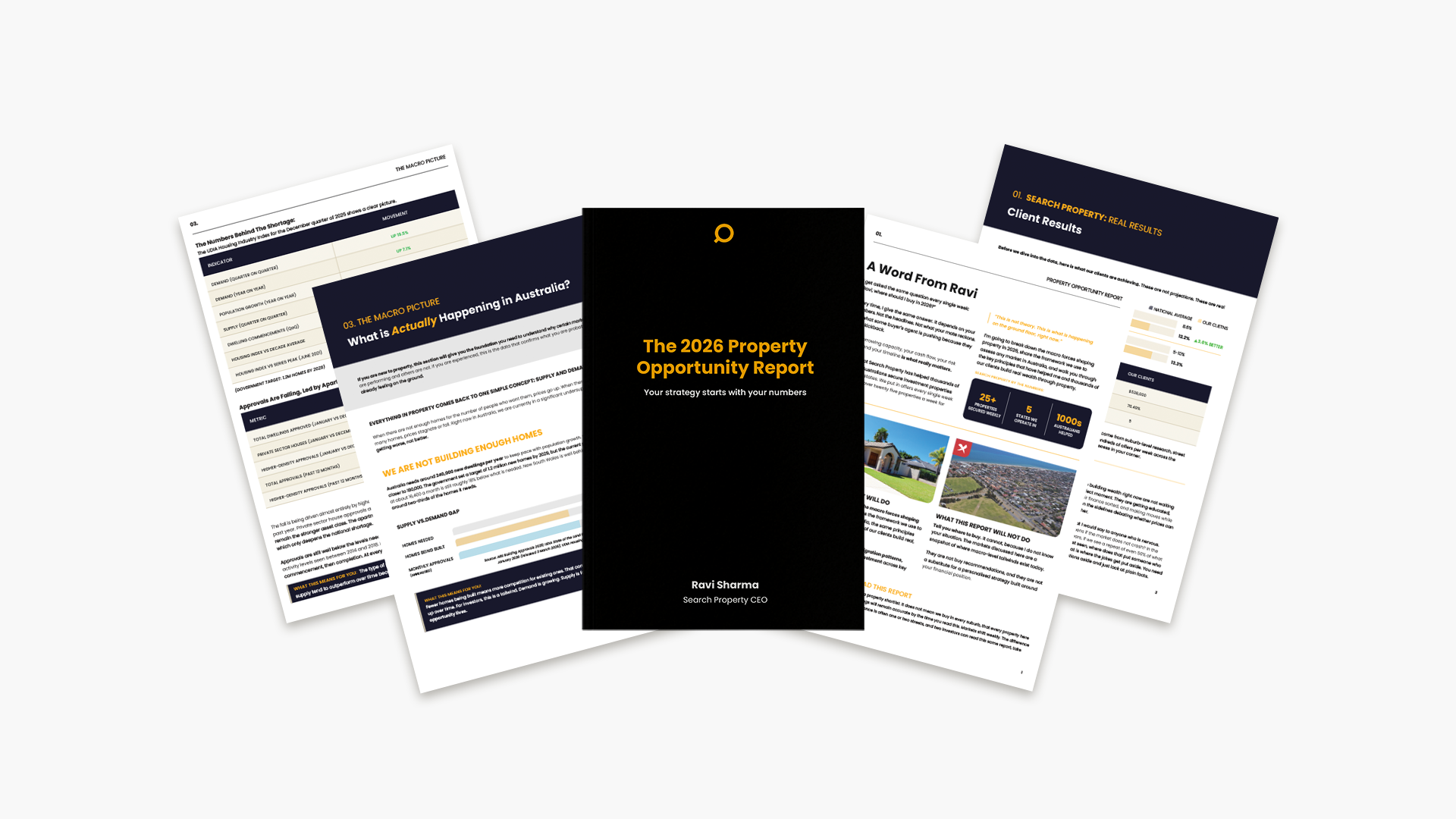
The report includes the full framework Search Property applies when evaluating every market in Australia. It covers supply constraints, population and migration patterns, rental tightness, affordability corridors, infrastructure and jobs, replacement cost, market speed, and cycle position.
When multiple indicators line up, that is when we move. That is how we identify suburbs entering their growth phase rather than those already at their peak.
The part most reports leave out is this: even when the macro indicators are perfect, the property still has to fit your numbers. A market can be the top performer in the country and still be the wrong move for you if it stretches your cash flow too thin or does not align with your risk profile.
What Our Clients Are Achieving
Search Property clients are currently achieving an average annual capital growth of 12.2% compared to the national average of 8.6%. Capital growth in the first 12 months for client purchases is averaging 13.3% against a national benchmark of 5% to 10%.
These results come from suburb-level research, street-level due diligence, and a team of over 40 full-time staff executing hundreds of offers per week across the country.
Download the Full 2026 Property Opportunity Report
This blog is just a snapshot. The full PROPERTY OPPORTUNITY REPORT goes deeper across every market, includes the complete framework, breaks down key principles for 2026, and walks through the step-by-step process our team uses to build personalised investment strategies for everyday Australians.
If you are serious about understanding where the opportunities are in 2026 and how to position yourself to take advantage of them, the full report is where to start.
From there, the next step is a conversation. Book a FREE investment assessment call with Search Property. We'll review your financial position, discuss your goals, and help you build a clear plan to move forward with confidence.
Disclaimer: Important Notice for Readers
By reading the content provided on this blog, you acknowledge and agree to the terms outlined in this disclaimer, binding yourself to its provisions unconditionally.
This blog presents information for informational, educational, and general non-advisory purposes only. It's important for you, the reader, to understand that the information provided does not take into account your specific personal, financial, or other circumstances. Consequently, we do not offer legal, financial, investment, or taxation advice, recommendations, or guidance. Before acting upon any information from this blog, you are strongly advised to consult with an independent professional, including legal, financial, taxation, accounting, or other relevant advisors, to verify the information’s relevance to your particular situation.
The information is provided in good faith, derived from sources believed to be reliable. However, we do not guarantee the accuracy, completeness, or applicability of the information to your individual circumstances, needs, objectives, or financial situation. The information may be selective and has not been independently verified. Therefore, it should not be the sole basis for any decision-making.
We expressly disclaim any liability for errors, omissions, or inaccuracies in the information, as well as any direct or indirect losses, damages, or expenses that arise from relying on our content, regardless of the cause, including negligence or other factors. Your engagement with this blog is entirely at your own risk.
Please be aware, we do not hold an Australian Financial Services Licence as defined by section 9 of the Corporations Act 2001 (Cth), nor are we authorised to provide financial services, and we have not provided financial services to you.
Disclaimer: Search Property Pty Ltd (SP) does not provide financial or investment advice and does not hold a financial services license as defined in the Corporations Act 2001 (Cth). Any advice given by SP is general in nature and does not take into account your personal circumstances or objectives, financial situation or needs.

.png)

.png)
.png)

.png)
.png)
.png)
.png)
.png)

