The CGT Changes Are Coming. What They Mean for Your Investment Property.
On 12 May 2026, the Federal Government handed down a budget that changed the rules for Australian property investors. The most significant change is the reform to capital gains tax. From 1 July 2027, the 50% CGT discount that has applied to assets held longer than 12 months is replaced with cost-base indexation and a 30% minimum tax rate on real gains.
If you own investment property, are considering selling, or are thinking about buying, understanding exactly how these changes affect your position is very important.
The current system is straightforward. Hold an asset for more than 12 months and the ATO taxes only 50% of your capital gain. If your property grew by $200,000, you pay tax on $100,000 at your marginal rate.
From 1 July 2027, that changes to indexation. Your purchase price is uplifted by CPI over the holding period and only the gain above inflation is taxed. This is how CGT worked in Australia between 1985 and 1999 before the Howard government introduced the 50% discount.
In addition, a 30% minimum tax rate now applies to real gains accruing after 1 July 2027. Even in a low-income year where your marginal rate might be lower, you will not pay less than 30% on those gains.
For property investors in a moderate growth environment, the practical difference between the old system and the new one is relatively contained. If your property grew 6% and inflation ran at 3%, you pay tax on the 3% real gain rather than 50% of the 6% nominal gain. The outcomes are broadly similar.
The bigger impact is for high-growth assets in markets that significantly outpace inflation, where the gap between nominal and real gains is large. Investors who bought in Perth, Brisbane, or Adelaide during the peak growth years and are planning to sell after 1 July 2027 need to model their position carefully.
How the Transitional Rule Works
Assets bought before 1 July 2027 and sold after are not simply caught by the new rules. There is a transitional arrangement that splits your gain at 1 July 2027.
The ATO uses a market value at 1 July 2027 as the split point. Gains accrued up to that date are taxed under the existing 50% discount. Gains accrued after that date are taxed under indexation with the 30% minimum floor.
You can either obtain a formal valuation as at 1 July 2027 or use the ATO's apportionment formula, which back-calculates the split from your actual growth rate over the holding period.
The practical implication is clear. The longer you have held your property before 1 July 2027, the more of your total gain falls under the favourable 50% discount rather than the new rules. Investors who bought five or ten years ago have a significantly more favourable transitional position than those who bought in 2025 or 2026.
What Is Not Changing
Before making any reactive decisions, it is worth being clear about what the budget did not touch:
The main residence exemption remains fully intact
SMSFs and superannuation funds are excluded from both the CGT and negative gearing changes
Small business CGT concessions are retained with the threshold lifted from $2 million to $10 million in annual turnover
The 60% CGT discount for affordable housing is retained
Widely-held managed investment trusts are unaffected
Companies are excluded from the CGT changes
Testamentary trusts used to manage deceased estate income are exempt from the 30% minimum trust distribution tax
If you hold investment property inside an SMSF, nothing changes for that structure. If your primary concern is your family home, the main residence exemption continues unchanged.
The Negative Gearing Connection
The CGT reform does not sit in isolation. It sits alongside the removal of negative gearing on established properties purchased after 12 May 2026.
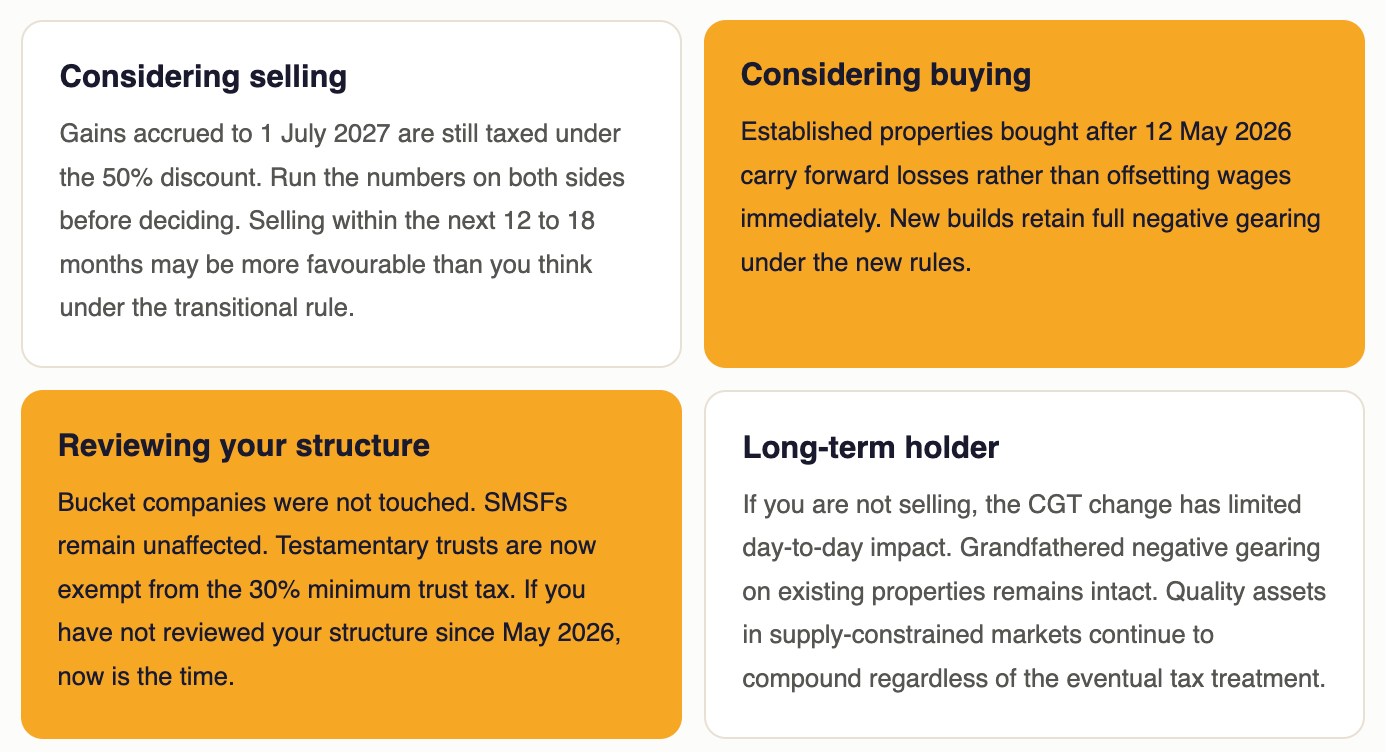
For established residential properties bought after that date, losses carry forward and offset future property income rather than being immediately deductible against wages. Properties exchanged before 7:30pm on 12 May 2026 are fully grandfathered. New builds retain full negative gearing under the new rules.
The combined effect of both changes reshapes the after-tax economics of established property investment in a meaningful way. Not fatally, but enough to make structure and asset selection more consequential than they were before May 2026. Investors who get both right will continue to build wealth through property. Those who do not will find the new environment significantly more costly.
Model Your Position With the Search Property CGT Calculator
To help investors understand exactly how these changes apply to their specific situation, Search Property has created a CGT calculator that models your sale under both the current rules and the new 2027 rules side by side.
Enter your purchase date, sale date, purchase price, sale price, and annual income. The calculator then applies the ATO's apportionment formula to split your gain at 1 July 2027 and shows you the after-tax proceeds, tax payable, and after-tax return under both regimes.
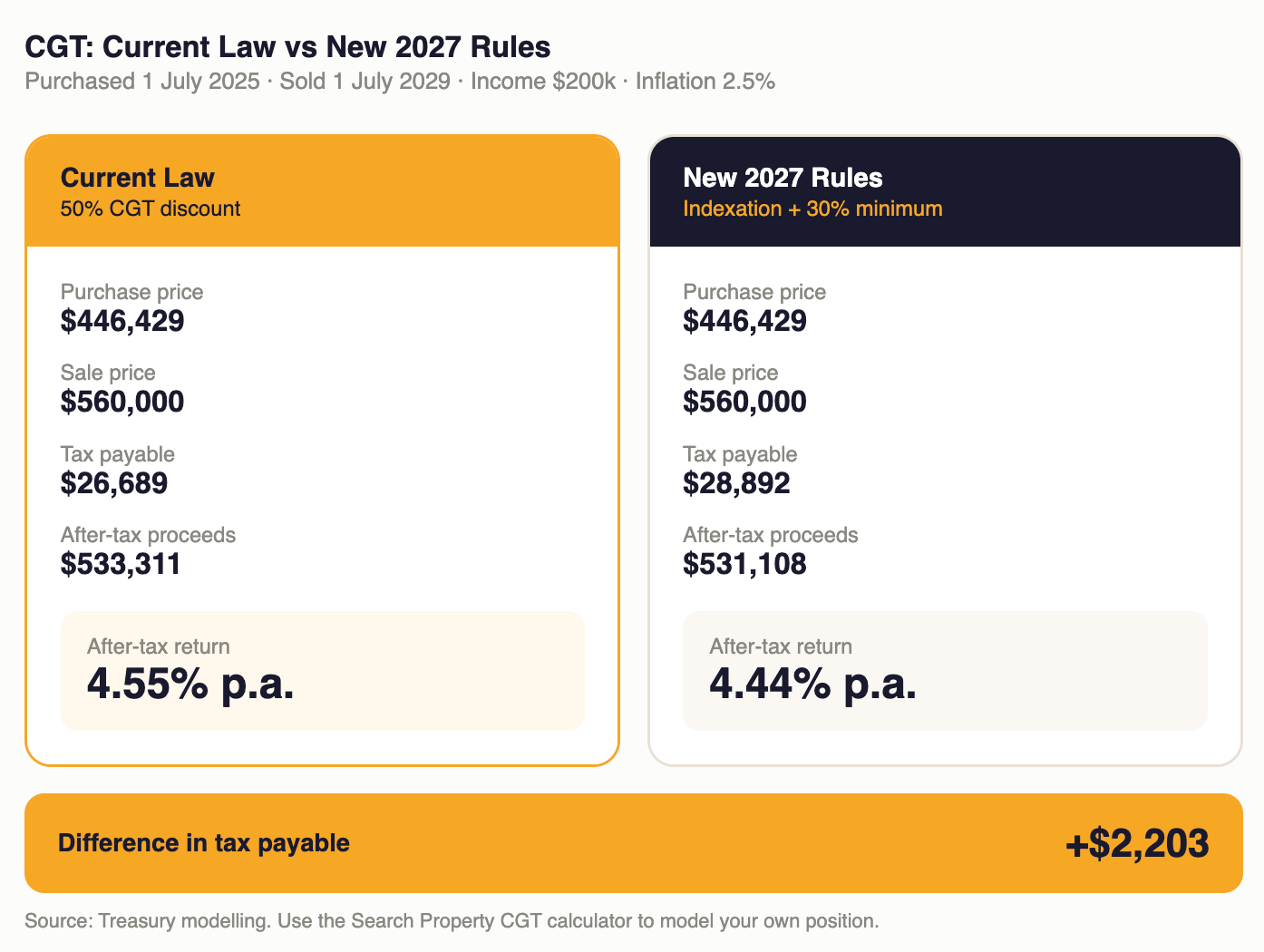
Here is an example using Treasury's own modelling assumptions:
Under current law, tax payable is $26,689 with after-tax proceeds of $533,311 and an after-tax return of 4.55% per year.
Under the new transitional rules, tax payable increases to $28,892 with after-tax proceeds of $531,108 and an after-tax return of 4.44% per year. The difference is $2,203 in additional tax on this specific sale.
For a four-year hold in a moderate growth scenario, the impact is real but manageable. The calculator allows you to adjust holding period, growth rate, income level, and inflation assumptions to model your own position accurately.
What This Means for the Decisions You Are Facing Right Now
The Bottom Line
The 2027 CGT changes are significant. They are not the end of property investment as a wealth-building strategy for Australians.
Property in supply-constrained markets with long-term demand drivers still compounds. Rental income still flows. The structural housing shortage that has underpinned Australian property values for decades has not been resolved by a tax change.
What has changed is the margin for error. The premium on getting the asset selection, the structure, and the timing right has increased. Use the calculator. Model your position. Make decisions based on your actual numbers rather than the headline.
Want to Understand How These Changes Apply to Your Portfolio?
At Search Property, we help Australians cut through the noise and build data-driven investment strategies aligned with long-term wealth goals. Our buyers agents have helped thousands of clients build wealth through property because we focus on fundamentals, not headlines.
Book an investment assessment call with Search Property. We'll discuss your goals, model the new rules against your position, and help you build a clear plan to move forward with confidence.
Frequently Asked Questions
When do the CGT changes start?
The new rules apply to gains accruing from 1 July 2027. Gains accrued before that date on assets you already own are still taxed under the existing 50% discount through the transitional rule. Sales that occur before 1 July 2027 are taxed entirely under current rules.
Are SMSFs affected by the CGT changes?
No. Superannuation funds including SMSFs are excluded from both the CGT and negative gearing changes announced in the 2026 budget. Property held inside an SMSF continues under the same tax treatment as before.
How does the transitional rule work if I sell after 1 July 2027?
Your total gain is split at 1 July 2027. Gains accrued up to that date are taxed under the existing 50% discount. Gains accrued after that date are taxed under the new indexation model with a 30% minimum rate. The split can be calculated using a formal valuation or the ATO's apportionment formula. The Search Property CGT calculator models this automatically.
Is it worth selling before 1 July 2027 to avoid the new rules?
It depends on your specific numbers. For investors with large gains in high-growth markets, selling before 1 July 2027 locks in the full 50% discount on the entire gain. For investors with modest gains or long holding periods, the transitional rule may mean the difference is smaller than expected. Use the CGT calculator to model your position before making any decision.
Does negative gearing still apply after the budget changes?
For properties exchanged before 7:30pm on 12 May 2026, full negative gearing is retained for as long as you hold them. For established properties purchased after that date, losses carry forward rather than being immediately deductible against wages. New builds retain full negative gearing. For a full breakdown read our guide to the 2026 federal budget and what it means for property investors.
Disclaimer: Important Notice for Readers
By reading the content provided on this blog, you acknowledge and agree to the terms outlined in this disclaimer, binding yourself to its provisions unconditionally.
This blog presents information for informational, educational, and general non-advisory purposes only. It's important for you, the reader, to understand that the information provided does not take into account your specific personal, financial, or other circumstances. Consequently, we do not offer legal, financial, investment, or taxation advice, recommendations, or guidance. Before acting upon any information from this blog, you are strongly advised to consult with an independent professional, including legal, financial, taxation, accounting, or other relevant advisors, to verify the information’s relevance to your particular situation.
The information is provided in good faith, derived from sources believed to be reliable. However, we do not guarantee the accuracy, completeness, or applicability of the information to your individual circumstances, needs, objectives, or financial situation. The information may be selective and has not been independently verified. Therefore, it should not be the sole basis for any decision-making.
We expressly disclaim any liability for errors, omissions, or inaccuracies in the information, as well as any direct or indirect losses, damages, or expenses that arise from relying on our content, regardless of the cause, including negligence or other factors. Your engagement with this blog is entirely at your own risk.
Please be aware, we do not hold an Australian Financial Services Licence as defined by section 9 of the Corporations Act 2001 (Cth), nor are we authorised to provide financial services, and we have not provided financial services to you.
Disclaimer: Search Property Pty Ltd (SP) does not provide financial or investment advice and does not hold a financial services license as defined in the Corporations Act 2001 (Cth). Any advice given by SP is general in nature and does not take into account your personal circumstances or objectives, financial situation or needs.

.png)

.png)




.png)


