Every year that your property grows in value, the gap between what it is worth and what you owe widens. Most Australian property owners watch that gap grow without ever deploying it. They save a second deposit from scratch, take years longer than necessary to make their next purchase, and miss years of compounding in the process.
The investors who build serious portfolios are not necessarily earning more or saving harder. They are using the equity their existing assets have already built to fund the next purchase, getting into the market sooner, and compounding across more assets simultaneously.
Equity is the difference between what your property is worth and what you owe on it.
If your property is worth $900,000 and your mortgage balance is $500,000, your equity is $400,000. That $400,000 is not cash sitting in an account. It is value locked inside the asset that most investors leave untouched while they spend years rebuilding a cash deposit for the next purchase.
Not all equity is accessible. Banks will typically lend up to 80% of a property's value without requiring lenders mortgage insurance. The formula for calculating usable equity is:
Using the same example:
Property value: $900,000
80% of property value: $720,000
Mortgage balance: $500,000
Usable equity: $220,000
That $220,000 is the amount you can potentially access and deploy into the next purchase without touching your savings. It is the deposit that your first property built for you.
How to Access It
There are two main ways to unlock equity from an existing property.
Refinancing. You approach your current lender or a new lender and increase your mortgage to reflect the accessible equity. On the example above, a $500,000 mortgage refinanced to $720,000 releases $220,000 in cash that functions exactly like a deposit.
Line of credit or equity loan. Some lenders offer a separate facility secured against your property rather than requiring a full refinance. You draw on it as needed and pay interest only on the amount drawn. This can be more flexible if your existing loan has terms you want to preserve.
The right structure depends on your current loan, interest rates, and how your mortgage broker advises you to proceed. Different lenders apply different serviceability calculations and valuation methodologies. Getting the right broker matters more than most investors realise.
The Numbers: What Equity Can Fund
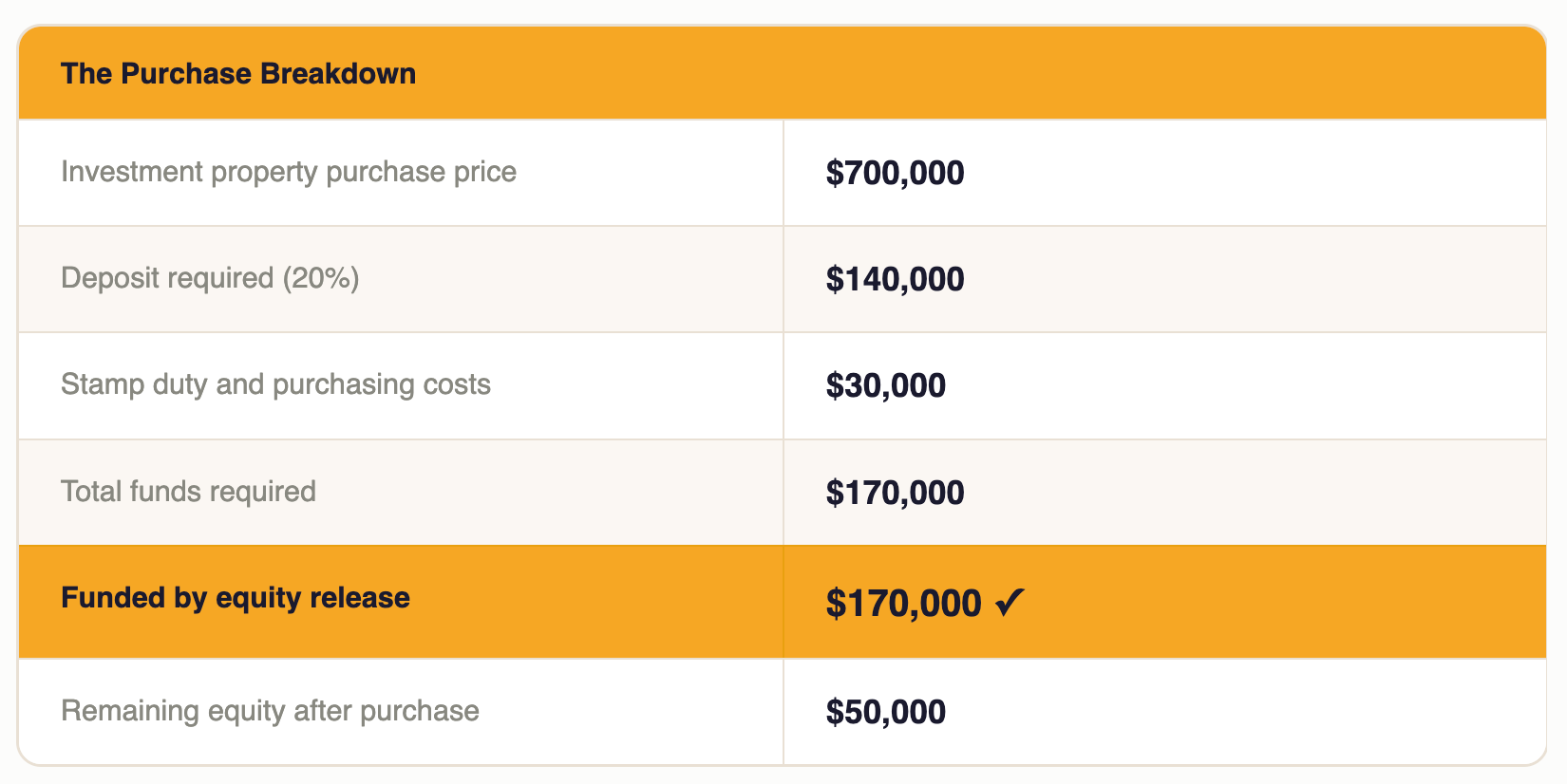
Here is how a $220,000 equity release translates into a second investment property:
No additional savings. No years waiting to rebuild a deposit. The investor now holds two properties with two assets compounding simultaneously.
One Property vs Two: The Compounding Gap
This is where the equity strategy produces results that most investors underestimate.
A single property worth $900,000 growing at 7% annually generates approximately $63,000 in capital growth in year one.
Two properties, one at $900,000 and one at $700,000, growing at the same rate generate approximately $112,000 in year one.
Same income. Same savings rate. Dramatically different wealth trajectory.
Over ten years, the gap between holding one property and two compounds into a substantially different financial position. The equity from both properties continues growing and funds further purchases. Each acquisition accelerates the next. This is the equity snowball.
The Equity Snowball: Using Equity to Buy Multiple Properties
The reason experienced investors build large portfolios faster than most people think possible is the equity snowball.
Property one grows. Equity is accessed. Property two is purchased. Both properties grow. More equity is accessed. Property three is purchased. The cycle continues, and each purchase accelerates the next because the equity base compounds across a growing number of assets. This is how investors use equity to buy multiple properties without ever saving another deposit from scratch. The binding limit is not your savings, it is your serviceability, which is why growing your income during the accumulation phase matters as much as building equity.
Equity and Debt Recycling: The Tax Dimension
One of the most overlooked aspects of accessing equity for investment is the tax treatment.
When you borrow against your home equity to invest in income-producing assets, the interest on that portion of the loan becomes tax deductible. You are converting what was non-deductible home loan debt into deductible investment debt. This is the principle behind debt recycling.
The effect is a simultaneous improvement in your tax position and an acceleration of your wealth-building. Every dollar of equity deployed into investment property is working harder than it was sitting unleveraged in your home.
Speak to a property-specialist accountant before accessing equity to ensure the loan structure captures the full tax benefit available to you.
What the Bank Is Assessing
Accessing equity is not automatic. Banks assess two things before approving an equity release.
Serviceability. Can you service the increased debt? The bank assesses your income, existing debts, and living expenses against the total loan including the new investment debt. Serviceability is the primary constraint on how much equity you can access and how many properties you can hold. This is why growing your income during the accumulation phase matters as much as building equity.
Security. Banks order independent valuations rather than relying on your own estimate or an online calculator. A conservative valuation can reduce the usable equity figure significantly. A mortgage broker who knows which lenders apply the most favourable valuation methodologies can make a material difference to the outcome.
The Risks Worth Understanding
Equity strategies are powerful and they carry risks that are worth understanding clearly.
Property values can fall. If your property declines in value, your equity shrinks. In an extreme scenario you may owe more than the property is worth. Buying in supply-constrained markets with genuine long-term demand drivers significantly reduces this risk.
Debt increases your exposure to rate movements. Each equity release adds to your total debt and therefore your sensitivity to interest rate changes. Holding a cash buffer of at least three to six months of repayments across all properties provides meaningful protection against vacancy or rate rises.
Serviceability becomes the ceiling. As the portfolio grows, your ability to service the debt becomes the binding constraint rather than the deposit itself. Managing cash flow carefully across the portfolio is essential for keeping the snowball moving.
Equity vs Savings: When to Use Each
Savings as a deposit leaves equity intact and unleveraged. Equity as a deposit gets you into the next market sooner without waiting years to rebuild a cash position.
For most investors in the accumulation phase, deploying equity into the next purchase produces a stronger long-term outcome than waiting. The compounding effect of getting into the market earlier typically outweighs the additional debt taken on to access the equity.
Whether that approach suits your specific situation depends on your income, borrowing capacity, tax position, and goals. A mortgage broker and accountant who understands investment lending should be involved in that assessment before any decision is made.
Ready to Find Out How Much Equity You Can Access?
At Search Property, we help Australians cut through the noise and build data-driven investment strategies aligned with long-term wealth goals. Our buyers agents have helped thousands of clients build wealth through property because we focus on fundamentals, not headlines.
Book an investment assessment call with Search Property. We will discuss your equity position, your borrowing capacity, and the markets that give your next purchase the strongest foundation for long-term growth.
Frequently Asked Questions
How much equity do I need to buy an investment property?
As a general rule you need at least 20% of the investment property's purchase price plus purchasing costs including stamp duty and legal fees. Using the formula property value multiplied by 80% minus your mortgage balance gives you your usable equity. On a $900,000 property with a $500,000 mortgage that is $220,000 in usable equity, enough to fund the deposit and costs on a property priced at approximately $650,000 to $700,000.
Does it matter whether I use refinancing or a line of credit?
Both release the same equity but through different structures. Refinancing replaces the existing loan with a larger one. A line of credit sits alongside it as a separate facility. The right structure depends on your existing loan terms, the interest rates available, and how your broker advises you to separate deductible investment debt from non-deductible home loan debt for tax purposes.
What if my bank's valuation comes in lower than expected?
A lower valuation reduces your usable equity. If the shortfall is significant, a broker can approach alternative lenders whose valuation methodologies may produce a more favourable result. In some cases it is worth waiting six to twelve months for the property to grow further before accessing equity.
Is the interest on equity I access tax deductible?
The interest on equity accessed and used for investment purposes is generally tax deductible. Interest on equity used for personal purposes is not. Keeping these separate through correct loan structuring from the outset is important. Speak to a property-specialist accountant before accessing equity to ensure the structure captures the full deductibility available.
Can I use equity to buy multiple properties?
Yes. As each property grows, you can access the new equity it creates and use it to fund the next purchase, repeating the process across a growing portfolio. This is the equity snowball. The limit is your serviceability, meaning your ability to service the total debt, rather than your deposit savings.
I only own one property. Is it too early to think about equity?
No. If your property has grown in value since purchase, you may already have usable equity. The first step is understanding your current position. A formal assessment from a mortgage broker who understands investment lending will tell you what is accessible now and what the next purchase could look like.
Disclaimer: Important Notice for Readers
By reading the content provided on this blog, you acknowledge and agree to the terms outlined in this disclaimer, binding yourself to its provisions unconditionally.
This blog presents information for informational, educational, and general non-advisory purposes only. It's important for you, the reader, to understand that the information provided does not take into account your specific personal, financial, or other circumstances. Consequently, we do not offer legal, financial, investment, or taxation advice, recommendations, or guidance. Before acting upon any information from this blog, you are strongly advised to consult with an independent professional, including legal, financial, taxation, accounting, or other relevant advisors, to verify the information’s relevance to your particular situation.
The information is provided in good faith, derived from sources believed to be reliable. However, we do not guarantee the accuracy, completeness, or applicability of the information to your individual circumstances, needs, objectives, or financial situation. The information may be selective and has not been independently verified. Therefore, it should not be the sole basis for any decision-making.
We expressly disclaim any liability for errors, omissions, or inaccuracies in the information, as well as any direct or indirect losses, damages, or expenses that arise from relying on our content, regardless of the cause, including negligence or other factors. Your engagement with this blog is entirely at your own risk.
Please be aware, we do not hold an Australian Financial Services Licence as defined by section 9 of the Corporations Act 2001 (Cth), nor are we authorised to provide financial services, and we have not provided financial services to you.
Disclaimer: Search Property Pty Ltd (SP) does not provide financial or investment advice and does not hold a financial services license as defined in the Corporations Act 2001 (Cth). Any advice given by SP is general in nature and does not take into account your personal circumstances or objectives, financial situation or needs.



.png)

.png)




.png)


