What Can I Realistically Borrow? How Lenders Assess Your Borrowing Capacity
Most people who want to invest in property start with the same question. What can I borrow? The answer is rarely what an online calculator suggests. Calculators use generic assumptions. Lenders use detailed assessments of your income, your spending, your debts, and a deliberately conservative interest rate. Understanding how that assessment works is the fastest way to find out where you stand before you start looking at properties.
Your income. Lenders assess what you earn, and they treat different types of income differently. Base salary is counted in full. Overtime, bonuses, commissions, and casual or self-employed income are often discounted or averaged over a longer period. Rental income from existing properties is not counted at 100% either.
Your expenses. Lenders do not just take your word for what you spend. They compare your declared living expenses against a benchmark known as the Household Expenditure Measure (HEM) and generally use whichever figure is higher. Cutting your spending on paper does not help if the benchmark sits above it.
Your existing debts and commitments. Home loans, car loans, personal loans, and buy now pay later accounts all reduce what you can borrow. Credit cards count based on the limit, not the balance. A card with a $15,000 limit and nothing owing still reduces your capacity.
Your household situation. Children and other dependants increase the living expenses lenders assume, which reduces capacity.
The Stress Test: Why You Are Assessed at a Higher Rate Than You Pay
This is the part that surprises most borrowers.
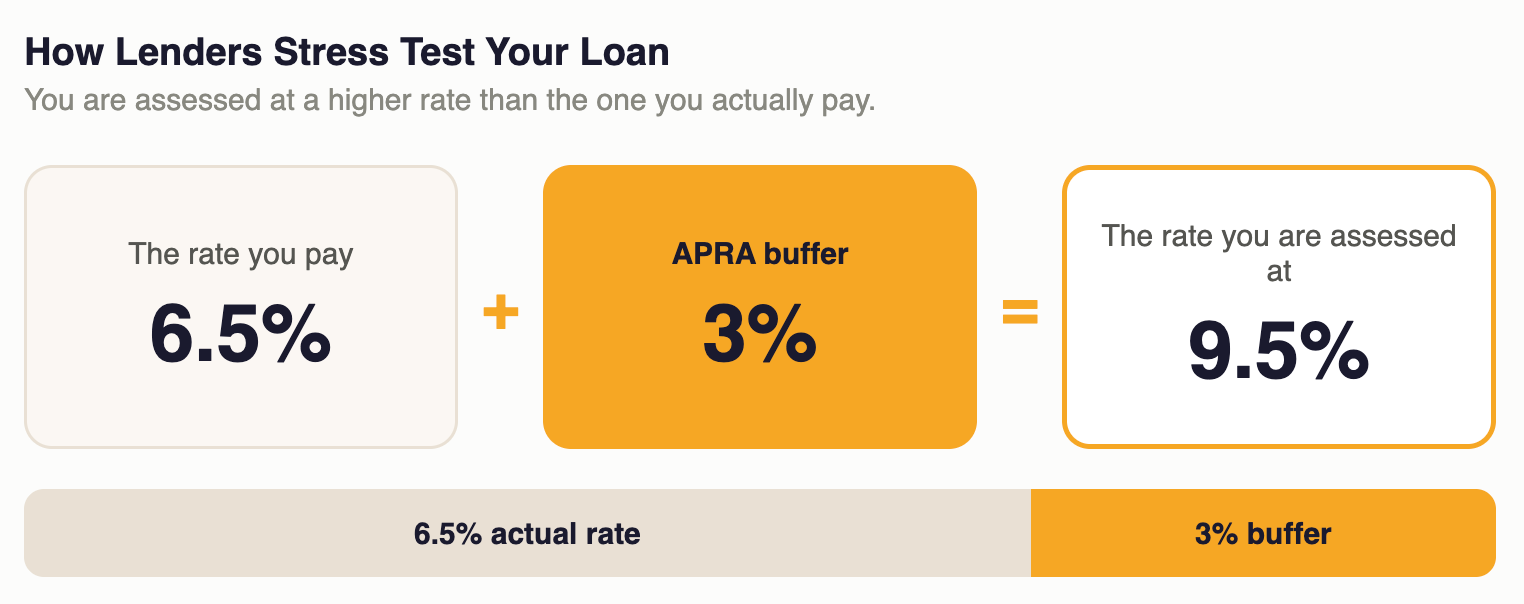
Lenders do not assess you at the rate you will actually pay, they add a buffer. APRA requires lenders to assess a borrower's ability to repay at an interest rate 3 percentage points above the actual loan rate. If your loan rate is 6.5%, you are assessed as if it were 9.5%.
The buffer exists to make sure borrowers can still manage if rates rise or their circumstances change. With the cash rate now at 4.6%, it is doing more work than it was a few years ago.
The effect on borrowing capacity is large. On a $1 million loan, every 1% on the assessment rate is roughly $10,000 a year in interest, which is why small changes in how lenders apply their policies can move your number materially.
What Reduces Your Borrowing Capacity
A few factors quietly cut the number, often without borrowers realising.
Credit card limits, including unused ones
Buy now pay later accounts
Living expenses above the HEM benchmark
Existing loans, particularly those on principal and interest repayments
Variable or irregular income that lenders average down
Having more dependants
Reviewing these before you apply can lift your capacity without earning a dollar more. Closing unused cards and clearing small debts are common first steps.
How Lender Policies Are Shifting
Lenders are adjusting their policies to restore some of the servicing capacity that tighter regulation has taken away. According to a March 2026 report in Broker Daily, brokers are seeing banks look for ways to give servicing back to borrowers while the 3% buffer stays in place.
Rental income shading is easing. NAB reduced the share of rental income it excludes from serviceability calculations from 20% to 10% (plus expenses). On $1,000 a week in rent, that lifts the income counted from $800 to $900. For an investor with existing properties, that can meaningfully increase the amount they can borrow for the next purchase.
Casual income is being treated more flexibly. Several lenders have opened up options for casual income, and Westpac updated its rules around casual employment. The reasoning is that a borrower who has worked casually in the same role for years may have income as stable as many full-time employees.
APRA now limits high debt to income lending. From 1 February 2026, APRA restricted lenders from writing more than 20% of new mortgages to borrowers with debt of six times their income or more. This is a limit on a lender's overall book rather than on any one borrower, and the RBA reports that the share of new high DTI lending remains well below the cap. Even so, it makes lenders more selective with borrowers at the top of that range.
More banks are joining the 5% Deposit Scheme. ANZ became the last major bank to join the government scheme, which lets eligible first home buyers purchase with a deposit as low as 5% (2% for single parents) without paying lenders mortgage insurance. More lenders on the panel can mean faster approvals and more competitive rates for those buyers. The scheme is for first home buyers purchasing a home to live in, rather than for investment purchases.
The takeaway is that the same borrower can receive meaningfully different results from different lenders. Policy details change often, which is why a current assessment matters more than a figure you worked out months ago.
What Lifts Your Borrowing Capacity
Reducing or closing credit card limits
Paying down or clearing personal loans and car loans
Lowering regular spending well before you apply, so your statements reflect it
Applying with a partner who has stable income
Choosing a lender whose policies suit your situation, such as how they treat rental income or casual and self-employed earnings
Using an interest-only period on an investment loan, which can change how repayments are assessed
Lender choice matters more than most people expect. A broker who works across many lenders can match your profile to the one that treats your income most favourably.
Investment Property Adds Another Layer
When you borrow to invest, the assessment gets more detailed.
Rental income is shaded. Lenders count only a portion of expected rent to allow for vacancy and costs, and the share varies by lender.
Your existing portfolio is included. Every loan you already hold is assessed, along with its repayments, which is why capacity can shrink quickly as a portfolio grows.
Loan structure changes the assessment. An interest-only period lowers repayments during that period, but lenders assess you over the remaining principal and interest term, so the benefit is smaller than many expect. A 40-year term can lift capacity a little, though the gain is modest.
Online calculators are a starting point, not an answer. They typically use one set of assumptions, do not apply a specific lender's policy, do not reflect how your income is actually treated, and often understate expenses.
The result is a number that can be too high, which leads to disappointment when a lender assesses you, or too low, which causes you to rule out opportunities you could have pursued. The only reliable figure comes from a formal assessment with a broker who understands investment lending and runs your position through the policies of multiple lenders.
How to Find Out What You Can Realistically Borrow
Gather your documents. Recent payslips, tax returns, bank statements, and details of all existing debts and credit limits.
Tidy up before you apply. Reduce unused credit limits and clear small debts where it makes sense.
Speak to a broker who works across many lenders. At Search Property we work with Refyne Loans for exactly this.
Ask about structure as well as the number. The right loan structure can protect your capacity for the next purchase, not just the first.
Build your strategy around the result. Your real borrowing capacity determines which markets and property types are open to you.
Ready to Find Out What You Can Realistically Borrow?
At Search Property, we help Australians cut through the noise and build data-driven investment strategies aligned with long-term wealth goals. Our buyers agents have helped thousands of clients build wealth through property because we focus on fundamentals, not headlines.
Book aFREE investment assessment with Search Property. We'll look at your position, your borrowing capacity, and the strategy that fits your goals.
Frequently Asked Questions
Why is my borrowing capacity lower than the online calculator said?
Calculators use generic assumptions. Lenders apply a higher assessment rate, compare your expenses against a benchmark, count credit card limits in full, and treat different income types in different ways. These factors combine to produce a lower and more accurate figure.
Do unused credit cards affect how much I can borrow?
Yes. Lenders generally assess the limit, not the balance. Reducing or closing cards you do not use can lift your capacity.
How much rental income will a lender count?
It varies by lender. NAB, for example, now excludes 10% of rental income plus expenses rather than 20%, so on $1,000 a week it counts $900 instead of $800. Because policies differ, the lender you choose can change your result.
Can I borrow if I work casually?
Often yes, and more lenders are opening up to it. Some, including Westpac, have updated how they treat casual income, particularly for borrowers with a consistent history in the same role. The treatment still varies, so it is worth asking a broker which lenders suit your situation.
Does a longer loan term increase how much I can borrow?
Slightly. A longer term spreads repayments over more years, which can raise capacity a little. The effect is modest, particularly when an interest-only period shortens the assessed principal and interest term.
Disclaimer: Important Notice for Readers
By reading the content provided on this blog, you acknowledge and agree to the terms outlined in this disclaimer, binding yourself to its provisions unconditionally.
This blog presents information for informational, educational, and general non-advisory purposes only. It's important for you, the reader, to understand that the information provided does not take into account your specific personal, financial, or other circumstances. Consequently, we do not offer legal, financial, investment, or taxation advice, recommendations, or guidance. Before acting upon any information from this blog, you are strongly advised to consult with an independent professional, including legal, financial, taxation, accounting, or other relevant advisors, to verify the information’s relevance to your particular situation.
The information is provided in good faith, derived from sources believed to be reliable. However, we do not guarantee the accuracy, completeness, or applicability of the information to your individual circumstances, needs, objectives, or financial situation. The information may be selective and has not been independently verified. Therefore, it should not be the sole basis for any decision-making.
We expressly disclaim any liability for errors, omissions, or inaccuracies in the information, as well as any direct or indirect losses, damages, or expenses that arise from relying on our content, regardless of the cause, including negligence or other factors. Your engagement with this blog is entirely at your own risk.
Please be aware, we do not hold an Australian Financial Services Licence as defined by section 9 of the Corporations Act 2001 (Cth), nor are we authorised to provide financial services, and we have not provided financial services to you.
Disclaimer: Search Property Pty Ltd (SP) does not provide financial or investment advice and does not hold a financial services license as defined in the Corporations Act 2001 (Cth). Any advice given by SP is general in nature and does not take into account your personal circumstances or objectives, financial situation or needs.

.png)

.png)
.png)

.png)



.png)

