New Build or Established Property? What Rising Construction Costs Mean
Building a home costs more than it did a year ago, and far more than it did a decade ago. That changes the new build versus established decision in ways that are easy to miss when you compare two listings side by side.
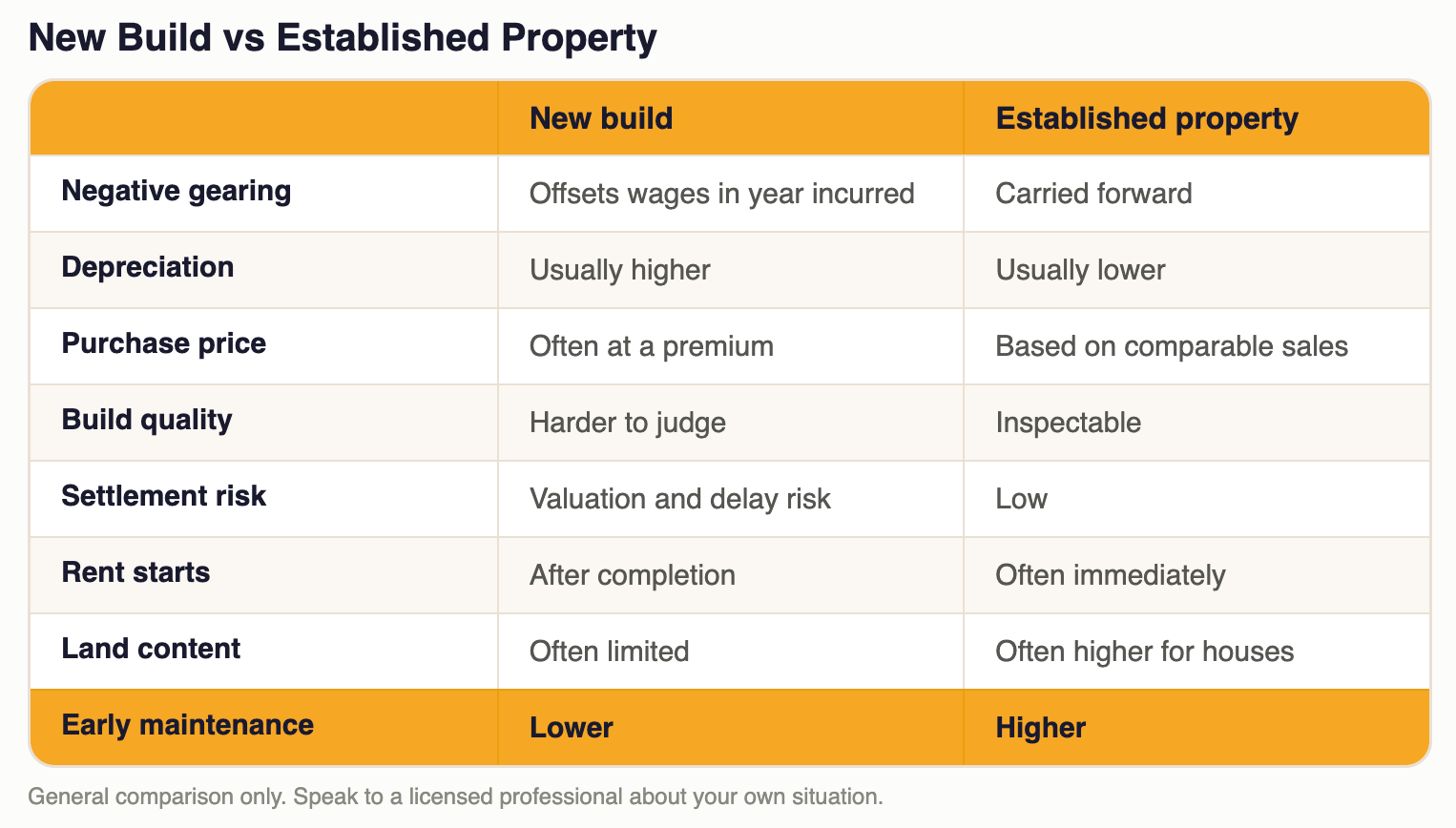
The 2026 tax changes pull the same way. New builds kept full negative gearing, while established properties bought after 12 May 2026 did not. On paper that makes new look attractive, but rising costs, funding pressure, and builder failures add risks the tax treatment does not cover.
According to ABS data cited by Ray White Group’s chief economist:
New dwelling prices were 5.7% higher in the year to July, compared with 0.7% a year earlier
House construction input costs rose 2.1% in the June quarter and 3.8% over the year
Electrical, cable, and conduit costs rose 11.2% in three months
Overall, house construction input costs are around 68% higher than in 2012
For a buyer, higher costs show up in three places.
The price of new stock. When it costs more to build, new homes are priced higher. New builds are often listed at a premium to comparable established properties, and that premium has to be recovered through growth and rent.
The risk that a project stalls. Developers usually need to pre-sell a large share of a project before a bank will fund construction. Higher costs and weaker pre-sales make that harder, and borrowing through an SMSF to buy off the plan is ending for new arrangements, which removes one source of buyers. Construction insolvencies have also reached record levels, and when a builder fails, projects can be delayed or abandoned.
The value of what already exists. When it costs more to build a comparable home than an existing one sells for, established stock has an inbuilt cushion. That varies by suburb and property type, and it does not protect against price falls. It does mean replacing what already exists is getting more expensive.
For established residential properties bought after 12 May 2026, negative gearing losses carry forward against future property income instead of offsetting your wages in the year they occur. Properties exchanged before that date are grandfathered, and new builds keep full negative gearing.
Here is an illustration. Suppose a property runs at a $10,000 annual shortfall and the owner is on a 37% marginal rate.
New build: the loss can be offset against wages in the year it occurs, reducing tax by about $3,700
Established property bought after 12 May 2026: the loss carries forward and offsets future property income, so the benefit arrives later
The deduction is delayed rather than removed. The CGT changes from 1 July 2027 are also worth modelling for either type with an accountant, and our guide to the 2026 CGT changes explains how the transitional rule works.
A tax deduction reduces a loss. It does not turn a weak property into a good one. The tax treatment should be a tiebreaker between two strong options, not the reason to buy.
What a New Build Offers
Full negative gearing. The immediate offset described above.
Higher depreciation. A new building and its fittings usually generate larger deductions than an older property. The rules for second-hand assets are more restrictive, and our investment property tax blog covers what you can claim.
Lower maintenance early on. New materials, modern layouts, and builder warranties reduce repair costs in the first years.
Broad tenant appeal. Modern properties can attract tenants and may suit some investors’ rental strategies.
Where New Builds Carry More Risk
Off-the-plan timing risk. The price is set 12 to 24 months before settlement. If the market softens, the bank’s valuation at settlement can come in below your contract price, leaving you to find the difference.
Developer and builder risk.The collapse of the Bathla Group left construction of more than 2,000 apartments in limbo. Buyers with deposits tied up carry the uncertainty while the project is resolved.
Build quality pressure. Fast, cheap, and high quality rarely come together. If governments and developers push for speed while costs rise, quality can give way, and the shift toward modular building is already under way. Some of it will be good. Independent inspections at key stages matter more.
A price premium. New properties are often priced above established ones nearby, so more of your return depends on growth catching up.
Less land. Land tends to appreciate and buildings depreciate. A new apartment gives you very little land, and a new house and land package in an outer estate may give you more land but in a location with plenty of similar stock.
Local oversupply. Nationally, supply is short. Locally, a precinct with many similar apartments completing at once can still be oversupplied.
Where Established Properties Have the Edge
A known quantity. You can see the street, the build quality, the rental history, and what comparable homes have sold for.
Land content and scarcity. Established houses in supply-constrained suburbs benefit most when demand grows, because new competing stock is limited.
No settlement gap. You buy at today’s price and receive rent from the start, without waiting for construction.
Room to negotiate. In a softer market, vendors are often more motivated than the listing suggests, and off-market stock can reduce competition.
Replacement cost support. As building costs rise, the cost of replicating what already exists rises with them.
The trade-offs are real. Under the 2026 rules, an established property bought after 12 May needs a stronger cash flow position to hold, because losses are carried forward instead of offsetting your wages. Older properties also bring more maintenance and fewer depreciation deductions.
What to Check Before You Buy Either
For a new build:
The builder’s and developer’s track record and financial position
Contract terms, including sunset clauses and what happens if completion is delayed
Whether the project has reached its pre-sale threshold and secured construction finance
How the price compares with recent sales of established homes nearby
How many similar properties are being completed in the same area
Independent inspections at key stages and the warranty cover
For an established property:
A building and pest inspection
The rental history and how current rent compares with the market
Recent comparable sales in the same street and suburb
Upcoming maintenance, and strata costs for units
Land size and what the zoning allows
Which Suits Which Investor?
These are examples to help you think through your own position, not recommendations.
A higher-income investor who values the immediate offset and can tolerate settlement and builder risk may find a new build suits their strategy, provided the location and price are sound.
An investor who prefers a known quality, land content, and room to negotiate may lean toward established, and needs the cash flow to hold the property while losses carry forward.
Either type needs the same foundations. Strong rental demand, constrained supply, and a sensible price matter more than whether the property is new or old.
At Search Property we evaluate every asset on investment fundamentals rather than on whether it is new or established. In our experience, many of the strongest regional opportunities are established homes in growth corridors.
Ready to Choose the Right Property for Your Strategy?
At Search Property, we help Australians cut through the noise and build data-driven investment strategies aligned with long-term wealth goals. Our buyers agents have helped thousands of clients build wealth through property because we focus on fundamentals, not headlines.
Do new builds still get negative gearing after the 2026 budget?
Yes. New builds retain full negative gearing, while losses on established residential properties bought after 12 May 2026 carry forward against future property income. Properties exchanged before that date are grandfathered. Confirm how the rules apply to your purchase with an accountant.
Are new builds a better investment than established properties?
Neither is automatically better. New builds offer tax advantages and lower early maintenance, while established properties offer a known quality, land content, and no settlement gap. Location, rental demand, and price usually matter more than the type of property.
What is the biggest risk of buying off the plan?
Timing and funding. The price is set long before settlement, so the valuation can come in lower if the market softens, and projects can be delayed or cancelled if the developer cannot secure finance or if a builder fails.
Why do construction costs affect established property values?
When building a comparable home costs more, existing homes become more expensive to replace, which can support their value. It varies by suburb and property type, and it does not guarantee prices will not fall.
Do new builds have higher depreciation deductions?
Usually, because the building and fittings are new. The rules for second-hand assets are more restrictive. A quantity surveyor’s depreciation schedule shows what you can claim on a specific property.
Disclaimer: Important Notice for Readers
By reading the content provided on this blog, you acknowledge and agree to the terms outlined in this disclaimer, binding yourself to its provisions unconditionally.
This blog presents information for informational, educational, and general non-advisory purposes only. It's important for you, the reader, to understand that the information provided does not take into account your specific personal, financial, or other circumstances. Consequently, we do not offer legal, financial, investment, or taxation advice, recommendations, or guidance. Before acting upon any information from this blog, you are strongly advised to consult with an independent professional, including legal, financial, taxation, accounting, or other relevant advisors, to verify the information’s relevance to your particular situation.
The information is provided in good faith, derived from sources believed to be reliable. However, we do not guarantee the accuracy, completeness, or applicability of the information to your individual circumstances, needs, objectives, or financial situation. The information may be selective and has not been independently verified. Therefore, it should not be the sole basis for any decision-making.
We expressly disclaim any liability for errors, omissions, or inaccuracies in the information, as well as any direct or indirect losses, damages, or expenses that arise from relying on our content, regardless of the cause, including negligence or other factors. Your engagement with this blog is entirely at your own risk.
Please be aware, we do not hold an Australian Financial Services Licence as defined by section 9 of the Corporations Act 2001 (Cth), nor are we authorised to provide financial services, and we have not provided financial services to you.
Disclaimer: Search Property Pty Ltd (SP) does not provide financial or investment advice and does not hold a financial services license as defined in the Corporations Act 2001 (Cth). Any advice given by SP is general in nature and does not take into account your personal circumstances or objectives, financial situation or needs.

.png)

.png)
.png)

.png)
.png)