Australia’s Death of the Middle Class: What It Means for Property
Is the Australian middle class disappearing? The question is no longer limited to housing forums. Households on solid incomes are finding that a home in the city they work in is out of reach, while households that already own property keep building wealth.
“Death of the middle class” is a strong phrase, and it is debated. What the data does show is a widening gap between households that own appreciating assets and households that do not. Here is how that gap forms, why prices keep rising even though most people feel priced out, and what it means if you do not own property yet.
The affordability numbers are real. Sydney is the second least affordable major city in the world, with a typical home costing 13.8 to 14.0 times median household income. Australia is the only country with four capital cities on the list of least affordable major housing markets.
Prices have also risen strongly over the long run. National prices are down 2.7% from their March 2026 peak according to the realestate.com.au Home Price Index, though that follows several years of strong growth, and many markets remain well above where they were.
Those two facts seem to contradict each other. They stop doing so once you look at who is actually buying.
The Price Is Set by the Marginal Buyer, Not the Average One
A median house price describes the middle of all sales. It does not describe the buyer who sets the price. In a market with limited supply, the price is set at the margin, by the buyers who are willing and able to pay the most for the homes available.
Most households cannot compete at that level. A household saving a deposit while rent rises may be priced out of a house at just over $1.6 million, the median in Sydney. That does not push prices down, because they were never the buyers setting the price.
As long as enough buyers can afford the homes on offer, and demand at the margin exceeds supply, prices hold or rise. The relevant question is not whether the average buyer can afford the average home. It is whether enough buyers can afford the homes that are available.
A large share of the country feeling priced out and a market that still clears are not contradictory. They describe different groups of buyers.
Equity Changes Who the Marginal Buyer Is
Increasingly, the marginal buyer is someone who already owns property.
An owner who bought a well-located property several years ago may now hold significant equity. That equity can fund a deposit on a second or third purchase without saving from scratch, which is the mechanism covered in our blog to using equity to buy an investment property.
Compare two households on the same income. One bought a quality property in 2020 and held it through the growth that followed. The other waited. The first now has equity to deploy. The second faces higher prices with nothing behind them and may struggle to afford a single property.
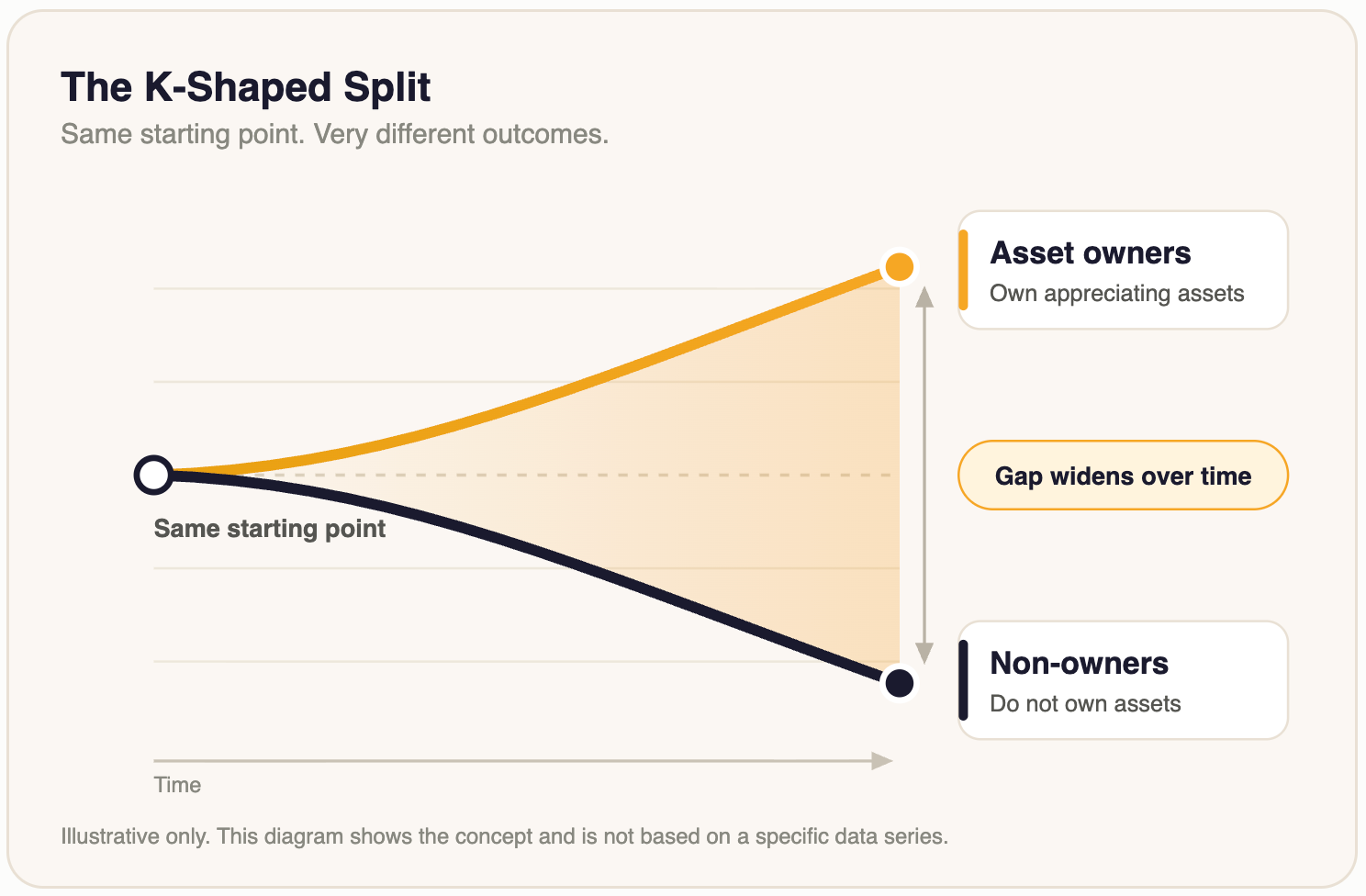
This is why the gap widens. Asset owners compete for property with the benefit of capital growth. Non-owners compete with savings from income. Some economists describe the result as a K-shaped pattern, where people who own assets move up and people who do not fall behind.
Why the Gap Seems to Appear Suddenly
Gaps built on compounding look small for a long time and then look very large.
Property prices and incomes work the same way. A modest difference between price growth and income growth in the early years turns into a large one after a decade. It can feel as though affordability collapsed overnight when it deteriorated gradually. It also explains why the cost of waiting compounds, check out our blog comparing renting versus buying in monthly terms.
Family Wealth Is Widening the Gap
Another factor is the role of family. More parents who own property are helping their children into the market, whether through gifts, guarantor arrangements, or letting them live at home longer to save.
That support keeps demand strong. It also means buyers whose families can help compete against buyers who cannot, which widens the gap between households with property in the family and households without it. It is not a choice anyone makes in the market, and it is not something a first home buyer can control.
What This Does Not Mean
None of this means prices only rise. The cash rate is now 4.6%, lenders assess borrowers at a rate 3 percentage points higher, and tax changes have reduced investor demand. Together these have pushed prices down in several cities.
It also does not mean everyone should buy property, or that buying is the right move for every household. Affordability limits what the marginal buyer can pay, and a market cannot stay expensive indefinitely without buyers who can afford it. The point is narrower. Unaffordability for most households does not automatically mean prices will fall, because the market is set by the buyers who can afford them.
The useful question is not whether the system is fair. It is what your realistic options are.
Understand your actual position. What you can borrow, which markets fit your budget, and how lenders assess you often differs from what you assume.
Consider where you buy, not only whether you buy. Prices in the city you want to live in may be out of reach while markets elsewhere are not. Rentvesting, which means renting where you want to live while investing where the numbers work, is one way households approach this.
Think about the long run. The households that have built wealth through property generally got into the market and stayed in it. That takes time, sacrifice, and trade-offs.
Those trade-offs are personal. Some people decide to put every spare dollar toward a deposit. Others choose to spend on a good life now, and that is a reasonable decision too. Both approaches involve giving something up, and neither is wrong.
Ready to Find Out Where You Realistically Stand?
At Search Property, we help Australians cut through the noise and build data-driven investment strategies aligned with long-term wealth goals. Our buyers agents have helped thousands of clients build wealth through property because we focus on fundamentals, not headlines.
Book a FREE investment assessmentcallwith Search Property. We’ll look at your position, your borrowing capacity, and the strategy that fits your goals.
Frequently Asked Questions
How can housing be unaffordable and prices still rise?
Prices are set at the margin, by the buyers who can afford the available homes, not by the average buyer. When enough buyers can pay and demand exceeds supply, prices can hold or rise even while most households feel priced out.
What is the marginal buyer?
The marginal buyer is the buyer whose willingness and ability to pay sets the price for the homes available. In a tight market that is often someone with equity, dual incomes, or family support.
What is a K-shaped economy?
It describes a pattern where one group moves up and another moves down at the same time. In housing, people who own appreciating assets build wealth, while people who do not own property fall further behind.
Does unaffordability mean prices will fall?
Not automatically. Affordability limits what buyers can pay, and higher interest rates and tax changes have pushed prices down in several cities. Prices can fall further, and nothing in the market guarantees growth.
Is it still possible to build wealth through property in 2026?
Many Australians still do, though the path looks different to previous generations. Options include buying in more accessible markets, rentvesting, using equity from a first purchase, and getting finance and structure right. The right approach depends on your income, borrowing capacity, and goals.
Disclaimer: Important Notice for Readers
By reading the content provided on this blog, you acknowledge and agree to the terms outlined in this disclaimer, binding yourself to its provisions unconditionally.
This blog presents information for informational, educational, and general non-advisory purposes only. It's important for you, the reader, to understand that the information provided does not take into account your specific personal, financial, or other circumstances. Consequently, we do not offer legal, financial, investment, or taxation advice, recommendations, or guidance. Before acting upon any information from this blog, you are strongly advised to consult with an independent professional, including legal, financial, taxation, accounting, or other relevant advisors, to verify the information’s relevance to your particular situation.
The information is provided in good faith, derived from sources believed to be reliable. However, we do not guarantee the accuracy, completeness, or applicability of the information to your individual circumstances, needs, objectives, or financial situation. The information may be selective and has not been independently verified. Therefore, it should not be the sole basis for any decision-making.
We expressly disclaim any liability for errors, omissions, or inaccuracies in the information, as well as any direct or indirect losses, damages, or expenses that arise from relying on our content, regardless of the cause, including negligence or other factors. Your engagement with this blog is entirely at your own risk.
Please be aware, we do not hold an Australian Financial Services Licence as defined by section 9 of the Corporations Act 2001 (Cth), nor are we authorised to provide financial services, and we have not provided financial services to you.
Disclaimer: Search Property Pty Ltd (SP) does not provide financial or investment advice and does not hold a financial services license as defined in the Corporations Act 2001 (Cth). Any advice given by SP is general in nature and does not take into account your personal circumstances or objectives, financial situation or needs.

.png)

.png)
.png)

.png)
.png)
.png)