Property vs Super: How to Build Your Retirement Income
Retirement income usually comes from three places: super, the Age Pension, and any other assets you own. Super is built to be the main source. It is invested for you over decades and can generally only be accessed once you reach preservation age, which is usually 60. The Age Pension is means tested, so the more you hold in assets and income, the less of it you tend to receive. That is where the property versus super question comes from. Super is diversified, tax-concessional, and hands-off. Property gives you control and the ability to borrow, with more concentration.
The Association of Superannuation Funds of Australia, estimates that a comfortable retirement for a single person costs around $55,923 a year. A commonly quoted lump sum target for that lifestyle is $630,000. For comparison, the median Australian super balance across all ages is $60,037. These figures come from our retirement guide, which draws on ASFA, ATO, and CoreLogic data.
A few points matter when you read those numbers.
The median across all ages includes people decades away from retirement, so it is not a fair measure of where someone aged 60 stands.
Many retirees receive some Age Pension, which reduces how much they need to fund themselves.
Your own number depends on whether you own your home, whether you are single or a couple, and what lifestyle you want.
The aim is not to hit a headline figure. It is to work out your number and see how far your current path gets you.
How Super Works
Super is built to be hands-off. Your employer contributes, the money is invested for you, and you generally can access it from preservation age, which is 60 for most people, once you meet a condition of release.
What it offers
Automatic contributions, with no tenants, repairs, or loan repayments
Investment spread across shares, bonds, property, and other assets, depending on the option you choose
Concessional tax treatment, which can be more favourable again once you start drawing an income stream
Professional management, or full control if you run an SMSF
What to weigh
You have limited control over how your money is invested
You generally cannot touch it until you meet a condition of release
Contribution limits and tax settings can change
Fees and investment choice have a large effect over decades
Returns are not guaranteed and can fall
How Property Works
Property suits people who want more control and are comfortable using borrowing. You choose the asset, the location, and how long you hold it.
What it offers
Rental income and capital growth from a tangible asset
Leverage, which lets you control a large asset with a smaller deposit
Control over when to buy, hold, renovate, or sell
Equity in one property that can fund the next purchase
What to weigh
Your money is concentrated in one asset and one location
You carry holding costs, vacancy risk, and interest rate risk. The cash rate is now 4.6%, and lenders assess new borrowers at a rate 3 percentage points above their actual loan rate
Property is not easy to sell in part, and selling has costs
Tax rules for new purchases changed in 2026
You need a deposit and borrowing capacity
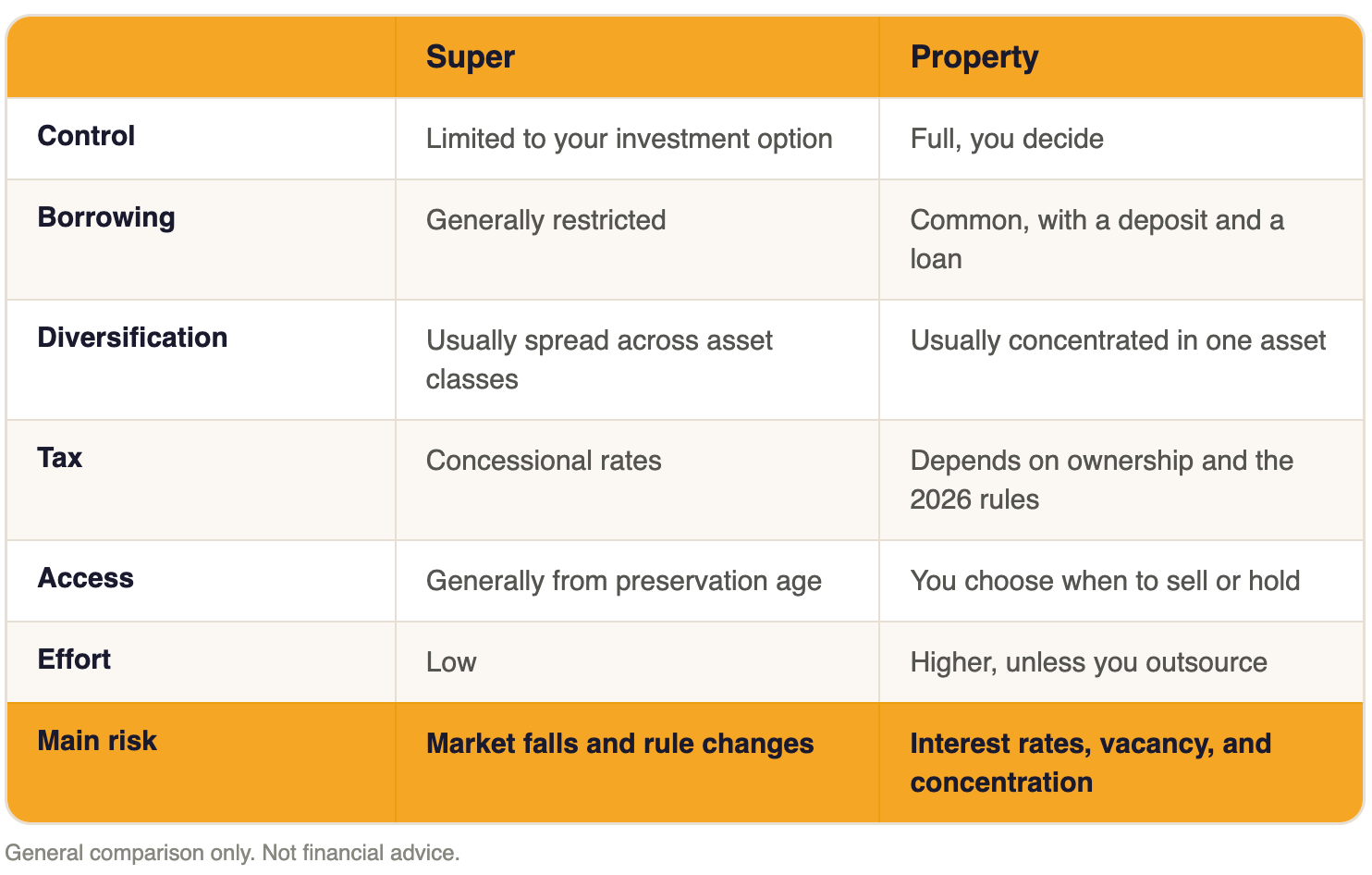
Property vs Super at a Glance
What Changed in 2026
Three changes matter for anyone weighing property against super:
Negative gearing. For established residential properties bought after 12 May 2026, losses carry forward against future property income instead of offsetting your wages. Properties exchanged before that date are grandfathered, and new builds keep full negative gearing.
Capital gains tax. From 1 July 2027, the 50% CGT discount is replaced with indexation and a 30% minimum tax on real gains. A transitional rule splits the gain at that date, so growth before 1 July 2027 is still taxed under the existing discount.
SMSF borrowing. Borrowing to buy residential property through an SMSF has ended for new arrangements. Existing arrangements are grandfathered, and an SMSF can still buy property with cash. Super funds, including SMSFs, were excluded from the negative gearing and CGT changes above.
Three Ways to Close the Gap
If your super is not on track to reach your number, these are the three levers our retirement guide covers.
1. Use equity you already have
If you own a home with equity, you may be able to use it as the deposit on an investment property without saving a new deposit. Usable equity is generally your property value multiplied by 80%, minus your mortgage. Our how to use equity to buy an investment property blog walks through the calculation.
The trade-off is more debt. You need enough income to service it, and a plan to bring it down before you stop working.
2. Build from cash flow
Over time, rents tend to rise while loan balances fall, so many properties improve their cash flow the longer you hold them. The idea is to hold assets that can support your income later, ideally with less debt by the time you retire.
This takes years and is not guaranteed. It works best with a cash buffer of three to six months of repayments and a clear view of what the property needs to earn.
3. Add property through an SMSF
An SMSF lets you hold property inside super. With borrowing ended for new arrangements, a purchase generally needs enough cash already in the fund. Strict rules apply, including that the fund must be run to provide retirement benefits, and there are setup and ongoing compliance costs.
An SMSF is not suited to small balances, and it should only be considered with specialist advice.
Can You Use Both?
Many people do. A common pattern is to let employer super run in the background while an investment property builds equity and income over the same years. The two serve different jobs, one steady and diversified, the other concentrated with more control.
Before deciding how to split your effort, ask yourself:
How many years until I want to stop working?
How much debt can I carry through a rate rise without losing sleep?
What would the property need to earn for the plan to work?
Who is on my team, including a broker, an accountant, and an adviser?
Review the plan regularly, because your income, rates, and the rules will all change.
Ready to See Where You Stand?
At Search Property, we help Australians cut through the noise and build data-driven investment strategies aligned with long-term wealth goals. Our buyers agents have helped thousands of clients build wealth through property because we focus on fundamentals, not headlines.
Neither is better for everyone. Super is hands-off, diversified, and tax-concessional, while property offers more control and leverage but concentrates your money in one asset. Many people hold both. The right mix depends on your timeline, income, and how much risk you can carry.
Can I use my super to buy an investment property?
You generally cannot withdraw super to buy property before you meet a condition of release. An SMSF can hold property, but borrowing to buy residential property through an SMSF has ended, so a purchase needs cash already in the fund. Speak to a specialist adviser before considering it.
How much do I need to retire comfortably?
ASFA estimates a comfortable retirement for a single person costs around $55,923 a year, with a commonly quoted lump sum target of $630,000. Your own number depends on whether you own your home, whether you are single or a couple, and whether you receive part of the Age Pension.
Does the Age Pension change how much I need?
Yes. If you receive some Age Pension, you need to fund less of your retirement yourself. Eligibility depends on your assets and income, so check the current rules or speak to an adviser.
Do the 2026 tax changes affect property held in super?
Super funds, including SMSFs, were excluded from the negative gearing and CGT changes. The separate ban on SMSF borrowing for new residential property arrangements does apply.
Disclaimer: Important Notice for Readers
By reading the content provided on this blog, you acknowledge and agree to the terms outlined in this disclaimer, binding yourself to its provisions unconditionally.
This blog presents information for informational, educational, and general non-advisory purposes only. It's important for you, the reader, to understand that the information provided does not take into account your specific personal, financial, or other circumstances. Consequently, we do not offer legal, financial, investment, or taxation advice, recommendations, or guidance. Before acting upon any information from this blog, you are strongly advised to consult with an independent professional, including legal, financial, taxation, accounting, or other relevant advisors, to verify the information’s relevance to your particular situation.
The information is provided in good faith, derived from sources believed to be reliable. However, we do not guarantee the accuracy, completeness, or applicability of the information to your individual circumstances, needs, objectives, or financial situation. The information may be selective and has not been independently verified. Therefore, it should not be the sole basis for any decision-making.
We expressly disclaim any liability for errors, omissions, or inaccuracies in the information, as well as any direct or indirect losses, damages, or expenses that arise from relying on our content, regardless of the cause, including negligence or other factors. Your engagement with this blog is entirely at your own risk.
Please be aware, we do not hold an Australian Financial Services Licence as defined by section 9 of the Corporations Act 2001 (Cth), nor are we authorised to provide financial services, and we have not provided financial services to you.
Disclaimer: Search Property Pty Ltd (SP) does not provide financial or investment advice and does not hold a financial services license as defined in the Corporations Act 2001 (Cth). Any advice given by SP is general in nature and does not take into account your personal circumstances or objectives, financial situation or needs.