What difference does the number of investment properties make? It is easy to assume you need a large portfolio before it matters. The numbers show that even one or two properties can change your position over time. They also show that more properties bring larger holding costs for years before the benefits arrive.
This blog models one, three, and five properties over 30 years using one set of assumptions, then tests them against a tougher case.
Deposit and costs: 10% deposit ($70,000) plus 5% purchase costs ($35,000), so $105,000 cash per property
Loan: 90% of the price, interest-only, so the debt never falls. That is $630,000 per $700,000 property
Capital growth: 6% a year
Rent: 4% of the purchase price in the first year, growing 4% a year
Running costs: $6,000 a year per property, held flat. This covers rates, insurance, and management
Interest rate: 5.5%
Not included: tax, selling costs, lenders mortgage insurance, and vacancy
Buying timeline:
One property: bought in year one
Three properties: two in year one and the third a year later. The third costs about $742,000, because prices have risen
Five properties: two in year one, then one a year for three years. Total purchase price is about $3.76 million, with about $3.39 million of debt and about $564,000 of cash needed over four years
Buying sooner generally helps, because you have more time in the market and later purchases cost more. In this model a property bought in year four costs about $834,000 instead of $700,000.
What the Numbers Show
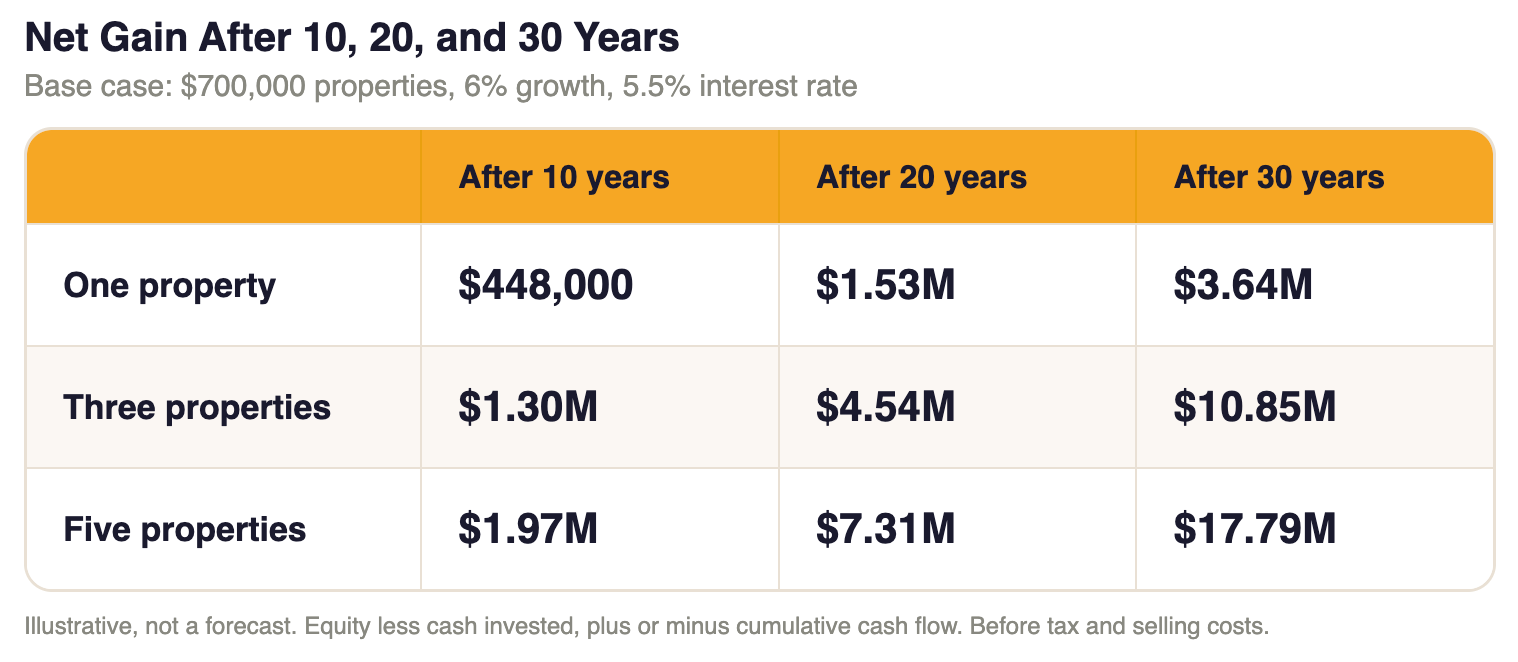
This table shows the net gain at each point. It is equity (value minus loans), less the cash you put in at purchase, plus or minus the cumulative cash flow along the way.
After 10 years, the portfolios are worth about $1.25 million, $3.76 million, and $6.27 million. After 30 years, they are worth about $4.02 million, $12.06 million, and $20.10 million.
Two patterns stand out:
Compounding is slow, then fast. Very little seems to happen in the first ten years, and then the gap between the paths widens. By year 30, three properties produce about three times the net gain of one, and five produce about five times.
The debt shrinks without being paid down. The loans stay the same size, but values rise, so the loan-to-value ratio falls from 90% to about 16% by year 30.
These gains are before tax and selling costs. They are also on paper, so you can only use them by selling or borrowing against them.
Cash Flow: The Part That Takes Years
The gains come with holding costs. Under these assumptions each property starts at a shortfall because the interest is larger than the rent.
One property: about $12,650 a year short at the start, turning positive in year 11, and about $46,700 a year by year 30
Three properties: a peak shortfall of about $36,100 a year, turning positive in year 11, and about $139,600 a year by year 30
Five properties: a peak shortfall of about $55,100 a year, turning positive in year 12, and about $230,600 a year by year 30
By year 30 the rent has outgrown the interest, because the loan stays flat while the rent rises 4% a year. A larger portfolio then gives you choices. For example, you could sell one property and use the proceeds to pay down debt on the others, though that triggers selling costs and capital gains tax.
The early years are what limit most people. Five properties need about $352,000 of cash over the early years, on top of the deposits, before the portfolio pays for itself.
A Tougher Case
The assumptions above are favourable. The interest rate is lower than most loans today, and running costs stay flat for 30 years. Here is what happens with 3% growth, a 6.5% interest rate, and running costs rising 3% a year.
The holding costs are much heavier in this case.
Peak annual shortfalls: about $18,950 for one property, $55,500 for three, and $89,400 for five
Cash flow turns positive: in year 16, year 17, and year 18
Most cash needed over the early years: about $165,000, $500,000, and $850,000
The strategy still produces gains over 30 years, though much smaller. After ten years, five properties have a net gain of only $220,000. National prices are currently down 2.7% from their March 2026 peak, so this case is worth taking seriously.
What the Model Leaves Out
Tax. For established residential properties bought after 12 May 2026, losses carry forward against future property income instead of offsetting your wages. New builds keep full negative gearing. From 1 July 2027, the CGT discount is replaced with indexation and a 30% minimum tax on real gains.
Lenders mortgage insurance. At 90% loan-to-value, LMI applies, and the model does not include it.
Borrowing capacity. Lenders assess you at a rate 3 percentage points above your actual loan rate. Five properties at 90% means about $3.4 million of debt, which very few borrowers can obtain.
Interest-only limits. The model assumes interest-only repayments for 30 years. Interest-only terms are usually limited to a set period, after which repayments can rise.
Yields. Rent grows 4% a year and values grow 6%, so the yield falls over time.
Vacancy and repairs. Real properties have vacancies and unexpected costs.
Spreading the Portfolio
Many investors spread a larger portfolio across states and property types. Each state has its own rules, including stamp duty and land tax, and those rules can change. Properties in neighbouring suburbs also behave more like one property than several.
Spreading takes more research and local knowledge, which is where a buyers agent or other adviser helps. Check out our blog on property diversification for more information.
Questions to Ask Before You Choose
What can you borrow? Get a formal assessment, because it decides how many properties are possible.
Can you carry the peak shortfall? The figures above show how much cash each path needs before it turns positive.
Do you hold a buffer? Three to six months of repayments across all your properties is a common starting point.
Are the properties in supply-constrained markets with real demand drivers? Our cash flow blog shows how to test the numbers.
How long can you hold? The results depend on holding for decades.
Many investors start with one property and add more once they have seen how holding costs and the market behave.
Ready to Work Out How Many Properties Fit Your Plan?
At Search Property, we help Australians cut through the noise and build data-driven investment strategies aligned with long-term wealth goals. Our buyers agents have helped thousands of clients build wealth through property because we focus on fundamentals, not headlines.
How many investment properties do I need to retire?
There is no set number. It depends on your income, your spending, your debt, and how the properties perform. In this model, one property produced about $3.64 million of net gain over 30 years under favourable assumptions, and about $1.02 million in the tougher case.
Is it better to buy one investment property or several?
Several properties can multiply the gains, but they also multiply the holding costs and the debt. In the model, five properties needed about $352,000 of extra cash in the early years in the base case, and about $850,000 in the tougher case.
How much equity could one investment property generate?
Under the base assumptions, one $700,000 property reached about $624,000 of equity after 10 years and about $3.39 million after 30. The tougher case gave about $311,000 and $1.07 million.
Can I buy five investment properties?
It depends on your borrowing capacity. Lenders assess you at a higher rate than you pay, and five properties at 90% means about $3.4 million of debt. Most investors do not reach that number.
Do I need to pay off the loans?
The model assumes you never do, which is why interest-only terms matter. Some investors sell a property later and use the proceeds to reduce debt on the others, though selling brings costs and capital gains tax.
Disclaimer: Important Notice for Readers
By reading the content provided on this blog, you acknowledge and agree to the terms outlined in this disclaimer, binding yourself to its provisions unconditionally.
This blog presents information for informational, educational, and general non-advisory purposes only. It's important for you, the reader, to understand that the information provided does not take into account your specific personal, financial, or other circumstances. Consequently, we do not offer legal, financial, investment, or taxation advice, recommendations, or guidance. Before acting upon any information from this blog, you are strongly advised to consult with an independent professional, including legal, financial, taxation, accounting, or other relevant advisors, to verify the information’s relevance to your particular situation.
The information is provided in good faith, derived from sources believed to be reliable. However, we do not guarantee the accuracy, completeness, or applicability of the information to your individual circumstances, needs, objectives, or financial situation. The information may be selective and has not been independently verified. Therefore, it should not be the sole basis for any decision-making.
We expressly disclaim any liability for errors, omissions, or inaccuracies in the information, as well as any direct or indirect losses, damages, or expenses that arise from relying on our content, regardless of the cause, including negligence or other factors. Your engagement with this blog is entirely at your own risk.
Please be aware, we do not hold an Australian Financial Services Licence as defined by section 9 of the Corporations Act 2001 (Cth), nor are we authorised to provide financial services, and we have not provided financial services to you.
Disclaimer: Search Property Pty Ltd (SP) does not provide financial or investment advice and does not hold a financial services license as defined in the Corporations Act 2001 (Cth). Any advice given by SP is general in nature and does not take into account your personal circumstances or objectives, financial situation or needs.