How to Make Your Property Portfolio Recession-Resistant
No property portfolio is recession proof. What matters is whether you can hold your properties through a downturn without being forced to sell.
A portfolio can look healthy on paper and still be fragile. The weak points are usually small, such as a thin buffer, high borrowing, or one income carrying the shortfall, and they only show up under pressure. This blog covers how to spot them, a worked example of two portfolios with the same properties, and seven ways to build resilience.
Fragility usually comes from several small weaknesses that add up:
A thin cash buffer, so one bad quarter uses up everything
High loan-to-value ratios, which leave little cushion if prices fall
A shortfall that depends on one income, so a job loss would break it
Loans that reprice together, or interest-only periods that end around the same time and push repayments up
Concentration, such as one suburb, one tenant type, one employer, or an oversupplied apartment precinct
Reliance on tax deductions, which is riskier now that losses on established properties bought after 12 May 2026 carry forward instead of offsetting your wages
No protection, such as landlord insurance or income protection
Deferred maintenance, which leads to vacancies and costly repairs
Why Forced Selling Is the Real Risk
Falling prices alone do not sink an investor. Selling into a falling market does.
The RBA’s latest Financial Stability Review found that fewer than 1% of borrowers are in negative equity, and that even if prices fell a further 20%, only around 5% of mortgages would be. Negative equity does not force a sale if you can keep making repayments, though it can limit your ability to refinance or borrow again. The review also points to the labour market as the key factor. A modest rise in unemployment fits an orderly adjustment, while a sharp rise would be what turns a correction into something worse.
A crash is usually associated with rapidly rising unemployment, widespread mortgage distress and forced selling, and impaired credit. So the aim is to be able to hold.
A Stress Test Example
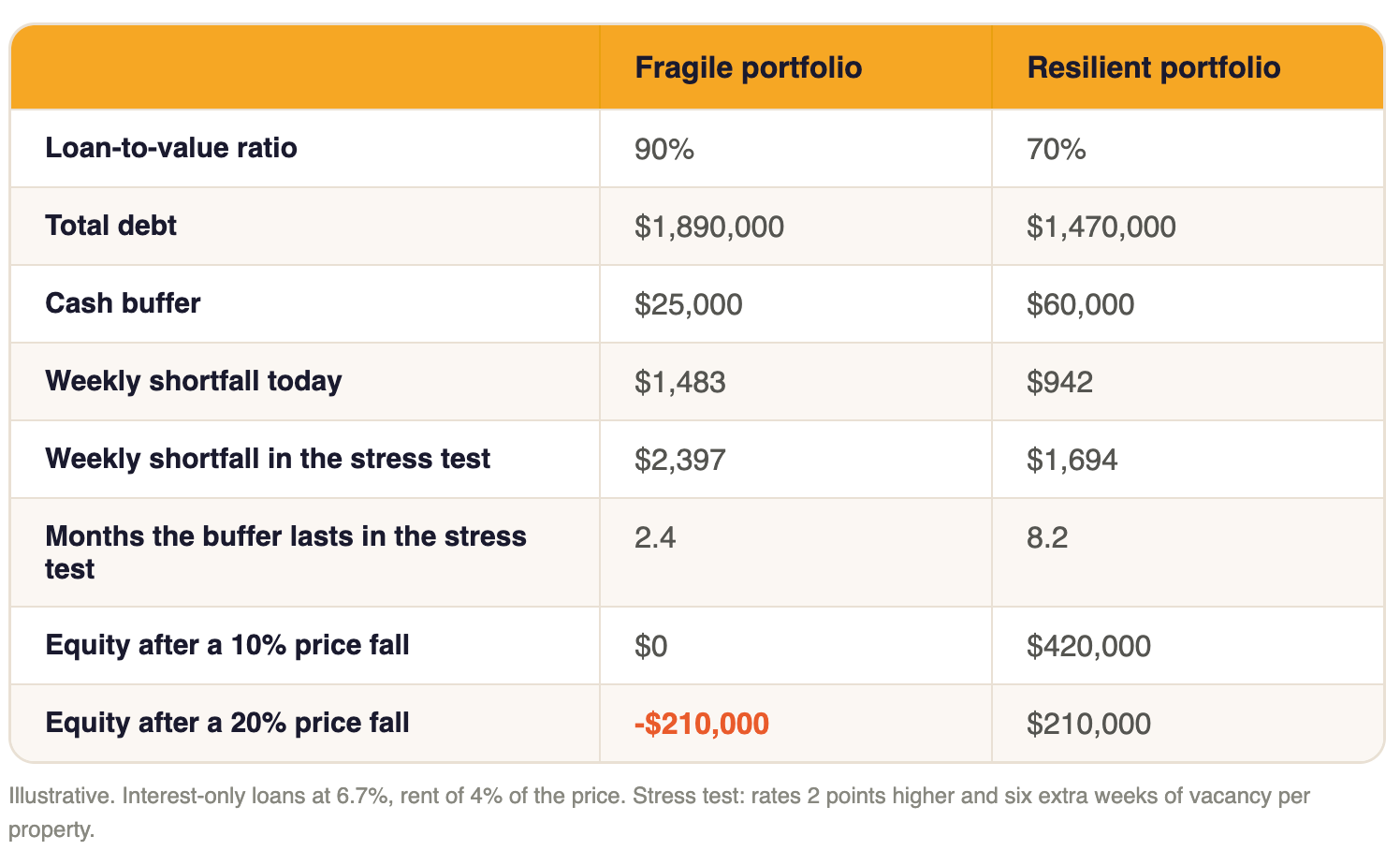
Here are two investors who own the same three $700,000 properties. The difference is how much cushion each one holds.
Assumptions: interest-only loans at 6.7%, rent of 4% of the price ($538 a week per property), and $11,500 a year of other costs per property including a two-week vacancy allowance. The stress test adds a 2 percentage point rate rise, six extra weeks of vacancy on every property, and a fall in prices.
The properties are identical. The difference is leverage and cash, and it changes everything.
The buffer only buys time. Even the resilient portfolio needs about $1,700 a week in the stress test, so the household needs income to carry it. A buffer gives you months to adjust, not years.
The price falls are tests, not forecasts. A 10% fall and a 20% fall are chosen to show how much cushion each portfolio has. They are not predictions. The point is to see whether you could keep holding if values dropped.
This is an illustration. Lenders may not approve 90% loan-to-value across three properties, and lenders mortgage insurance would apply.
Seven Ways to Build Resilience
1. Hold a real buffer. Three to six months of repayments across all your properties is a common starting point, and more is safer when conditions are uncertain. An offset account keeps the cash available while it reduces interest.
2. Keep leverage in check. Leave some borrowing capacity unused, and aim for an equity cushion that survives a fall in prices. Our using equity to buy an investment property blog shows how to see what is usable without overreaching.
3. Improve cash flow. Review rents against the market, check your costs, and ask your broker whether your loan rate is competitive. Know when any interest-only periods end, because repayments rise when they do. Check out this cash flow blog to test the numbers.
4. Diversify. Spread across locations, property types, and tenant bases. Each state has its own rules, and properties in neighbouring suburbs behave more like one property than several. Diversification also reduces risk but it's important to not diversify too early.
5. Own assets with durable demand. Look for strong rental demand, constrained supply, and a diverse local economy. Vacancy is below 2.0% in every capital city according to Cotality’s Rental Review for the June quarter, which supports rents overall, though it does not make every property a good one.
6. Protect your income. Landlord insurance covers risks such as rent default and tenant damage. Income protection and an emergency fund cover you if your own income stops.
7. Maintain and manage well. A good property manager and regular upkeep keep tenants longer, which reduces vacancy and re-letting costs.
If You Are Already Stretched
Work out your real shortfall, including a rate rise and a vacancy.
Speak to your lender early. Lenders have hardship arrangements, and it is easier to use them before you fall behind. Westpac reported offering 42,000 hardship packages this year, and CBA reported more than 147,000 tailored payment arrangements.
Talk to a financial counsellor. The National Debt Helpline offers free advice on 1800 007 007.
Consider your options. Some investors choose to sell one property on their own terms instead of risking a forced sale later. That has costs and tax consequences, so get advice first.
Avoid panic. Selling into a falling market locks in the loss.
Ready to Stress-Test Your Portfolio?
At Search Property, we help Australians cut through the noise and build data-driven investment strategies aligned with long-term wealth goals. Our buyers agents have helped thousands of clients build wealth through property because we focus on fundamentals, not headlines.
Book a FREE investment assessment call with Search Property. We’ll look at your position and how it holds up under pressure.
Frequently Asked Questions
Can a property portfolio be recession proof?
No. Property values and rents can fall in a downturn, and vacancies can rise if tenants lose work. The aim is a portfolio that can hold through one, with a cash buffer, moderate borrowing, and cash flow that still works under stress. A downturn does the most damage to investors who are forced to sell, so the ability to keep paying the loans matters more than any single feature of the properties.
How much cash buffer should I hold?
Three to six months of repayments across all your properties is a common starting point, kept in cash or an offset account, on top of your deposit and purchasing costs. More is safer when rates are rising, your income is variable, or you own several properties.
What is a good loan-to-value ratio for resilience?
There is no single number. A lower ratio leaves more cushion if prices fall. In the example, the portfolio at 90% had no equity left after a 10% fall, while the one at 70% still had $420,000. Lenders also set their own limits, and lenders mortgage insurance applies above 80%. Your own level depends on your income, your buffer, and your goals, and many investors keep some borrowing capacity unused for safety. A broker can show you where you sit.
Does negative equity force me to sell?
No, as long as you keep making repayments and meet your loan conditions. Negative equity means the loan is larger than the property’s value. It matters if you need to refinance, borrow for another purchase, or sell, because a sale would leave a shortfall you would need to repay. The RBA’s Financial Stability Review found that fewer than 1% of borrowers are in negative equity.
What should I do if I cannot cover my repayments?
Speak to your lender early, before you fall behind. Lenders have hardship arrangements, which may include temporary reduced repayments or other changes to your loan, and it is easier to arrange them before arrears build up. You can also contact the National Debt Helpline on 1800 007 007 for free financial counselling. Get advice from your broker and accountant before selling, because selling in a falling market can lock in a loss.
Disclaimer: Important Notice for Readers
By reading the content provided on this blog, you acknowledge and agree to the terms outlined in this disclaimer, binding yourself to its provisions unconditionally.
This blog presents information for informational, educational, and general non-advisory purposes only. It's important for you, the reader, to understand that the information provided does not take into account your specific personal, financial, or other circumstances. Consequently, we do not offer legal, financial, investment, or taxation advice, recommendations, or guidance. Before acting upon any information from this blog, you are strongly advised to consult with an independent professional, including legal, financial, taxation, accounting, or other relevant advisors, to verify the information’s relevance to your particular situation.
The information is provided in good faith, derived from sources believed to be reliable. However, we do not guarantee the accuracy, completeness, or applicability of the information to your individual circumstances, needs, objectives, or financial situation. The information may be selective and has not been independently verified. Therefore, it should not be the sole basis for any decision-making.
We expressly disclaim any liability for errors, omissions, or inaccuracies in the information, as well as any direct or indirect losses, damages, or expenses that arise from relying on our content, regardless of the cause, including negligence or other factors. Your engagement with this blog is entirely at your own risk.
Please be aware, we do not hold an Australian Financial Services Licence as defined by section 9 of the Corporations Act 2001 (Cth), nor are we authorised to provide financial services, and we have not provided financial services to you.
Disclaimer: Search Property Pty Ltd (SP) does not provide financial or investment advice and does not hold a financial services license as defined in the Corporations Act 2001 (Cth). Any advice given by SP is general in nature and does not take into account your personal circumstances or objectives, financial situation or needs.