Can I Afford the Holding Costs of an Investment Property?
Affording the purchase is one thing. Affording the property month after month, on top of your current housing costs, is what decides whether the investment works.
That matters more than usual right now. The RBA raised the cash rate to 4.85% this week, the fifth increase this year. This blog shows how to work out your own number, with a worked example, a rate stress test and ways to ease the load.
Holding costs are what it costs to own the property each year, minus the rent it earns. They include:
Loan interest or repayments, which is usually the largest cost
Council rates and water
Landlord insurance
Property management fees
Maintenance and repairs
Vacancy, meaning rent you do not receive between tenants
Land tax and strata levies, depending on the state and property type
If the costs add up to more than the rent, the difference is a shortfall, which you pay from your own income. If the rent is higher, you have a surplus.
A Worked Example
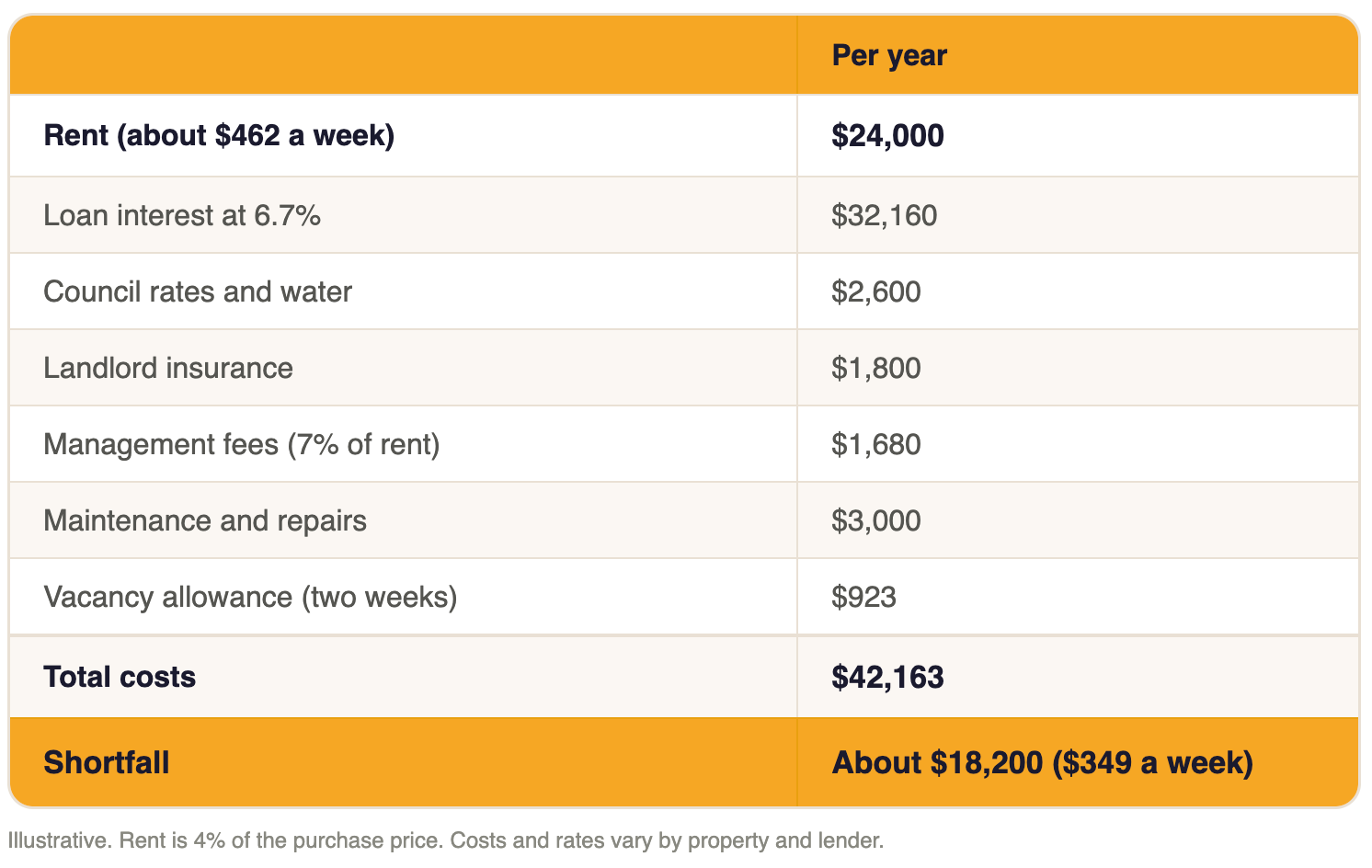
Here is a $600,000 investment property bought with a 20% deposit. The loan is $480,000, interest-only at 6.7%, which is the rate Finder used in its example after the latest hike. Rent is 4% of the price. All of this is illustrative.
An eight-week vacancy instead of two weeks would add about $2,800.
Alongside Your Current Housing Costs
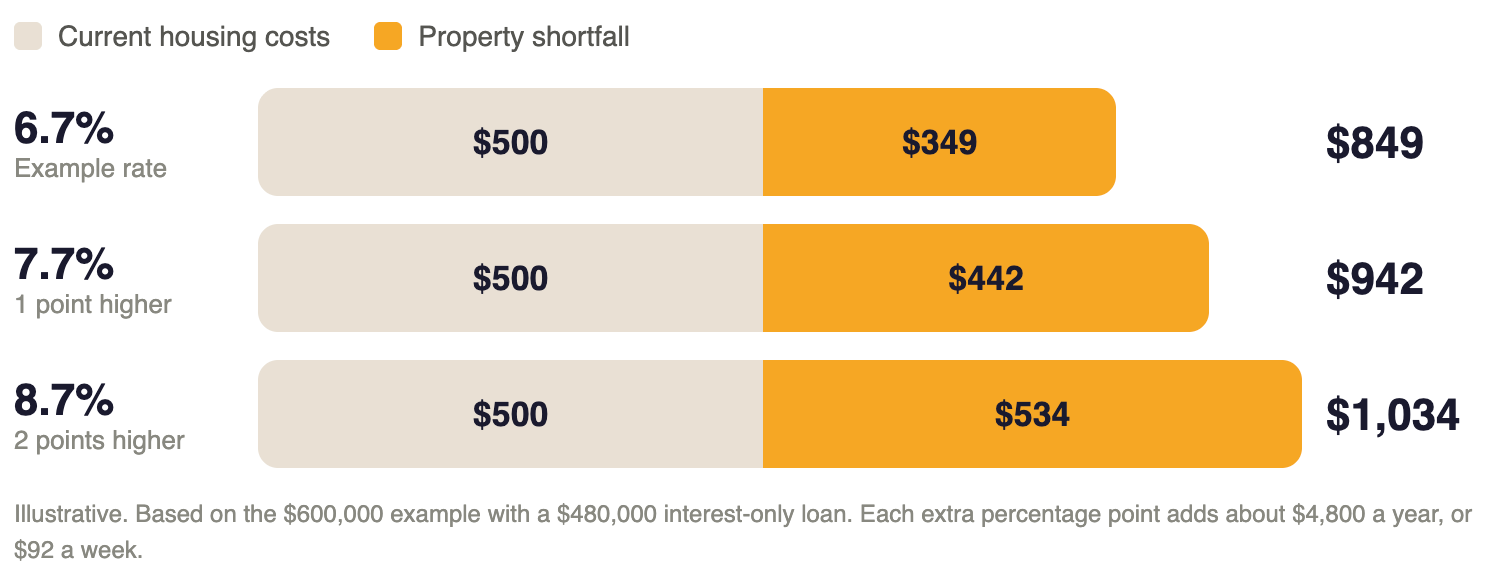
The shortfall is added to what you already pay. Suppose your current housing costs are $500 a week, either rent or home loan repayments. Here is what the total looks like at today’s rate and if rates rise further.
Each extra percentage point adds about $4,800 a year in interest on this loan, or about $92 a week. If you also have a home loan, your own repayments rise with rates too, so both sides of the budget move together.
Cash Out of Pocket vs After Tax
For established residential properties bought after 12 May 2026, losses carry forward against future property income instead of reducing the tax on your wages from 1 July 2027. For these properties, assume the shortfall is cash out of your pocket.
New builds keep full negative gearing. At a 30% marginal tax rate, an $18,200 loss could reduce your tax by about $5,400, leaving about $12,700 as the net cost. Depreciation may add further deductions. Speak to an accountant before relying on any of this.
A Simple Test for Your Own Numbers
Add up your current housing costs per week. Include rent or home loan repayments, rates, and insurance.
Estimate the property’s shortfall. Use a rental appraisal and real quotes for insurance, rates, and management, not assumptions.
Add 2 percentage points to the interest rate and recalculate.
Add your living costs and other commitments.
Ask two questions. Could you pay all of it from income at the higher rate, without touching your savings? And do you hold a buffer of three to six months of repayments across all your properties?
If the answer to both is yes, you have headroom. If it only works by using your buffer, it is tight. If it does not work at all, the answer today is not yet.
If You Own Your Home
You have two loans to carry. Both rise with the cash rate, and lenders count both when they assess you. If you are using equity as the deposit, remember that borrowing more to cover holding costs adds debt on top of debt.
If You Rent
Your rent and the property’s shortfall both apply. Cotality’s latest Quarterly Rental Review shows national rents increased 0.5% in the three months to September, so the rent side of your budget is not fixed either. Some renters choose rentvesting, which means renting where they want to live and investing elsewhere.
Ways to Reduce the Load
Borrow less. A larger deposit or a lower price reduces the interest bill, which is the biggest cost.
Choose the property for rental demand. Yield matters, though quality and growth matter too, so avoid chasing yield alone.
Use an offset account. Cash held in an offset account reduces the interest charged while staying available as a buffer.
Check depreciation. A quantity surveyor’s schedule can identify deductions that many investors miss. Our investment property tax blog covers what you can claim.
Negotiate. National prices are down 2.7% from their March 2026 peak, according to the realestate.com.au Home Price Index, so vendors are often more flexible than the listing suggests.
Consider timing and sequence. Building a larger buffer first, or waiting for your income to rise, can make the same purchase far more comfortable.
Interest-only repayments lower your repayments in the early years. They do not reduce the loan, and lenders assess you over the remaining principal and interest term, so the benefit is smaller than many expect.
When the Answer Is “Not Yet”
Warning signs include:
The shortfall is only affordable by using your buffer
You have no buffer, or less than three months of repayments
Your income is variable, or you carry other debts or large credit card limits
The numbers fail at 2 percentage points higher
Not yet is not never. Building a buffer, paying down debts, reducing credit limits, and reviewing your borrowing capacity can change the result within months.
Ready to Test Your Own Numbers?
At Search Property, we help Australians cut through the noise and build data-driven investment strategies aligned with long-term wealth goals. Our buyers agents have helped thousands of clients build wealth through property because we focus on fundamentals, not headlines.
Book a FREE investment assessment call with Search Property. We’ll look at your position, your borrowing capacity, and what the holding costs would mean for your budget.
Frequently Asked Questions
How much savings should I have before buying an investment property?
Beyond the deposit and purchasing costs, a common starting point is a cash buffer of three to six months of repayments across all your properties. The right amount depends on your income, your debts, and how much rate or vacancy movement you can absorb.
Is negative cash flow normal for an investment property?
It is common in the early years, when the interest on the loan is higher than the rent. Rents tend to rise over time, though that is not guaranteed, and you have to be able to carry the shortfall until then.
Can I use equity to cover holding costs?
It is possible, but it adds debt, and the interest on that debt becomes another cost. Speak to a broker and an accountant before using borrowed money to pay a shortfall.
Does a rate rise mean I should not invest?
Not necessarily. Higher rates raise holding costs and reduce borrowing capacity, while softer prices can give buyers more room to negotiate. The test is whether your numbers still work at a higher rate, with a buffer in place.
Can I afford an investment property on one income?
It depends on the size of the shortfall and your other costs. Run the test above using one income at a rate 2 percentage points higher, and check what a lender will approve.
Disclaimer: Important Notice for Readers
By reading the content provided on this blog, you acknowledge and agree to the terms outlined in this disclaimer, binding yourself to its provisions unconditionally.
This blog presents information for informational, educational, and general non-advisory purposes only. It's important for you, the reader, to understand that the information provided does not take into account your specific personal, financial, or other circumstances. Consequently, we do not offer legal, financial, investment, or taxation advice, recommendations, or guidance. Before acting upon any information from this blog, you are strongly advised to consult with an independent professional, including legal, financial, taxation, accounting, or other relevant advisors, to verify the information’s relevance to your particular situation.
The information is provided in good faith, derived from sources believed to be reliable. However, we do not guarantee the accuracy, completeness, or applicability of the information to your individual circumstances, needs, objectives, or financial situation. The information may be selective and has not been independently verified. Therefore, it should not be the sole basis for any decision-making.
We expressly disclaim any liability for errors, omissions, or inaccuracies in the information, as well as any direct or indirect losses, damages, or expenses that arise from relying on our content, regardless of the cause, including negligence or other factors. Your engagement with this blog is entirely at your own risk.
Please be aware, we do not hold an Australian Financial Services Licence as defined by section 9 of the Corporations Act 2001 (Cth), nor are we authorised to provide financial services, and we have not provided financial services to you.
Disclaimer: Search Property Pty Ltd (SP) does not provide financial or investment advice and does not hold a financial services license as defined in the Corporations Act 2001 (Cth). Any advice given by SP is general in nature and does not take into account your personal circumstances or objectives, financial situation or needs.