What the RBA's August 2026 Chart Pack Says About Australian Property
Every month the Reserve Bank of Australia publishes a chart pack summarising macroeconomic and financial market conditions across the Australian economy. The August 2026 edition contains some of the most important data points available for property investors trying to understand where the market is heading and why.
Here is what the numbers are saying.
The Economy Is Growing but Households Are Feeling It
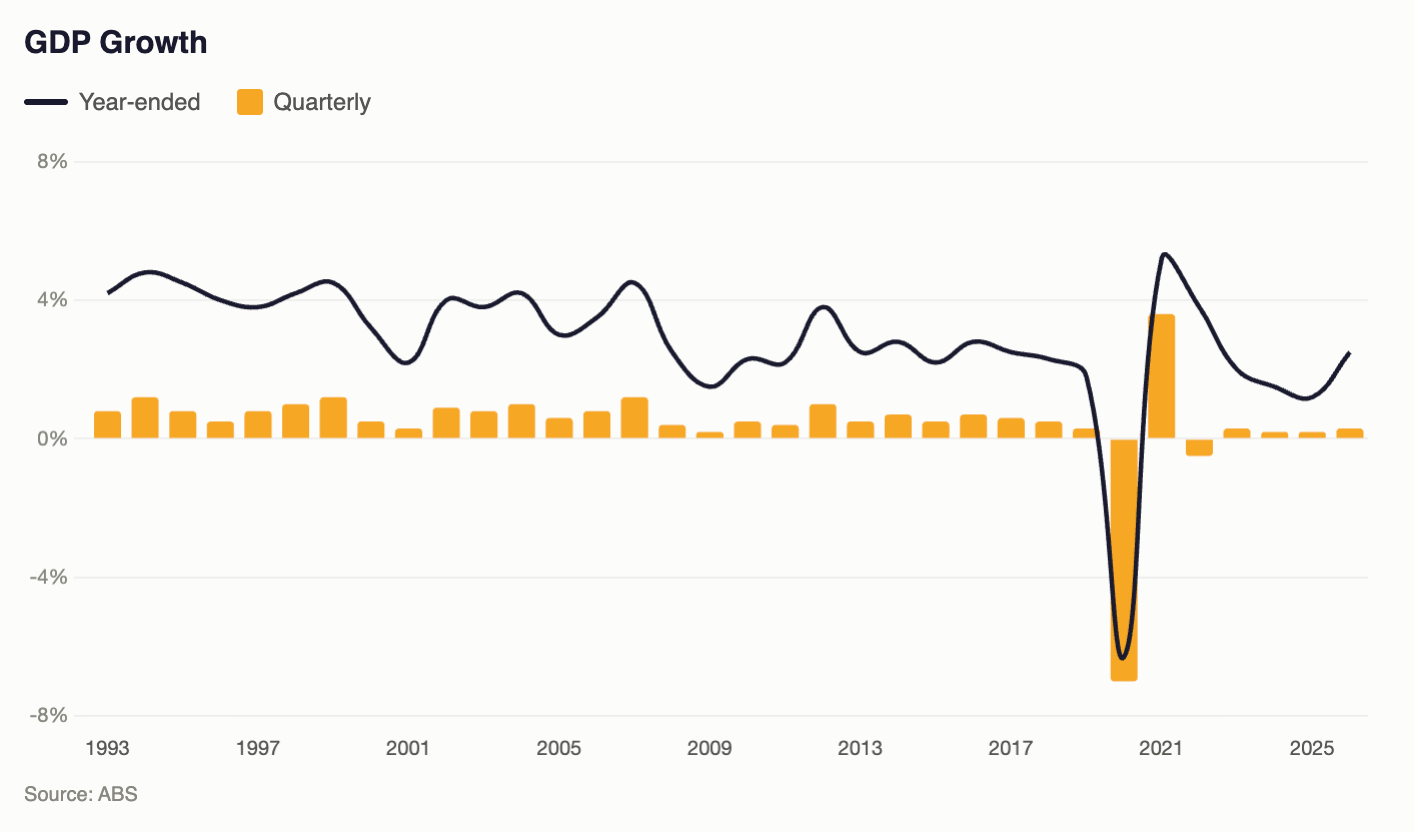
Australia's GDP grew 0.3% in the March quarter and 2.5% annually. On the surface that looks reasonable. The more telling figure is GDP per capita, which is contracting. The economy is growing but not fast enough to keep pace with population growth, meaning the average Australian is going backwards in real terms.
The Consumer Price Index rose 3.8% in the 12 months to May 2026, down from 4.0% in the previous period. The largest contributors were housing at 6.8%, food and non-alcoholic beverages at 3.3%, and recreation and culture at 3.3%.
The RBA has raised interest rates three times in 2026, bringing the cash rate back to its previous peak. Three of the four major banks now believe this is the top of the rate cycle with cuts expected in 2027.
The Labour Market Remains Resilient
Despite significant economic headwinds, Australia's labour market continues to hold up.
According to ABS data for June 2026:
Unemployment rate: 4.4%
Participation rate: 66.9%, the highest on record
Total employed: 14,807,400
Monthly hours worked: 2,015 million
Underemployment rate: 6.3%
There are currently 329,500 jobs advertised nationally, a decrease of 2.1% from February 2026 but still historically elevated. The healthcare, accommodation, and food services industries have seen particularly strong employment growth.
A low unemployment rate matters for property investors because it means fewer forced sales. Homeowners under mortgage stress who have employment can service their debt. The arrears data confirms this. Home loan arrears remain at post-GFC lows despite three rate rises in 2026.
Australian Household Wealth Is Still Strong
Despite cost of living pressures and rising rates, the net wealth position of Australian households remains historically strong. Asset growth has outpaced increased debt levels.
The numbers make this clear. The Australian residential property market is valued at approximately $12.6 trillion. Total mortgage debt against that asset base is approximately $2.6 trillion. That means for every dollar of debt there is approximately $4.85 worth of property. Half of all homeowners have no mortgage at all.
This is the structural foundation that property pessimists consistently underestimate. Australia is not a nation of heavily leveraged homeowners one rate rise away from forced sales. It is a nation with an enormous equity cushion built up over decades of compounding property growth.
The Housing Shortage Is Getting Worse Not Better
The government's target of 1.2 million new homes over five years is not being met. Building approvals from their December 2025 peak have fallen and the economics of new construction remain challenging.
Construction costs have risen substantially due to skilled labour shortages and supply chain pressures. The cost to build new apartments in most Australian markets now exceeds what buyers are willing or able to pay, meaning most development projects currently on the drawing board are not financially viable to proceed.
The estimated housing deficit now exceeds 250,000 properties nationally and there is no clear path to closing that gap in the near term. The implications are straightforward. A chronic undersupply of housing in a market with growing population and record migration levels means rental vacancy rates remain extremely low and rental growth continues accelerating.
This also has a direct implication for the value of established properties. When replacement cost significantly exceeds market value, existing stock has inbuilt equity protection. A property worth $800,000 that would cost $1.1 million to build provides a floor against significant price falls.
Home Lending Is Slowing but First Home Buyers Are Active
From its December 2025 peak, the value of home lending fell 3.8% in the March quarter. The decline was led by owner-occupiers down 4.3% with investors falling 3.0%.
Two data points within that are worth noting for investors.
First, the investor share of lending has risen to its highest level since September 2016 despite the budget changes. This suggests that while overall investor volumes have reduced, the relative share of the lending market attributable to investors has actually increased.
Second, first home buyer lending as a proportion of owner-occupier lending reached 29.0%, slightly above the decade average of 27.6%. The expansion of the 5% deposit guarantee is drawing more first home buyers into the market even as conditions remain challenging.
Consumer Confidence Remains Weak
Consumer confidence is one of the most reliable leading indicators of property market activity. It currently sits at historically low levels and is likely to remain suppressed while inflation persists and rate uncertainty continues.
Low confidence suppresses transaction volumes, sellers hold back, buyers hesitate and properties sit on market longer. This is the dynamic driving the current softness in Sydney and Melbourne and contributing to longer days on market in Brisbane and Perth.
When confidence recovers, typically triggered by the first confirmed rate cut or a sustained improvement in inflation data, the transaction volume that has been held back tends to return quickly. Markets with underlying demand and supply constraints respond sharply to confidence recovery.
What This Means for Property Investors
The RBA chart pack paints a picture of an economy under pressure but fundamentally sound. Unemployment is low, household equity is strong, mortgage arrears are at historical lows, the housing shortage is deepening and rate cuts are approaching.
The conditions that typically precede a property market recovery are assembling. Not all at once and not without further short-term volatility. But the structural underpinnings of Australian property values, scarce supply, population growth, household wealth, and labour market resilience, remain firmly in place.
The investors who position themselves during the period of maximum uncertainty, when confidence is low and competition is reduced, consistently arrive at the recovery in the strongest position.
Ready to Position Your Portfolio Ahead of the Recovery?
At Search Property, we help Australians cut through the noise and build data-driven investment strategies aligned with long-term wealth goals. Our buyers agents have helped thousands of clients build wealth through property because we focus on fundamentals, not headlines.
Book an investment assessment call with Search Property. We'll discuss your goals and position, and help you build a clear plan to move forward with confidence.
Frequently Asked Questions
Is Australia heading into a recession?
Not according to the current data. GDP grew 0.3% in the March quarter and 2.5% annually. GDP per capita is contracting but total economic output is still growing. The IMF projects global growth at 3.0% for 2026. Australia's labour market with unemployment at 4.4% and participation at record highs suggests the economy remains fundamentally resilient despite significant headwinds.
Why are property prices falling if unemployment is low and household wealth is strong?
Price softness in Sydney and Melbourne is being driven primarily by sentiment and affordability rather than fundamental weakness. High interest rates have reduced borrowing capacity. The 2026 budget changes have reduced investor confidence. Consumer sentiment is at historically low levels. These are cyclical conditions that respond to rate cuts and confidence recovery rather than structural deterioration in the market.
What does the housing shortage mean for property investors?
A deficit of more than 250,000 properties nationally with no near-term path to resolution means rental vacancy rates remain extremely low and rental growth continues accelerating. It also provides price support for established properties because replacement cost significantly exceeds market value in most markets. This inbuilt equity protection limits the downside for well-located established stock.
When are interest rates expected to fall?
Three of the four major banks believe the cash rate has peaked at its current level following three rises in 2026. Rate cuts are forecast for 2027. When cuts arrive, borrowing capacity recovers, buyer confidence returns, and markets that have been suppressed by affordability constraints respond quickly.
Should I buy investment property now or wait for rates to fall?
The investors who consistently achieve the strongest outcomes are those who buy during periods of reduced competition and motivated vendors, not those who wait for confirmation that conditions have improved. By the time rate cuts arrive and confidence recovers, competition increases and the entry point advantage disappears. The case for buying quality assets in supply-constrained markets is supported by the structural data in the August 2026 RBA chart pack regardless of the short-term rate cycle.
Disclaimer: Important Notice for Readers
By reading the content provided on this blog, you acknowledge and agree to the terms outlined in this disclaimer, binding yourself to its provisions unconditionally.
This blog presents information for informational, educational, and general non-advisory purposes only. It's important for you, the reader, to understand that the information provided does not take into account your specific personal, financial, or other circumstances. Consequently, we do not offer legal, financial, investment, or taxation advice, recommendations, or guidance. Before acting upon any information from this blog, you are strongly advised to consult with an independent professional, including legal, financial, taxation, accounting, or other relevant advisors, to verify the information’s relevance to your particular situation.
The information is provided in good faith, derived from sources believed to be reliable. However, we do not guarantee the accuracy, completeness, or applicability of the information to your individual circumstances, needs, objectives, or financial situation. The information may be selective and has not been independently verified. Therefore, it should not be the sole basis for any decision-making.
We expressly disclaim any liability for errors, omissions, or inaccuracies in the information, as well as any direct or indirect losses, damages, or expenses that arise from relying on our content, regardless of the cause, including negligence or other factors. Your engagement with this blog is entirely at your own risk.
Please be aware, we do not hold an Australian Financial Services Licence as defined by section 9 of the Corporations Act 2001 (Cth), nor are we authorised to provide financial services, and we have not provided financial services to you.
Disclaimer: Search Property Pty Ltd (SP) does not provide financial or investment advice and does not hold a financial services license as defined in the Corporations Act 2001 (Cth). Any advice given by SP is general in nature and does not take into account your personal circumstances or objectives, financial situation or needs.



.png)




.png)


