What a Cooling Property Market Means for Investors
When property headlines turn negative, most buyers step back. Auction clearance rates fall. Confidence drops. The majority of people who were considering buying quietly put their plans on hold.
For investors who understand how property cycles work, that's precisely when the opportunity opens up.
Australia's property market is entering a period of caution. Global uncertainty, rising oil prices, inflation pressure, and the prospect of further rate hikes are weighing on sentiment. The same conditions making headlines feel scary are creating one of the more favourable buying environments investors have seen in years.
Here's why.
Australia's Property Market Has Survived Everything
To understand why the current environment is an opportunity rather than a threat, it helps to look at what Australian property has already come through.
Over the past 50 years, the market has moved through consistent cycles. Growth, plateau, correction, recovery, and then the next growth period. Major world events have created ripples but never the catastrophic collapses that commentators regularly predict.
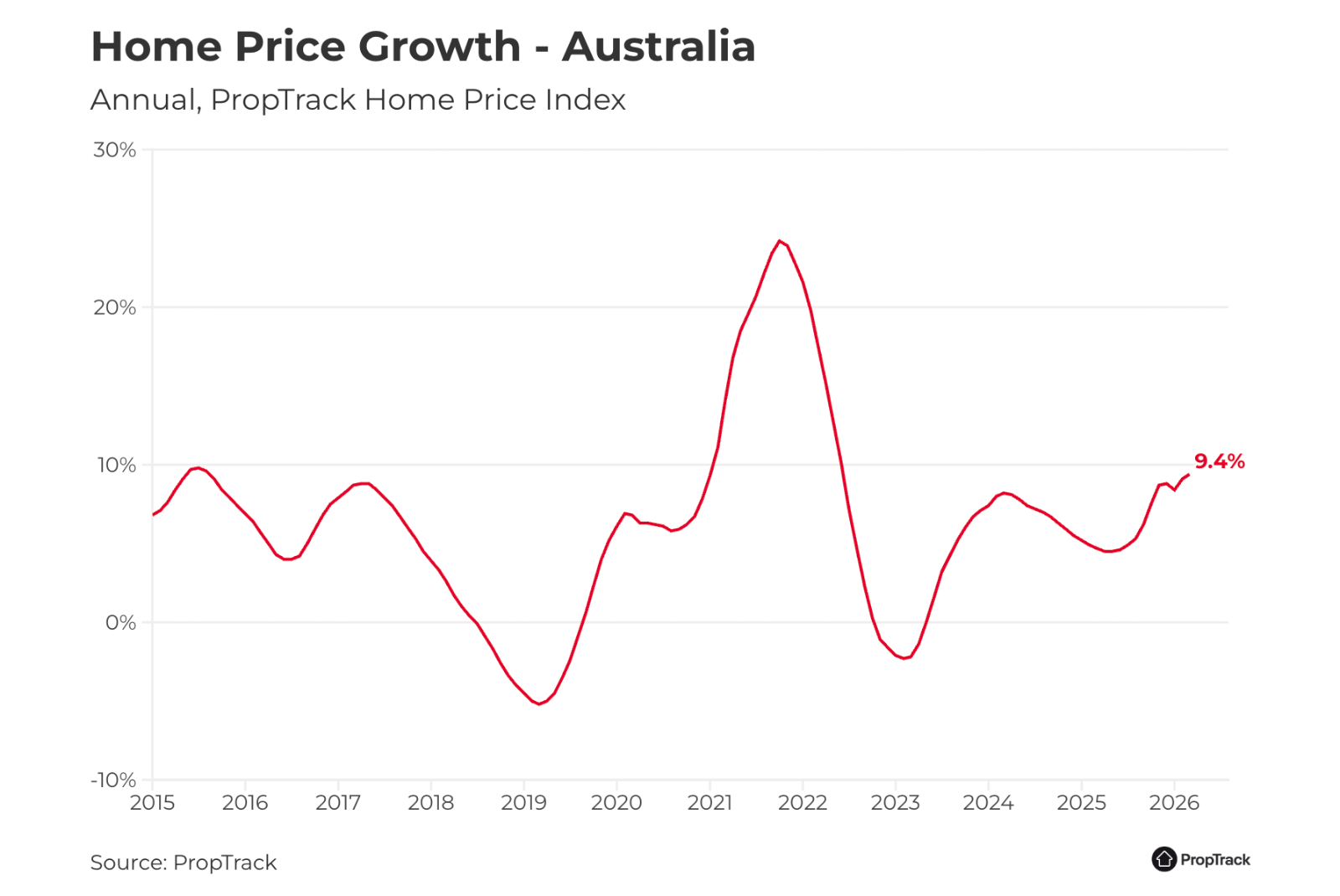
The Global Financial Crisis of 2008 is the most instructive example. At the time, the GFC was the most severe global financial shock in decades. Australian property values fell by less than 4% before recovering and then cycling through three subsequent growth periods.
The COVID pandemic produced a similar pattern. In the first month of lockdowns, the market stalled and prices dipped. Within months, values across the country went up by more than 30% over the following year. The investors who stayed the course and bought during those weeks of uncertainty generated some of the strongest returns of the entire decade.
Current conditions, driven by geopolitical uncertainty, oil price pressure, and inflation, are creating a similar moment of hesitation. The fundamentals that have driven Australian property through every previous cycle remain intact.
What Is Actually Happening in the Market Right Now
The data tells a more interesting story than the headlines suggest.
SQM Research has downgraded its housing forecast for capital city values over the next 12 months, revising national growth from a 6 to 10% prediction down to 0 to 3%. The most significant downgrades are in Melbourne, where the forecast has shifted from 4 to 7% growth to a range of -4 to -1%, and in Sydney, where 3 to 6% growth is now forecast at -6 to -2%.
Importantly, value growth is still forecast for all other major capitals and regional centres.
Advertised listings are rising in Sydney and Melbourne and the urgency that characterised the market 12 months ago has eased noticeably.
For buyers, this shift in conditions is meaningful. Less competition means more negotiating power. More stock means more choice. Vendors who need to sell are more willing to engage seriously on price and terms.
Supply Is Still the Dominant Force
The single most important factor in Australian property is one that doesn't change with geopolitical events or short-term rate cycles. It's supply.
Australia has a severe and ongoing housing shortfall. Construction costs remain elevated. Building approvals are not keeping pace with population growth. Developers are pulling back from new projects in an environment of rising costs and uncertain demand.
This structural undersupply acts as a floor on prices. Even in a period of softening demand, there are simply not enough homes to go around. That reality limits how far values can fall and provides the foundation for the next growth cycle when confidence eventually returns.
Higher rates will take potential borrowers out of the market and ease demand pressure, but the severe supply shortfall means value growth will slow or stop rather than fall significantly.
That is a critically different outcome to a market correction. Slow or flat growth in a supply-constrained market is not a crash. It is a pause before the next cycle.
The Opportunity Inside the Uncertainty
Most investors treat uncertainty as a stop sign. The smarter approach is to treat it as a filter.
When sentiment falls and competition thins out, the pool of active buyers shrinks. The investors still in the market are the ones with clear strategies, strong financial positions, and a long enough time horizon to look past the short-term noise. That is exactly the group you want to be in.
Cooling markets also change the negotiation dynamic in ways that don't get enough attention. Vendors who listed during a hot market and haven't sold are now in a different conversation. Days on market are extending. Clearance rates are below 50%. The urgency that pushed buyers into rushed decisions has gone. In its place is something far more useful: time, choice, and leverage.
That leverage shows up in ways beyond just the purchase price. Favourable settlement terms, subject to finance clauses, longer due diligence periods, and the ability to walk away without losing a bidding war are all conditions that simply weren't available six or twelve months ago.
The investors who recognise this shift and move deliberately are not taking on more risk than those who wait. In many cases they are taking on less, because they are entering at a point where vendor motivation is higher, competition is lower, and the emotional pressure that leads to poor decisions has largely disappeared from the market.
Uncertainty creates hesitation in most buyers. For the prepared few, it creates access.
What This Environment Means for Investors Specifically
For investors with a clear strategy and the financial buffers to hold through short-term volatility, the current market offers conditions that haven't been available for some time:
Access to higher quality properties that would have attracted fierce competition 12 months ago
More time to conduct thorough due diligence without pressure to act immediately
Entry prices in some markets at levels that will look very attractive in five years
The key word is strategy. Buying in a cooling market without one is just as risky as buying in a hot market without one. The property still needs to be in the right location, with the right fundamentals, at the right price.
That's where the work happens.
The Bottom Line
Australia's property market is cooling. Sentiment is cautious. Competition has eased. For investors who understand that this is how cycles work, none of this is surprising and none of it is a reason to stay on the sidelines.
The investors who built the strongest portfolios in Australia didn't buy at the bottom of every cycle. They bought consistently, held quality assets in supply-constrained markets, and let time and compounding do the work.
The current environment is not perfect. No environment is. What it is, for prepared investors, is an opportunity that won't be there once confidence returns.
The Window Is Open. Here Is How to Use It.
At Search Property, we help Australians build data-driven property investment strategies aligned with long-term wealth goals. Our team has helped thousands of clients grow their portfolios because we focus on fundamentals, not headlines.
Book a FREE investment assessment call with our team. We'll review your position, discuss your goals, and give you a clear plan to move forward with confidence.
Disclaimer: Important Notice for Readers
By reading the content provided on this blog, you acknowledge and agree to the terms outlined in this disclaimer, binding yourself to its provisions unconditionally.
This blog presents information for informational, educational, and general non-advisory purposes only. It's important for you, the reader, to understand that the information provided does not take into account your specific personal, financial, or other circumstances. Consequently, we do not offer legal, financial, investment, or taxation advice, recommendations, or guidance. Before acting upon any information from this blog, you are strongly advised to consult with an independent professional, including legal, financial, taxation, accounting, or other relevant advisors, to verify the information’s relevance to your particular situation.
The information is provided in good faith, derived from sources believed to be reliable. However, we do not guarantee the accuracy, completeness, or applicability of the information to your individual circumstances, needs, objectives, or financial situation. The information may be selective and has not been independently verified. Therefore, it should not be the sole basis for any decision-making.
We expressly disclaim any liability for errors, omissions, or inaccuracies in the information, as well as any direct or indirect losses, damages, or expenses that arise from relying on our content, regardless of the cause, including negligence or other factors. Your engagement with this blog is entirely at your own risk.
Please be aware, we do not hold an Australian Financial Services Licence as defined by section 9 of the Corporations Act 2001 (Cth), nor are we authorised to provide financial services, and we have not provided financial services to you.
Disclaimer: Search Property Pty Ltd (SP) does not provide financial or investment advice and does not hold a financial services license as defined in the Corporations Act 2001 (Cth). Any advice given by SP is general in nature and does not take into account your personal circumstances or objectives, financial situation or needs.

.png)

.png)
.png)

.png)



.png)

