Signs the Property Market Is Bottoming: What to Watch
Everyone wants to know when the property market will turn, though the answer only becomes clear after it has happened. Price indexes are built from sales that settled weeks ago, so by the time they confirm a recovery, buyers have already moved. What you can do is watch the signs that move first. This blog covers six of them, the ones that mislead, and why being able to hold your property matters more than catching the exact low.
Property markets do not turn on one day. Some buyers drift back while others stay on the sidelines, and some vendors cut their prices while others refuse to.
The data also looks backward. A home that sells today may not settle for several weeks, and it only reaches the price indices once the sale is recorded. So official figures can keep showing falls for a while after conditions have quietly improved.
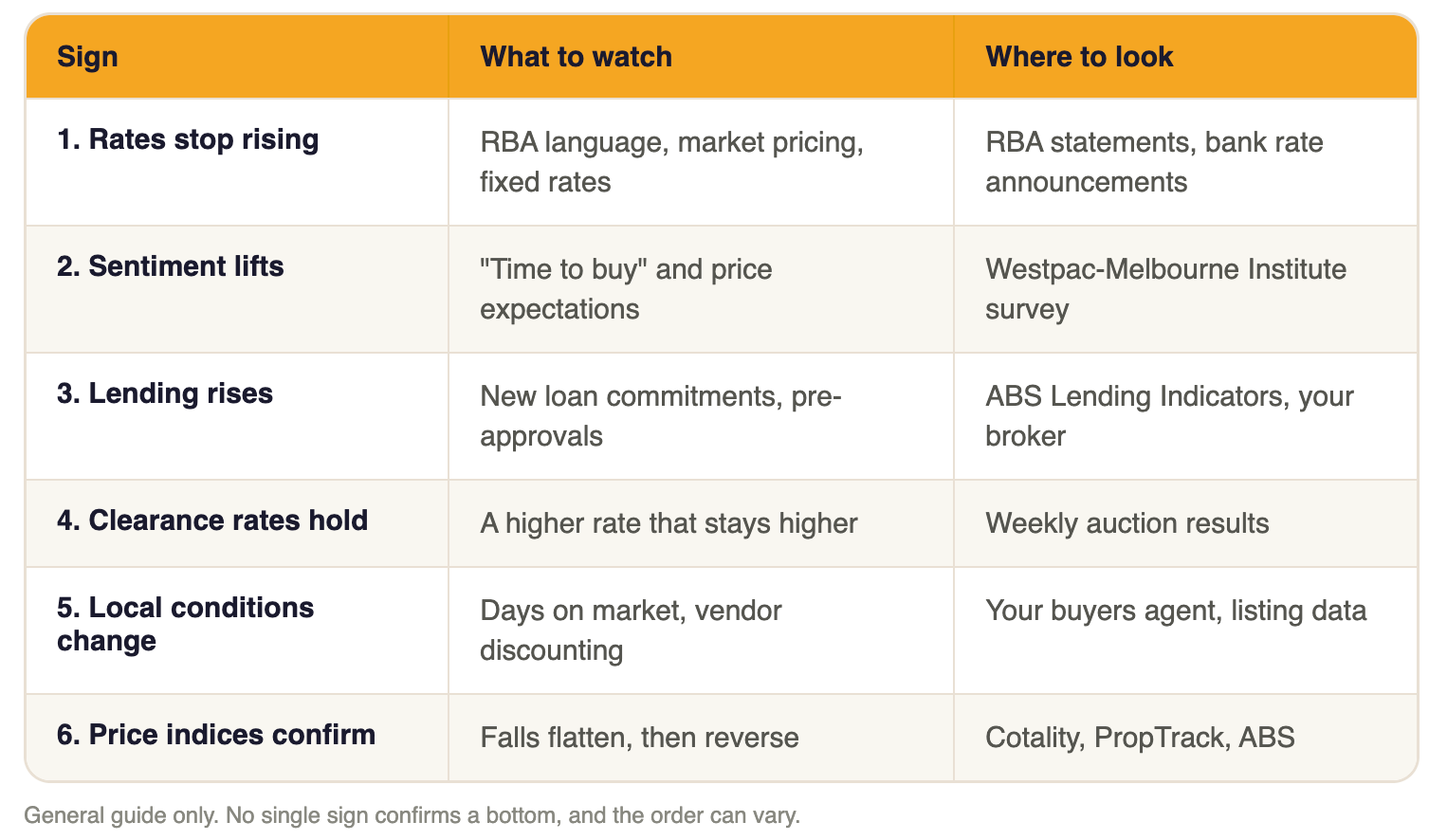
That is why the signs below run from leading indicators, which move first, to lagging ones, which confirm the turn last.
Housing prices in September were almost 5 per cent below their March peak.
New housing loan commitments have declined sharply, particularly for investors.
The cash rate is 4.85% after five rises this year, and the unemployment rate rose to 4.6% in the September quarter.
On the RBA’s own description, the early signs have not clearly turned yet. Economists are split on whether the November rise was the last, which matters for the first sign below.
Six Signs, in the Order They Tend to Appear
1. Interest rates stop rising
Many people assume prices need rate cuts before they recover. History suggests otherwise. In the last cycle, the RBA raised rates from May 2022 to November 2023, yet national home values turned in early 2023, while rises were still happening. What buyers needed was confidence that a ceiling was in sight, because once they can see their maximum repayment they are prepared to act again.
The 2017 to 2019 downturn turned around mid-2019, when RBA rate cuts and a loosening of APRA’s lending buffer arrived close together.
So watch for the RBA to shift from a tightening bias to a neutral one, and for fixed mortgage rates to start drifting lower, since banks often move before the RBA does.
2. Buyer sentiment lifts
Property is a confidence market. Buyers need to feel secure in their jobs and finances before they commit. The Westpac-Melbourne Institute consumer sentiment survey, including its “time to buy a dwelling” and house price expectation readings, tends to turn before transactions do. Look for several months of improvement in a row, not a single reading.
3. Finance approvals start rising
The ABS Lending Indicators show new home loan commitments each month. A sustained lift, especially among owner-occupiers, is one of the earliest signs that buyers are preparing to act. Brokers often see it first, as a rise in pre-approval enquiries from people who have been waiting.
4. Auction clearance rates hold at a higher level
Auction results are close to real-time data. As a rough guide, clearance rates around 55% to 60% suggest a balanced market, and rates consistently above 60% point to rising prices. The key word is consistently. One strong Saturday means little, while a rate that climbs and then holds is a real signal. Withdrawals and the number of auctions held matter too, because a rising clearance rate on very thin numbers can mislead.
5. Local conditions change
People working in the market every day often notice this first. Look for more people at open homes, more registered bidders at auctions, fewer properties passed in, smaller vendor discounts, and days on market that stop blowing out. Another tell is selling agents becoming less willing to accept conditional offers.
6. Price indices confirm it last
Indices usually record a few flat months before they start rising. The daily index tends to flatten first, then the monthly index, then the ABS figures. One measure worth watching is breadth, meaning the share of suburbs where values are still falling. When that share drops meaningfully, the downturn may be losing its grip, even if the headline index is still negative.
There Is No Single Bottom
Cities and suburbs turn at different times, and this downturn shows it.
According to Cotality data reported on 10 November, combined capital city values have fallen 8.1% over seven months, but the falls are uneven. Sydney is down 10.1% from its February 2026 peak, Perth 8.9%, Brisbane 8.3%, Melbourne 7.8% from its November 2025 peak, and Adelaide 4.4%. Combined regional values are down just 3.1% from their peak and are still 3.4% higher than a year ago, while Darwin and Hobart have yet to show clear signs of a downturn.
Some of the previously strongest capital cities have also recorded their sharpest declines on record, so the correction is no longer a Sydney and Melbourne story. Each city entered this cycle at a different point, with different levels of supply, employment, rental demand, and earlier price growth, so each is likely to find its floor at a different time.
Local conditions vary within cities too. The same report cites the Real Estate Buyers Agents Association of Australia’s list of the 20 most negotiable suburbs, which shows vendor discounts from 8.7% to more than 14%, across regional, suburban, and prestige markets.
So when someone asks when the market will bottom, the useful reply is to ask which market they mean.
Signals That Can Mislead
Headlines. They usually stay negative after the market has turned, because they report lagging price data.
One strong auction weekend. Long weekends and holiday periods have low volumes, which distort results.
Cherry-picked data. One suburb’s figures, or one distressed sale repeated as if it was typical.
A single rate decision. A pause is not a turn. What matters is the direction people expect.
Your own emotions. When everyone around you is gloomy, waiting feels safer than acting.
Why Waiting for Every Sign Can Cost You
By the time all six signs line up and the headlines say prices are rising, much of the opportunity has passed. Buyers return to open homes, vendors regain confidence, and you compete with the same people who told you to wait.
Conditions are often best when they still feel uncomfortable, with more choice, less competition, and more motivated vendors. That is not a reason to rush. Prices can fall further, and buying without a buffer adds risk. It does mean that trying to pick the exact bottom can distract from the decisions that matter more. Our blog to why a 30% property crash is not coming also covers the “revenge trade”, where waiting for a slightly better price ends up costing more.
Survivability Matters More Than Timing
If you buy a quality property in a location with strong long-term demand, it matters less in ten years whether you bought a few months before or after the low. What matters is that you could hold it.
Hold a buffer of three to six months of repayments across all your properties.
Stress-test your numbers at a rate 1% to 2% higher, and with a vacancy.
Keep borrowing at a level you can carry if conditions get worse before they get better.
Ready to Plan for What Comes Next?
At Search Property, we help Australians cut through the noise and build data-driven investment strategies aligned with long-term wealth goals. Our buyers agents have helped thousands of clients build wealth through property because we focus on fundamentals, not headlines.
How will I know when the property market has bottomed?
You will only know for certain in hindsight. Before then, a mix of signs tends to appear in order, starting with interest rates and sentiment, then lending and clearance rates, and finally the price indices.
Do property prices bottom before interest rates fall?
They can. In the last cycle, national home values turned in early 2023 while the RBA was still raising rates, and the 2019 turn came as rates were cut. What buyers need is confidence about where rates are heading
How long do property downturns last?
It varies. According to realestate.com.au’s analysis, Melbourne’s early 1990s correction took 32 months, while the current downturn has been unusually fast. The length depends on rates, employment, and sentiment.
Should I wait for the market to bottom before buying?
Nobody can pick the exact low, and waiting for every sign to line up can mean paying more. The more useful question is whether your finances can handle further falls, with a buffer and a stress test in place.
Which indicators are the most reliable?
Leading indicators such as interest rate expectations, sentiment, and loan approvals move first. Clearance rates give a read in real time, and price indices are the most reliable but confirm the turn last.
Disclaimer: Important Notice for Readers
By reading the content provided on this blog, you acknowledge and agree to the terms outlined in this disclaimer, binding yourself to its provisions unconditionally.
This blog presents information for informational, educational, and general non-advisory purposes only. It's important for you, the reader, to understand that the information provided does not take into account your specific personal, financial, or other circumstances. Consequently, we do not offer legal, financial, investment, or taxation advice, recommendations, or guidance. Before acting upon any information from this blog, you are strongly advised to consult with an independent professional, including legal, financial, taxation, accounting, or other relevant advisors, to verify the information’s relevance to your particular situation.
The information is provided in good faith, derived from sources believed to be reliable. However, we do not guarantee the accuracy, completeness, or applicability of the information to your individual circumstances, needs, objectives, or financial situation. The information may be selective and has not been independently verified. Therefore, it should not be the sole basis for any decision-making.
We expressly disclaim any liability for errors, omissions, or inaccuracies in the information, as well as any direct or indirect losses, damages, or expenses that arise from relying on our content, regardless of the cause, including negligence or other factors. Your engagement with this blog is entirely at your own risk.
Please be aware, we do not hold an Australian Financial Services Licence as defined by section 9 of the Corporations Act 2001 (Cth), nor are we authorised to provide financial services, and we have not provided financial services to you.
Disclaimer: Search Property Pty Ltd (SP) does not provide financial or investment advice and does not hold a financial services license as defined in the Corporations Act 2001 (Cth). Any advice given by SP is general in nature and does not take into account your personal circumstances or objectives, financial situation or needs.