Rentvesting: How to Build Wealth While You Rent in 2026
The property advice most Australians grew up with was built for a different market. Buy as soon as you can. Sacrifice lifestyle for the deposit. Get into your suburb. Pay it off. That advice worked when house prices were three to four times the average income.
Currently at eight to ten times, following it means either buying somewhere you do not want to live, waiting a decade longer than previous generations did, or both.
Rentvesting is the alternative. Rent where you want to be. Buy where the investment case is strongest. Build wealth without putting your life on hold to do it.
Rentvesting means renting the home you live in and simultaneously owning investment property elsewhere.
Instead of stretching yourself into a mortgage on a property you cannot afford in the suburb you want to live in, you rent that lifestyle. Instead of waiting years to save a deposit large enough for your preferred area, you buy in a market where your deposit goes further, yields are stronger, and the growth fundamentals are compelling.
You capture the wealth-building benefits of property ownership without being locked into a mortgage in a market that may not be the strongest investment choice available to you right now.
Why the Numbers Make Rentvesting Compelling in 2026
The affordability gap between renting and buying in major Australian cities has never been wider.
According to Compare the Market analysis, mortgage repayments on a median Sydney house are 106% higher than rent on the same property. In Brisbane, 75% higher. In Melbourne, 66% higher.
For many households the choice is not between renting and buying. It is between renting in a location they want to live in and being financially overstretched in a property that may not be the strongest investment for their strategy.
Rentvesting offers a third option. Rent where you want to live. Buy where the investment case is strongest. Build equity in the background. Move into your own home later when the portfolio has grown enough to make it possible on your terms.
The Core Case for Rentvesting
You invest where the numbers work, not where you happen to live. The strongest investment markets in Australia right now are not necessarily in the same city as the suburb you want to call home. Regional markets across the country are offering yields, supply constraints, and growth fundamentals that many capital city markets cannot match at current price points. Rentvesting lets you follow the data rather than your postcode.
You get into the market sooner. The deposit required for a $650,000 investment property in a regional growth market is significantly more achievable than the deposit required for a $1.6 million median Sydney house. Getting into the market earlier with a well-placed investment captures more of the compounding growth cycle than waiting five additional years to save for a home you may never be able to afford.
You maintain lifestyle flexibility. A mortgage ties you to one property in one location. Renting preserves the ability to move for work, relationships, or lifestyle without the friction of selling and buying. During the accumulation phase of building a portfolio, that flexibility has real financial value.
The tax treatment favours investors. When you own an investment property, holding costs including mortgage interest, property management fees, rates, insurance, and depreciation are tax deductible. When you own your own home, none of those costs are deductible. The investor who rentsvests may pay similar or lower after-tax holding costs than the owner-occupier at the same total property value.
A Rentvesting Scenario in 2026
Here is how rentvesting can work in practice for a household in their late twenties or early thirties.
THE RENTVESTOR:
Rents a two-bedroom apartment in inner Melbourne for $2,400 per month
Purchases a $650,000 investment property in a regional growth market with a 10% deposit of $65,000
Investment property grows at 7% annually: $45,500 in year one capital growth
Rental income covers approximately 80% of holding costs
Net out-of-pocket after tax deductions: approximately $400 to $600 per month
Total monthly outgoing: approximately $2,800 to $3,000
THE OWNER-OCCUPIER:
Purchases a comparable Melbourne property for $900,000 with a 20% deposit of $180,000
Monthly mortgage repayments at 6.5% over 30 years: approximately $4,550
Rates, insurance, and maintenance: approximately $500 per month
Total monthly outgoing: approximately $5,050
No rental income. No tax deductions.
The rentvestor is approximately $2,000 per month better off in cash flow terms, has deployed $115,000 less in deposit capital, and owns a growing investment asset building equity independently of their lifestyle decisions.
Addressing the Common Objections
"Renting is dead money." So is mortgage interest, council rates, insurance, maintenance, and stamp duty. The difference is that a mortgage builds equity in an asset over time while rent does not. The rentvestor is also building equity. Just not in the property they live in. The question is whether the investment property they own is growing. If it is in the right market with genuine long-term demand drivers, it is.
"I will never feel secure renting." This is a legitimate concern rather than a financial one. Rental security in Australia is less protected than in many comparable countries. For investors who can manage that uncertainty, the financial upside of rentvesting is substantial. For those who cannot, the emotional cost may outweigh the financial benefit.
"I want to renovate and make it my own." You can renovate an investment property. You can also rent a place that already has the features you want. The question is whether the desire to personalise a specific property justifies the financial cost of owner-occupation in an expensive market at this point in your wealth-building journey.
"Property always goes up so I should buy now." Yes. And the investment property you buy through rentvesting goes up too. You are still in the market. The question is whether you are in the right part of it.
For established residential properties purchased after 12 May 2026, negative gearing losses carry forward against future property income rather than offsetting wages immediately. New builds and off-the-plan apartments retain full negative gearing under the new rules.
For rentvesting investors, this shifts the emphasis toward properties with stronger yield fundamentals that transition toward positive cash flow sooner. Regional markets with gross yields above 5% in genuine growth corridors are well positioned for this. The carry-forward losses still have value. They simply arrive later rather than in the year they are incurred.
When Rentvesting Makes the Most Sense
Rentvesting is not the right strategy for everyone. It works best when:
The market you want to live in has poor investment fundamentals relative to its purchase price
Your deposit goes further in a higher-growth regional or interstate market
Lifestyle priorities require flexibility that a mortgage in an expensive city would constrain
You want to enter the property market sooner without waiting years to save a larger deposit
You are comfortable separating where you live from where you invest
It works less well when:
You are in a market where buying your own home is financially comparable to renting
Strong emotional attachment to owning where you live genuinely affects your wellbeing
Your preferred investment markets do not offer a meaningful yield or growth advantage
The Rentvesting Exit: When Do You Buy Your Own Home?
Rentvesting is a strategy, not a permanent arrangement. The goal for most rentvesting investors is to use the equity and returns from the investment portfolio to eventually purchase a home on their own terms.
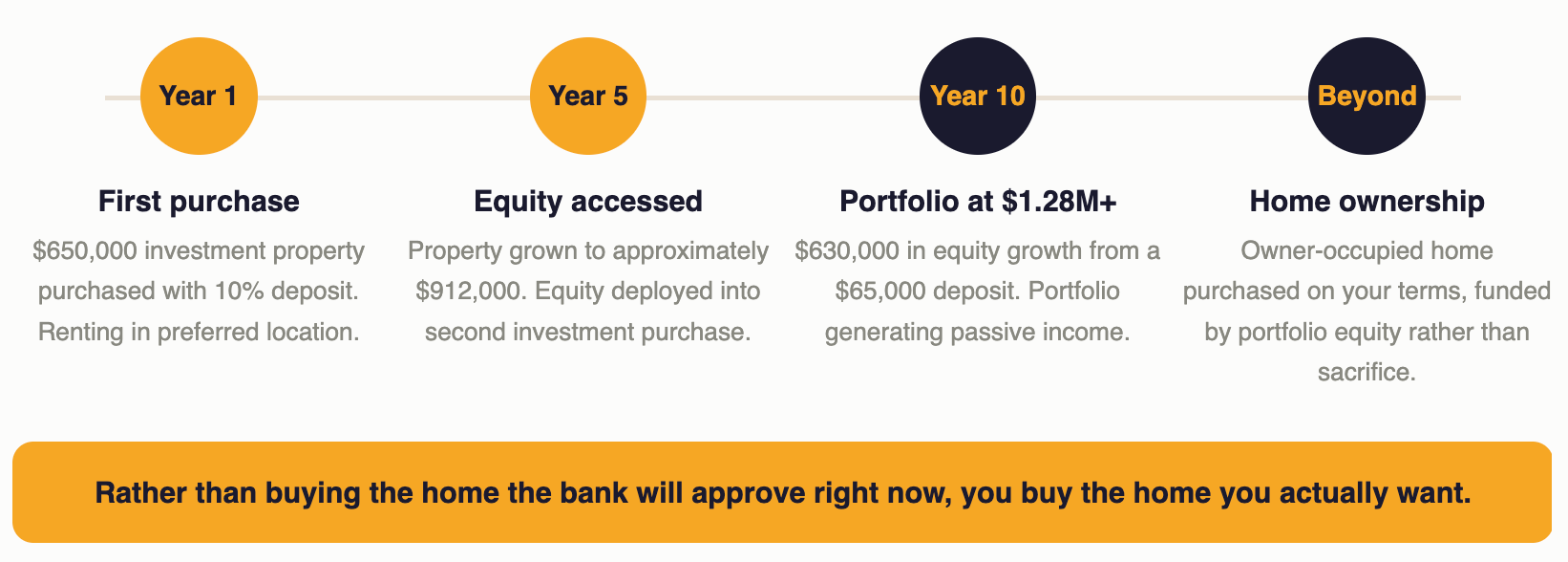
The rentvestor who bought a $650,000 investment property growing at 7% annually owns an asset worth approximately $1.28 million after ten years. They have built $630,000 in growth equity from a $65,000 deposit. That equity position changes the home ownership conversation entirely.
Rather than buying the home the bank will approve right now, they are buying the home they actually want, funded by a decade of compounding in a market where the fundamentals stacked up from the beginning.
Ready to Build Wealth While You Rent?
At Search Property, we help Australians cut through the noise and build data-driven investment strategies aligned with long-term wealth goals. Our buyers agents have helped thousands of clients build wealth through property because we focus on fundamentals, not headlines.
Book a FREE investment assessment with Search Property. We will discuss your goals, your current position, and identify the markets that give your portfolio the strongest foundation for long-term growth.
Frequently Asked Questions
Can I get the First Home Owner Grant if I rentvest?
No. The First Home Owner Grant and First Home Guarantee Scheme are designed for owner-occupiers purchasing their first home to live in. If you purchase an investment property first you will not qualify for these schemes when you later purchase an owner-occupied home. Whether this trade-off is worth it depends on the size of the grant relative to the investment opportunity available. In most cases the equity built through rentvesting significantly outweighs the value of the grant over a ten-year horizon.
Is rentvesting tax effective?
Yes. Holding costs on an investment property including mortgage interest, property management fees, council rates, insurance, and depreciation are tax deductible. The rent you pay on your own home is not. The combined after-tax cost of rentvesting is often lower than the out-of-pocket cost of owner-occupation at the same total property value.
Do I need a large deposit to start rentvesting?
No. Many investors start rentvesting with a 10% deposit on an investment property in an accessible market. On a $600,000 investment property that is $60,000 plus purchasing costs. Compared to the deposit required to purchase an owner-occupied home in Sydney or Melbourne, that is a significantly more achievable starting point for most households.
Can I live in my investment property later?
Yes. You can move into an investment property and convert it to your principal place of residence. There are capital gains tax implications to understand before doing so, particularly around the period during which the property was rented. Speak to a property-specialist accountant before making this decision.
How do I find the right investment market if I am rentvesting from a capital city?
This is where a buyers agent with national reach is most valuable. Identifying which regional markets have the genuine supply constraints, population growth, and yield fundamentals to support a rentvesting strategy requires suburb-level data and on-the-ground relationships that most individual investors do not have access to from a different city.
Disclaimer: Important Notice for Readers
By reading the content provided on this blog, you acknowledge and agree to the terms outlined in this disclaimer, binding yourself to its provisions unconditionally.
This blog presents information for informational, educational, and general non-advisory purposes only. It's important for you, the reader, to understand that the information provided does not take into account your specific personal, financial, or other circumstances. Consequently, we do not offer legal, financial, investment, or taxation advice, recommendations, or guidance. Before acting upon any information from this blog, you are strongly advised to consult with an independent professional, including legal, financial, taxation, accounting, or other relevant advisors, to verify the information’s relevance to your particular situation.
The information is provided in good faith, derived from sources believed to be reliable. However, we do not guarantee the accuracy, completeness, or applicability of the information to your individual circumstances, needs, objectives, or financial situation. The information may be selective and has not been independently verified. Therefore, it should not be the sole basis for any decision-making.
We expressly disclaim any liability for errors, omissions, or inaccuracies in the information, as well as any direct or indirect losses, damages, or expenses that arise from relying on our content, regardless of the cause, including negligence or other factors. Your engagement with this blog is entirely at your own risk.
Please be aware, we do not hold an Australian Financial Services Licence as defined by section 9 of the Corporations Act 2001 (Cth), nor are we authorised to provide financial services, and we have not provided financial services to you.
Disclaimer: Search Property Pty Ltd (SP) does not provide financial or investment advice and does not hold a financial services license as defined in the Corporations Act 2001 (Cth). Any advice given by SP is general in nature and does not take into account your personal circumstances or objectives, financial situation or needs.



.png)





.png)


