Five Ways to Reach Your Property Deposit Goal Faster
Saving a deposit is one of the biggest barriers between Australians and their first investment property. Property prices can move quickly, living costs continue to rise and the amount you need may feel like it is constantly increasing.
Reaching your goal faster is not simply about giving up everything you enjoy. It requires a clear target, a repeatable savings system and a property strategy that reflects what you can realistically afford. Here are five ways to get there faster.
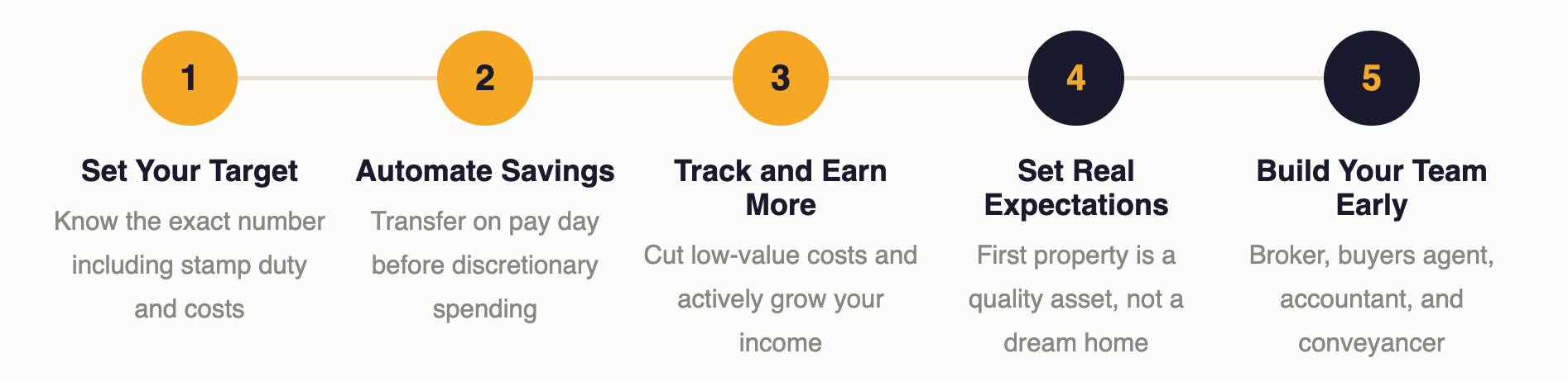
1. Set the Right Deposit Target From the Beginning
You cannot build an effective savings plan without knowing how much you actually need.
Your target should include more than the property deposit. You may also need to cover stamp duty, conveyancing, inspections, loan fees, insurance and other purchasing expenses. You should still have a financial buffer available after settlement for vacancies, maintenance and unexpected costs.
Many buyers aim for a 20% deposit because it may allow them to avoid lenders mortgage insurance. A smaller deposit may be accepted in some circumstances, but it can increase the cost of the loan.
Speak with a mortgage broker early to understand your borrowing capacity and the likely cash contribution required. This prevents you from spending years working towards an arbitrary number or discovering too late that you have not allowed for all the costs.
Once you have a figure, give it a deadline. Divide the remaining amount by the number of months until your target date. This turns a vague ambition into a measurable monthly goal.
2. Automate Your Savings and Separate Your Money
The simplest way to save consistently is to remove the need to make the decision every payday.
Set up an automatic transfer into a dedicated deposit account as soon as your salary arrives. The money should move before it can be absorbed into everyday spending. Saving then becomes part of your financial system rather than something you do with whatever is left at the end of the month.
Bills account: Rent, utilities, insurance and recurring expenses
Deposit account: Property savings that remain untouched
Keeping your deposit separate makes your progress visible and reduces the temptation to use the money for other purposes.
Consider a competitive high-interest savings account, but check the conditions required to receive bonus interest. Some accounts require minimum monthly deposits or restrict withdrawals. Interest will not replace regular saving, but it can help your balance grow faster through compounding.
3. Track Your Spending and Focus on the Biggest Wins
Most people know roughly what they spend. Far fewer know exactly where every dollar goes.
Track your expenses for at least 90 days using your banking app, a budgeting tool, or a spreadsheet. Include quarterly and annual costs, not just regular weekly spending. The goal is not to eliminate everything you enjoy. It is to identify expenses that are delivering little value relative to your property goal.
Start with the big items. Refinancing expensive debt, or reviewing major household bills will achieve more than obsessing over small daily purchases. Once the large costs are addressed, look for the quiet drains. Unused subscriptions, frequent food delivery, unnecessary account fees, and insurance or utility plans that have never been reviewed.
On the income side, overtime, freelance work, selling unused items, or directing a pay rise toward the deposit can meaningfully shorten the timeline. Commit tax refunds, bonuses, and other windfalls to the deposit before they disappear into everyday spending.
Cutting costs has a floor. Increasing income has no ceiling. The strongest approach does both simultaneously.
4. Be Realistic About Your First Investment Property
Some investors delay their purchase because they are saving for a property that does not match their current financial position.
Your first investment does not need to be your dream home, and it does not need to be located near where you live. Its job is to generate rental income, grow in value and provide a foundation for future purchases.
The better question is not, “What is the perfect property?” It is, “What is the strongest asset I can buy within my budget?”
That could be an established house in an interstate market, a property in a regional growth corridor or an asset at a lower entry price than your local area. The right option depends on market fundamentals, rental demand, holding costs and your wider investment strategy.
Waiting until you can afford a more expensive property can be counterproductive if prices are increasing faster than your savings. At the same time, rushing into an unsuitable asset simply to enter the market can create even greater problems.
5. Build Your Professional Team Before You Are Ready to Buy
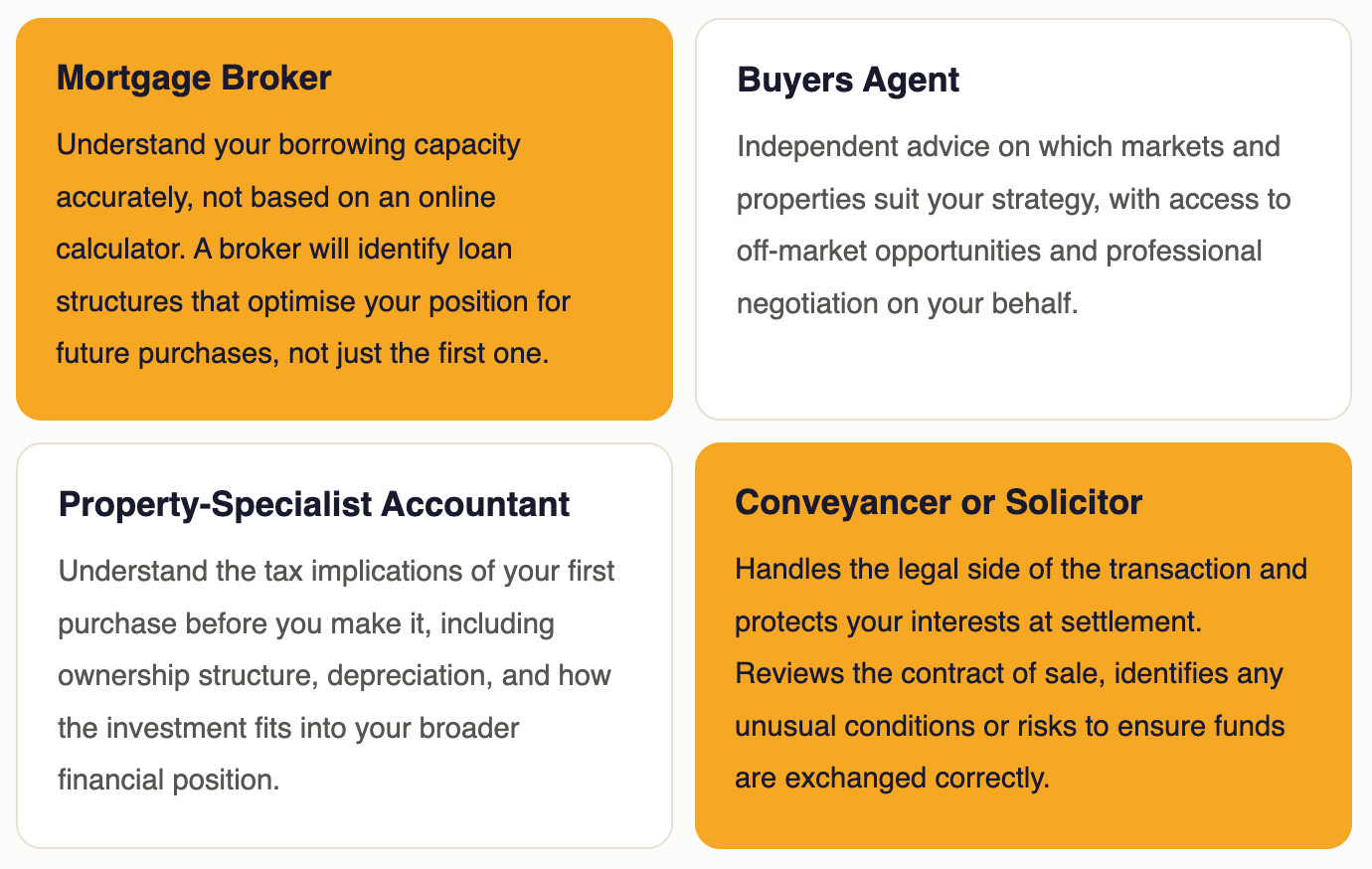
The property buying process inbolves legal, financial and marekt expertise that most first-time buyers do not have across all areas simultaneously. Trying to navigate it alone costs time, increases the risk of costly mistakes, and slows down the journey.
The team worth assembling before you are ready to buy includes:
A good team doesn’t just help you buy your first property. It helps you structure that purchase in a way that makes the second, third, and fourth purchases faster and more achievable. The cost of the right advice is consistently less than the cost of making avoidable mistakes.
The Bottom Line
Reaching your property deposit goal faster requires more than cutting discretionary spending.
Set an accurate target, automate your savings, understand where your money goes, increase the gap between your income and expenses, and remain realistic about what your first investment needs to achieve.
Most importantly, start preparing before the full deposit is sitting in your account. The earlier you understand your borrowing capacity and investment strategy, the better positioned you will be when you are ready to buy.
Ready to Turn Your Deposit Into Your First Investment?
At Search Property, we help Australians turn their savings or accessible equity into a clear, data-driven property investment strategy.
Our team supports clients through finance preparation, market and suburb selection, property sourcing, negotiation, due diligence and settlement.
Book an investment assessment call with Search Property. We will discuss your goals, review your position and help you understand the next step towards purchasing your investment property.
Frequently Asked Questions
How much should I save for an investment property deposit?
At Search Property, we generally recommend having at least $130,000 available in cash or accessible equity before purchasing an investment property. This can help cover the deposit, purchasing costs and a financial buffer. The exact amount required will depend on the property price, lender and your financial circumstances.
Do I need a 20% deposit for an investment property?
Not always. Some lenders may accept a smaller deposit, but borrowing more than 80% of a property’s value can result in lenders mortgage insurance and higher repayments. A mortgage broker can explain the options available for your circumstances.
Can I use equity as an investment property deposit?
Yes, eligible homeowners may be able to access equity in an existing property to fund the deposit and purchasing costs. Usable equity is not simply the difference between the property’s value and loan balance. It depends on the lender’s valuation, lending policies and your ability to service the additional debt.
Where should I keep my deposit savings?
A competitive high-interest savings account may be suitable when you need to preserve the money and access it within a relatively short period. Review the interest rate, withdrawal conditions and eligibility requirements. Obtain personal financial advice before choosing where to hold a large deposit.
Should I wait until I can afford a more expensive property?
Not necessarily. A higher price does not automatically mean a better investment. The priority is to buy an investment-grade asset that fits your budget and is supported by strong market fundamentals. Professional market and property analysis can help you decide whether buying sooner or continuing to save is the better option.
Disclaimer: Important Notice for Readers
By reading the content provided on this blog, you acknowledge and agree to the terms outlined in this disclaimer, binding yourself to its provisions unconditionally.
This blog presents information for informational, educational, and general non-advisory purposes only. It's important for you, the reader, to understand that the information provided does not take into account your specific personal, financial, or other circumstances. Consequently, we do not offer legal, financial, investment, or taxation advice, recommendations, or guidance. Before acting upon any information from this blog, you are strongly advised to consult with an independent professional, including legal, financial, taxation, accounting, or other relevant advisors, to verify the information’s relevance to your particular situation.
The information is provided in good faith, derived from sources believed to be reliable. However, we do not guarantee the accuracy, completeness, or applicability of the information to your individual circumstances, needs, objectives, or financial situation. The information may be selective and has not been independently verified. Therefore, it should not be the sole basis for any decision-making.
We expressly disclaim any liability for errors, omissions, or inaccuracies in the information, as well as any direct or indirect losses, damages, or expenses that arise from relying on our content, regardless of the cause, including negligence or other factors. Your engagement with this blog is entirely at your own risk.
Please be aware, we do not hold an Australian Financial Services Licence as defined by section 9 of the Corporations Act 2001 (Cth), nor are we authorised to provide financial services, and we have not provided financial services to you.
Disclaimer: Search Property Pty Ltd (SP) does not provide financial or investment advice and does not hold a financial services license as defined in the Corporations Act 2001 (Cth). Any advice given by SP is general in nature and does not take into account your personal circumstances or objectives, financial situation or needs.

.png)

.png)
.png)

.png)
.png)
.png)
.png)
.png)

